Applications
U.S. Army Retrofits Detroit Arsenal Building with 3D Printed Panels
A new collaborative pilot project at the U.S Army’s Detroit Arsenal, located in Warren, Michigan, is set to showcase how large-scale 3D printing can be utilized to upgrade aging infrastructure with minimal disruptions. The project will bring together the National…
- 3 min read
- Applications
- Six more stories
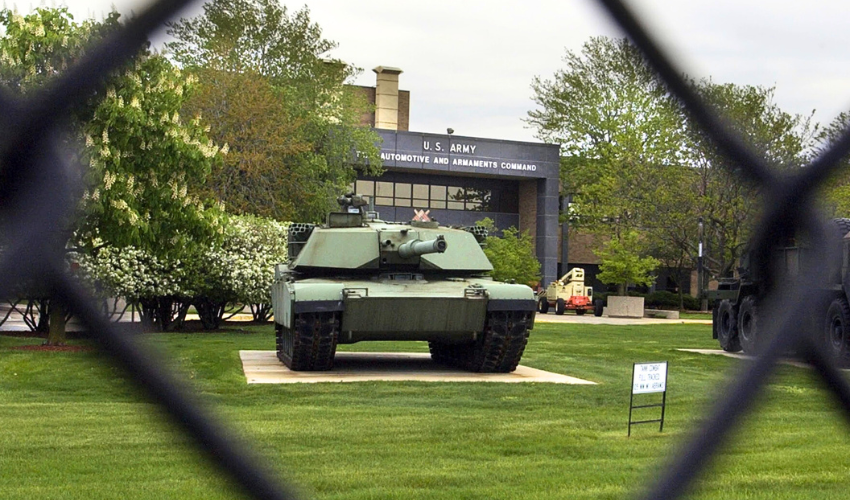
A new collaborative pilot project at the U.S Army’s Detroit Arsenal, located in Warren, Michigan, is set to showcase how large-scale 3D printing can be utilized to upgrade aging infrastructure with minimal disruptions. The project will bring together the National Renewable Energy Laboratory (NREL), Ameresco, and Branch Technology to retrofit the 1940-era building using robot-printed insulation panels.
Specifically, the project will target Building 25 of the Arsenal, which is around 16,250 square feet and currently suffers from outdated insulation and inefficient thermal performance. The U.S Army stated in a press release that by adding new 3D printed exterior panels, they will be able to reduce the building’s heating and cooling load by nearly 65%. The project will also be a cost-saving measure by reducing the load on the current HVAC system.
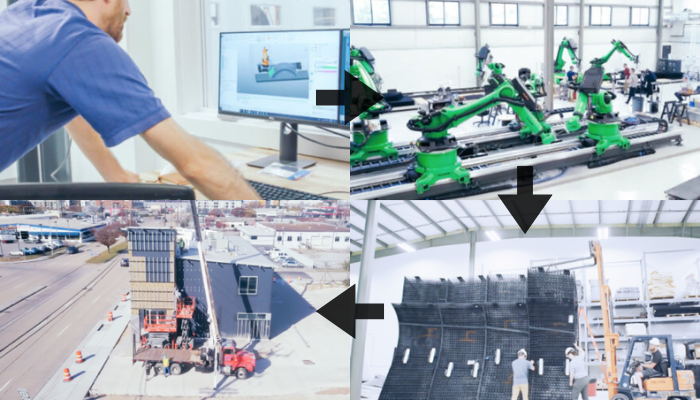
An example of Branch Technology’s Cellular Fabrication (C-Fab®) Process for design, printing, and application. (Credit: Branch Technology)
Unlike other traditional retrofit methods, which often have extensive interior modifications or demolition, Branch Technology announced that it will utilize off-site fabrication and on-site installation. The company plans to use precision laser scans to ensure each panel is tailored to the building’s surface. Afterwards, the company will print each panel using their C-Fab system, a large-scale robotic extrusion process that will create fiber-reinforced polymer lattice structures. These eight-inch panels will then be filled with cellulose foam and installed as a new high-performance envelope on the building.
More from the desk
Six other notes from the rest of the bench.
 ApplicationsResearchers 3D Print Hydrogels to Protect Astronauts from RadiationSpace is an extreme environment where dangers abound, and radiation is one of them. During space missions, astronauts and their equipment are exposed to much higher radiation than on Earth. Without appropriate protection, the equipment could malfunction. As for astronauts,&hellip
 NewsNova Meat reveals 3D printed pork during global disruption in meat supplyAt the beginning of the year, the Barcelona-based startup Nova Meat presented version 2.0 of its 3D printed plant-based steak. Now, it unveils a new product: 3D printed plant-based pork meat that they call pork skewer 2.0. The startup, which…
 ApplicationsThe Aerospace-Inspired 3D Printed Frame Behind Yangwang’s Record-Breaking U9 XtremeAdditive manufacturing has once again proven its ability to push the limits of performance. On August 22, 2025, the Yangwang U9 Xtreme (U9X) shattered records at Germany’s famed Nürburgring Nordschleife circuit, completing a lap in just 6:59.157 minutes, over five…
 NewsResearchers Make 3D Printed Models of Endangered Languages3D modeling is conceived as a way to demonstrate the complexity of systems, and accessibly showcase intricacy and fine details. While 3D models might bring to mind surgical planning or engineered parts, today we bring you a project from 2022…
 ApplicationsTriastek Inc. Receives FDA Testing Approval for Drug T21 for Treatment of Bowel DiseaseIt is more than obvious that medicine has benefited particularly from additive manufacturing within the last few years. In addition to the production of facial masks, prostheses, orthoses or even educational material, there has also been increasing investment in the…
 MaterialsSPEE3D Uses Its Patented Technology to Print Metal Rocket EnginesIn the aerospace industry, additive manufacturing is increasingly prevalent. Many companies are now using metal 3D printing to create rocket components, as well as rocket engines. Companies, such as Relativity, for instance, have notably developed additive manufacturing centers e