News
Researchers Make 3D Printed Models of Endangered Languages
3D modeling is conceived as a way to demonstrate the complexity of systems, and accessibly showcase intricacy and fine details. While 3D models might bring to mind surgical planning or engineered parts, today we bring you a project from 2022…
- 3 min read
- News
- Six more stories
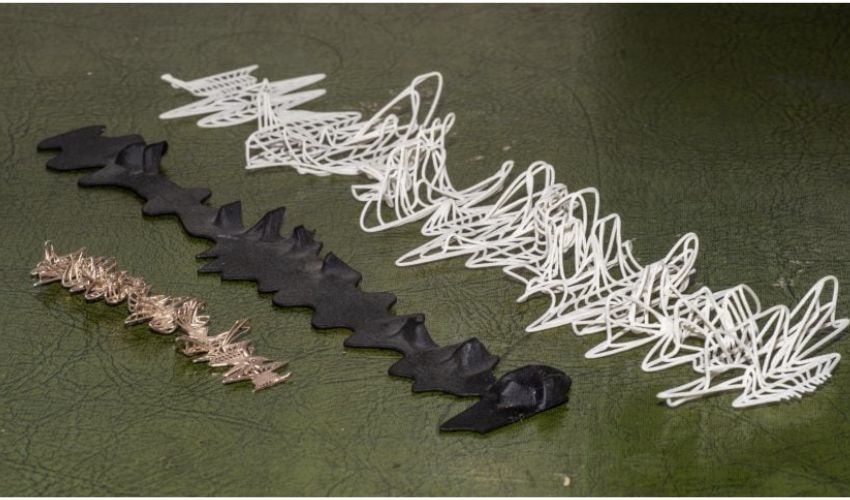
3D modeling is conceived as a way to demonstrate the complexity of systems, and accessibly showcase intricacy and fine details. While 3D models might bring to mind surgical planning or engineered parts, today we bring you a project from 2022 which uses the technology to map language. Alex Pillen, PhD researcher at the School at Antholopology at UCL, collaborated with Emma-Kate Matthews from the architectural school of the same university. They produced a range of models based on four languages: Kurdish, Tarania, (an Amazonian language), an ancient Mesopotamian dialect called Akkadian and American English.
The researchers wanted to model a grammatical aspect of these languages: specifically, evidentiality. This means whether evidence exists for a statement, and if so what kind; in linguistics it is the method by which evidence is conveyed. In certain languages, speakers express evidentiality through grammar. To take the example of Tarania, the speaker expresses four types of evidence using different grammar structures. These evidence types are visual, non-visual, inferred, reported, and assumed from common knowledge. American English was chosen to compare to the other languages as a reference, because in English evidentiality is not expressed through grammar and so the models were not like the others.
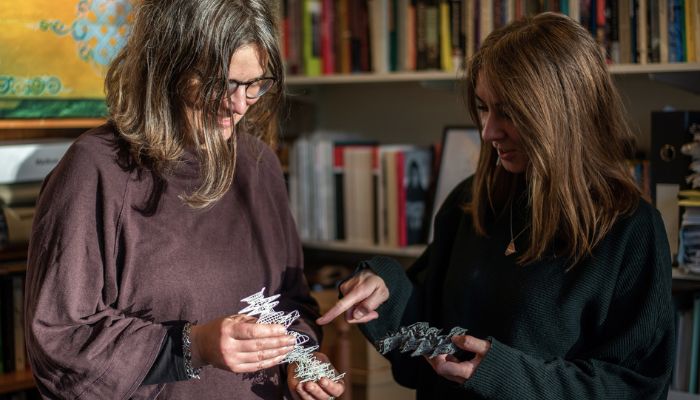
Co-creators of the 3D modeling language project, Alex Pillen (left) and Emma-Kate Matthews (right), with their designs
The team relied firstly on a established theoretical link between grammar and geometry which dates back as far as the 17th century. For the practical side of the project, they used Grasshopper and Rhino3D to map specific language features onto Cartesian system of coordinates. Firstly, they manually formatted the transcript was Excel, and gave each evidential a numerical weighting. The x-axis depicts the timeline of speech as one phrase succeeds another, with the y-axis indicating the number of syllables in each line of a transcript. The x- and y-axis can thereby represent the elementary structure of language reflected in a transcript. The z-axis is the indication of evidential grammar within the sample; these markers take on a ‘virtual weight’ which gives the model its 3D “wireframe” appearance.
More from the desk
Six other notes from the rest of the bench.
 GuidesPhillips on Their Hybrid AM Solution and Work with MeltioMore and more, we are seeing industries adopting additive manufacturing. In these new sectors, one of the common ways to integrate AM technologies is through some kind of hybrid solution. In other words, a solution that has both subtractive (or…
 NewsWae, an intelligent 3D printed waste management systemDesigner Daniel Lloyd has imagined a new waste management system designed using additive manufacturing, more particularly stereolithography. Called Wae, it also integrates sensors and ca smart meter to inform users about their waste habits. The objective is to encourage them&hell
 GuidesDeriva Sailmakers, the backpack brand committed to sustainable manufacturingDeriva Sailmakers is a backpack brand developed in the Basque Country that is committed to a more sustainable manufacturing process. Its objective is to promote a cleaner and stronger local fashion industry with the use of parts and fabrics made…
 GuidesVOJD Studios combines 3D printing & craftsmanship of fashion & luxuryAdditive manufacturing allows for a high level of customisation, which is harder to achieve with traditional design methods. Some interesting advantages have especially show up in the medical sector. However also in jewellery and fashion, where end consumers are looking for tailo
 NewsHow to 3D print high-performance materials (PAEK, PEI…): Experts give their advice!The additive manufacturing sector has seen an expansion in high-performance materials research in recent years, particularly for polymers. These include high-performance thermoplastics, better known by their acronyms, PEEK, PEKK and PEI (ULTEM). We are also seeing the development
 NewsEurovision has 3D Printed a Giant Trophy to Promote Circular EconomyThe Eurovision Song Contest is an annual competition involving various artists and performers representing countries that are members of the European Broadcasting Union. To mark the occasion in the Netherlands this year, a giant 3D printed trophy made from recycled…