Applications
Triastek Inc. Receives FDA Testing Approval for Drug T21 for Treatment of Bowel Disease
It is more than obvious that medicine has benefited particularly from additive manufacturing within the last few years. In addition to the production of facial masks, prostheses, orthoses or even educational material, there has also been increasing investment in the…
- 3 min read
- Applications
- Six more stories

It is more than obvious that medicine has benefited particularly from additive manufacturing within the last few years. In addition to the production of facial masks, prostheses, orthoses or even educational material, there has also been increasing investment in the printing of medicines. One such company that has been involved in this is the Chinese 3D-printed drug manufacturer Triastek Inc. Since its founding in 2015, they have been tackling digital pharmaceutical product development as well as smart manufacturing, in addition to the design of dosage forms – and all for the benefit of the public. Now, Triastek has received IND (Investigational New Drug) application approval from the U.S. Food and Drug Administration (FDA) for its 3D-manufactured drug called T21, which will be used to treat ulcerative colitis.
Ulcerative colitis is one of the most common chronic inflammatory bowel diseases. Affected individuals suffer from inflammation of the large intestine and it can also lead to severe stress and reduction in quality of life. Triastek’s drug T21 has IND approval and can therefore take the first step towards starting clinical trials in the United States.
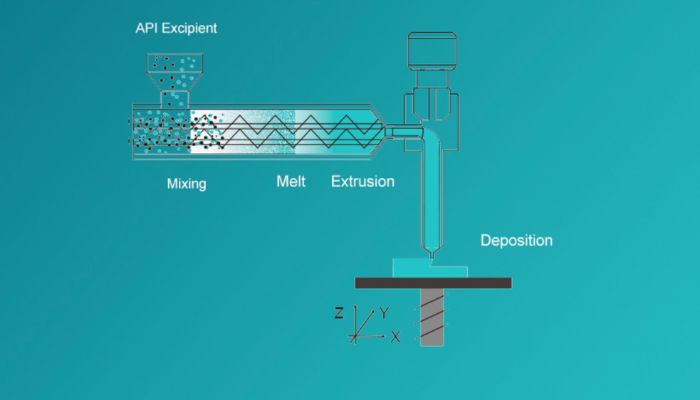
The figure illustrates the Melt-Extrusion Deposition (MED®) process (Image: Triastek)
How Was the T21 Drug Produced?
The 3D printing technology used here works by means of melt extrusion deposition (MED®), in which powdery starting materials are always brought to a soft or molten state. Then, the application of layer after layer begins until finally the 3D-printed drug T21 can be realized. The special feature that comes with the use of additive manufacturing is the targeted delivery of the drug meant for the colon. Here, the drug can target the large intestine segment of the gastrointestinal tract, thus also enabling the lower drug dose while maintaining the same effect. In addition, Triastek was thus able to use radioactive imaging agents at very early stages of the drug’s development. This means that the site of drug release within the gastrointestinal tract could be assessed. Ultimately, this means that future drugs can target specific segments within the gastrointestinal tract and provide for greater efficiency and success rates. Finally, the company further announces that this technology can not only be used for oral sustained release tablets, but can also be extremely helpful in further research for peptide drugs.
More from the desk
Six other notes from the rest of the bench.
 NewsAustralia’s First Fully 3D Printed Two-Story Home is CompletedContec, a construction and design agency based in Australia, recently announced its new 3D printed two-story family home located in Tapping, Perth. This new housing project, known as the Tapping Residence, is unlike its predecessors, is a multi-story building that…
 ApplicationsNASA and Rocket Lab Enter a New Era With the Neutron RocketWith the goal of further expanding its reach in space missions, NASA has signed an agreement with Rocket Lab USA, Inc. to integrate the Neutron rocket into the VADR program. This is a program to procure launch services at competitive…
 NewsWhat to Expect at RAPID + TCT 2022The biggest North American additive manufacturing event, RAPID + TCT will be taking place this year from May 17th-19th in Detroit, Michigan. This is the 30th year that the event will be held and is a joint project between two…
 NewsCould Paper Be the Answer to More Sustainable 3D Printing?There are already a large number of projects that have used additive manufacturing to ensure a more sustainable and environmentally friendly existence. Now, a research group at the Technical University of Hamburg (TUHH) led by Prof. Dr.-Ing. Claus Emmelmann has…
 ApplicationsHow Is 3D Printing Being Used for Electric Cars?With the increasing availability of hybrid and electric vehicles, the automotive industry is increasingly turning towards sustainability and away from fossil fuels. As the sector is known for its constant innovation, electric cars and recent projects showcase advances in manufact
 GuidesOur Guide to Intellectual Property in 3D PrintingIntellectual Property is a controversial and sometimes confusing issue. The moniker covers such a broad spectrum, that it requires years of experience to master. This is bad for designers who want to create 3D-printed models and share them for both…