Applications
New Ultrasound Process Could Enable In-Body 3D Printing
Could you imagine a world where it would be possible to 3D print organs or tissues directly inside your body? Although this might sound like the most outlandish science fiction, researchers at Duke University and Harvard Medical School may have…
- 3 min read
- Applications
- Six more stories
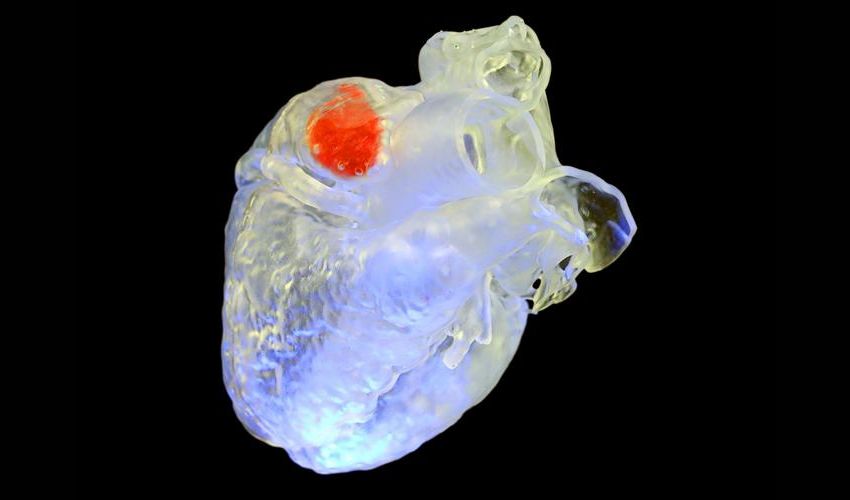
Could you imagine a world where it would be possible to 3D print organs or tissues directly inside your body? Although this might sound like the most outlandish science fiction, researchers at Duke University and Harvard Medical School may have made it possible. They have developed a new 3D printing process using focused ultrasound and a bio-compatible ink, which together could be used for everything from bone healing to heart valve repair. The hope is that this will lead the way to safer and less invasive surgical procedures.
Though we have long extolled the benefits of additive manufacturing in the medical sector, including the growing bioprinting field, there are still obstacles, especially when it comes to printing in the body. This is because many of the current processes use either extrusion or photopolymerization, neither of which are well-suited to through-tissue 3D printing.
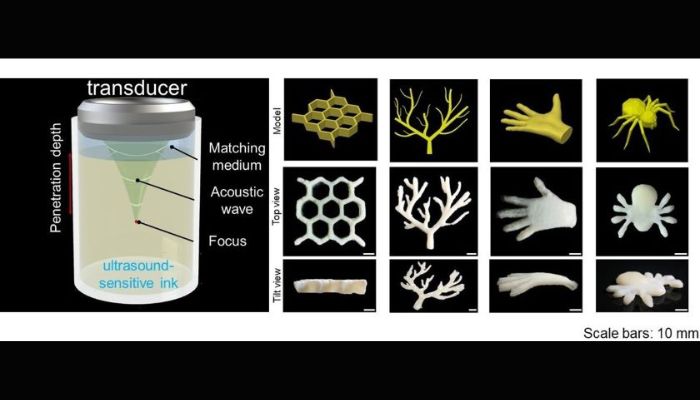
This technique used ultrasound-sensitive ink to build 3D structures at various depths, including through tissues in the human body
With extrusion, the reason it cannot be done inside the body is obvious, how would you put the apparatus in the body and if you need to cut open anyway why not make it externally? However, in-body 3D printing is also not possible with the various photopolymerization methods being developed. Why? Well, very simply, light is not able to travel through skin and organs as it scatters while passing through them. This is also the case for volumetric printing, which is what this latest 3D printing technology is based upon, and which uses photopolymerization and transparent inks.
More from the desk
Six other notes from the rest of the bench.
 ApplicationsAlstom Turns to 3D Printing to Design Parts for High-Speed TrainsAlstom is a French multinational company that provides sustainable mobility solutions for high-speed trains. One of the company’s fleets, which had been in operation for 10 years, was beginning to deteriorate and was at risk of becoming a safety hazard.…
 NewsMetal 3D Printing in the Food IndustryThe Swiss Bühler group specializes in the mechanical industry, particularly in the manufacture of machines for the food industry. In 2018, the company joined forces with Haas-Meincke, a Danish machine manufacturer that produces cakes and cookies of all kinds. Some…
 NewsASICS Works With Dassault Systems on 3D Printed ShoesAmidst the excitement of the Olympic Games, ASICS has announced a new partnership with French software manufacturer Dassault Systèmes. As athletes from around the world strive for gold, ASICS and Dassault Systèmes are setting new standards in footwear technology and…
 GuidesPlantish Offers Plant-Based Fish Thanks To 3D PrintingPlantish, an Israeli startup, wants to revolutionize the food sector and more specifically the way we consume fish. According to a report published by the United Nations Food and Agriculture Organization (FAO), global fish consumption is expected to increase from…
 MaterialsAll You Need to Know About Polycarbonate (PC) for 3D PrintingPolycarbonate (PC) is a family of thermoplastic polymers defined by the carbonate groups in their molecular structure. Engineering-grade PC is prized for its exceptional impact resistance, and certain grades are optically transparent, combining strength, durability and clarity in
 MaterialsThe Complete Guide to 3D Printing CompositesIn recent years, composite 3D printing has grown rapidly in popularity. In a composite material, at least two different materials are joined together with separate purposes. One material serves as the matrix and is intended to maintain the structure, while…