News
Metal 3D Printing in the Food Industry
The Swiss Bühler group specializes in the mechanical industry, particularly in the manufacture of machines for the food industry. In 2018, the company joined forces with Haas-Meincke, a Danish machine manufacturer that produces cakes and cookies of all kinds. Some…
- 3 min read
- News
- Six more stories
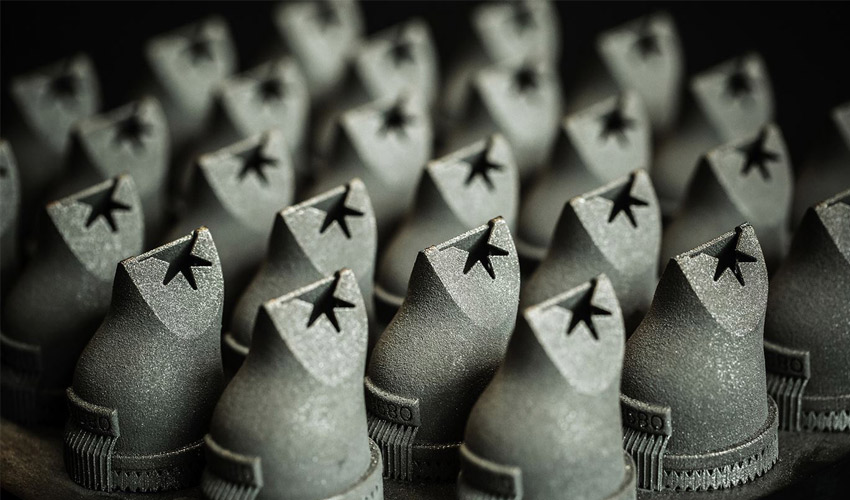
The Swiss Bühler group specializes in the mechanical industry, particularly in the manufacture of machines for the food industry. In 2018, the company joined forces with Haas-Meincke, a Danish machine manufacturer that produces cakes and cookies of all kinds. Some of the company’s machines are equipped with metal 3D-printed nozzles, offering more freedom in terms of design, complexity, and flexibility. The nozzles are made with metals compatible with food contact by the Danish Technological Institute, which is equipped with four metal 3D printers. Today, the Danish branch has gone further in its projects and uses metal additive manufacturing in the production of finished parts.
When we think of 3D printing in the food sector, we tend to imagine these small desktop FDM machines, capable of extruding dough or chocolate to design an original dish. And, there’s a healthy bit of hesitancy in the consumer market when it comes to eating 3D-printed. It is for this reason that we suggest that you move away from this concept and look at the food industry through another lens, in particular the “behind-the-scenes” of cookie production.
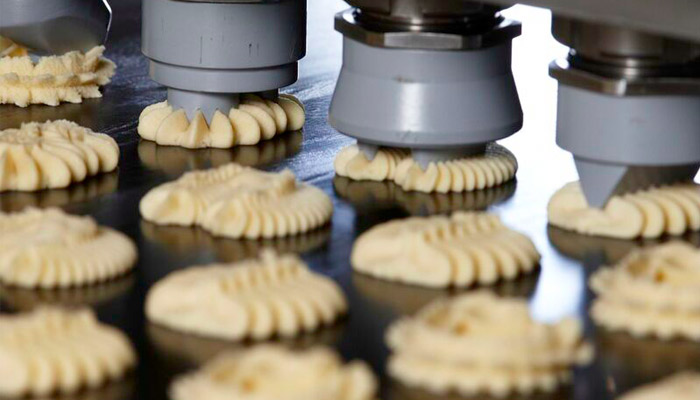
Bühler Meincke makes machines that produce cookies (Photo Credit: Bühler Meincke)
The Choice of Metal Additive Manufacturing
Bühler’s machines that make cookies today are equipped with nozzles from which the dough is extruded, just like the nozzle of an FDM 3D printer from which the plastic filament comes out. These nozzles have specific shapes depending on the imagined cakes. To manufacture them, Bühler went through manufacturing in several parts, assembled via a welding step thereafter; the shapes were too complex to be obtained by a milling process. However, the assembly phase adds additional constraints: by welding, we obtain joints in which bacteria can accumulate. A hell of a limit in the food sector.
More from the desk
Six other notes from the rest of the bench.
 GuidesThe 3D Printing Events You Don’t Want to Miss This YearEvery year in the world, users and actors of additive manufacturing and 3D printing meet at dedicated events, whether fairs, conferences or shows. They are the perfect opportunity to discover the latest innovations in the market and to interact with…
 NewsTCT Asia 2025: Experience the Next Era of Additive Manufacturing at the Event!Industry events play a crucial role in advancing additive manufacturing by connecting innovators, showcasing breakthroughs, and fostering collaboration. As one of Asia’s leading AM exhibitions, TCT Asia 2025 will bring together experts, businesses, and cutting-edge technologies t
 News3D Printing Startup, Fortify Raises $20 Million in Series B FundingBoston-based 3D printing startup, Fortify, also known as Fortify 3D, has just obtained $20 million in a round of series B funding. While the equity round was led by Cota Capital, there were also several other notable participants including Neotribe…
 NewsAir Up, the Water Bottle Designed With 3D Printing That Changes the Taste of WaterThe possibilities of additive manufacturing are countless and varied. The company we’re featuring today, Air Up, is one such example. Based in Munich, it has set a new trend in healthy drinks by selling bottles that flavor water using the…
 Materials3D Printing Steel: Everything You Need to Know!Steel is a well-known metal in the industrial production and 3D printing sectors. It is an alloy based on iron (Fe) and other elements, mainly carbon (C), but also materials such as zinc (Zn) or silicon (Si). These alloys modify…
 ApplicationsPROTIQ and its New Solution for Orthopedic ShoesIn the orthopedic sector and more broadly in medicine, additive manufacturing has become an essential technology. Whether for the production of prostheses, orthoses or implants, 3D printing allows medical devices to be manufactured in a short period of time and…