Applications
How Is 3D Printing Being Used for Electric Cars?
With the increasing availability of hybrid and electric vehicles, the automotive industry is increasingly turning towards sustainability and away from fossil fuels. As the sector is known for its constant innovation, electric cars and recent projects showcase advances in manufact
- 3 min read
- Applications
- Six more stories
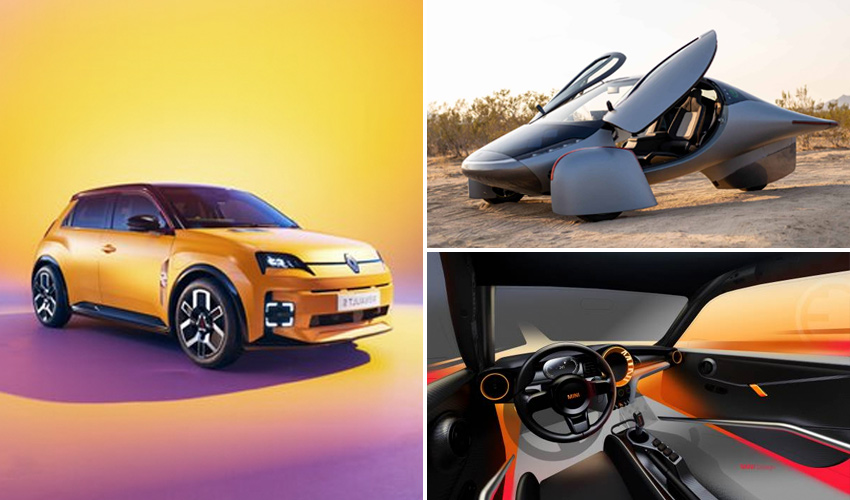
With the increasing availability of hybrid and electric vehicles, the automotive industry is increasingly turning towards sustainability and away from fossil fuels. As the sector is known for its constant innovation, electric cars and recent projects showcase advances in manufacturing, performance and design. So it’s natural to see that many electric vehicles incorporate 3D-printed parts and are designed using 3D modeling software. Here is a list illustrating the use of 3D printing in electric cars, offering an overview of its current role. The examples are presented in no particular order and reflect the current state of 3D printing in this field.
3D Printing in the Ford Electric Explorer SUV
A recent project implementing 3D printing in the manufacture of electric vehicles is Ford’s Explorer SUV. The American automaker used SLA and SLS 3D printing technologies for this model. Ford uses Formlabs’ solutions to create prototypes of various components such as mirrors, door handles, dashboard parts, as well as mechanical elements and assemblies. The company has long combined traditional production methods with 3D printing to improve material utilization, reduce costs, and increase production efficiency and speed.
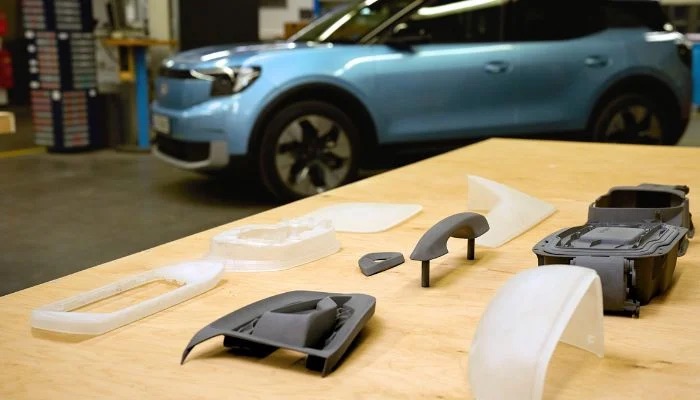
3D-printed parts for Ford’s Explorer SUV (photo credits: Ford)
The e-Miles L7e
The e-Miles Company is dedicated to developing greener mobility solutions. It recently launched the e-Miles L7e, an electric car specially designed for urban environments and sustainable freight transport. This vehicle stands out for its unique driving system, using a button instead of a steering wheel and pedals, making it accessible to a wide audience. The quadricycle is made up of 90% 3D-printed parts, from bodywork to interior components. Equipped with batteries that can be recharged in 8 hours, and an 8 kW motor, the e-Miles L7e can reach a top speed of 85 km/h.
More from the desk
Six other notes from the rest of the bench.
 MaterialsCombining Ceramics and Metals in a Single Resin 3D Printing ProcessLast week, the city of Hanover, Germany, hosted the annual Hannover Messe, an event dedicated to the manufacturing industry and digital transformation. From robotics to artificial intelligence, the focus is on automation, technology, and digitalization. And among the exhibitors a
 ApplicationsUS Troops 3D Print Drone Parts While Flying in Black HawkThe Indiana Army National Guard has achieved a technological first by successfully demonstrating 3D printing aboard a UH-60 Black Hawk helicopter. This marks a considerable milestone in military innovation, showcasing the shift towards additive manufacturing within the defense se
 ApplicationsMIT Has Unveiled 3D Printed Hearts That Look and Act Like the Real ThingHuman technology has advanced so far in the past few centuries, and it is undeniable that one of the sectors where we have seen the most growth is medical. Considering that nothing is scarier than the prospect of facing serious…
 PrintersMetal X: Metal 3D printing at a low price thanks to MarkForgedIn 2014, MarkForged made headlines for his new 3D printer, the Mark One. This was the first machine capable of extruding carbon filaments. Following two years later, they were developing a more affordable Onyx Series that would be based on…
 NewsHow is Formlabs strengthening its presence in Europe?The American manufacturer Formlabs is one of the historical players in the 3D printing market, particularly in the stereolithography segment. Today, the company employs more than 500 people in 7 offices worldwide and has already produced more than 40 million…
 Applications#3DExpress: Partnership Seeks to Further Silicone 3D PrintingIn this week’s 3DExpress, start off with a new French partnership between Lynxter and 3Deus that could help advance silicone additive manufacturing in the industrial and healthcare sectors. Then learn about Creality’s latest launch and how the combination of chocolate