News
The Sunflower Village: Using 3D Printing to Move Towards More Sustainable Communities
As the construction industry reinvents itself to address growing global environmental issues, 3D printed buildings have been gaining momentum. Whether in the United States, the Netherlands or China, where the first 3D printed retractable bridge was installed, the use of…
- 3 min read
- News
- Six more stories
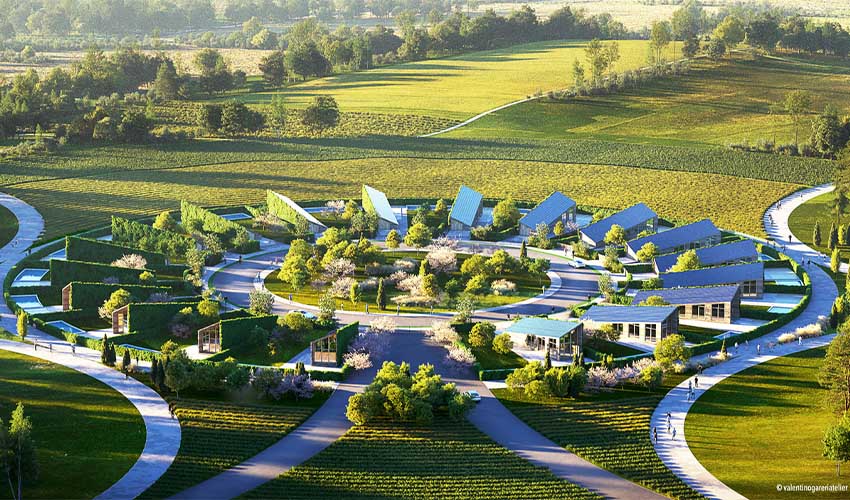
As the construction industry reinvents itself to address growing global environmental issues, 3D printed buildings have been gaining momentum. Whether in the United States, the Netherlands or China, where the first 3D printed retractable bridge was installed, the use of 3D printing in construction is rapidly growing. And some want to go even further. Architect Valentino Gareri, along with Steve Lastro of 6Sides, which specializes in technology and wellness, and Delos, one of the world’s leading real estate companies, have designed the Sunflower Village, a sustainable, ecological, innovative and 3D printed hamlet!
Composed of 19 sustainable houses, and designed for low-density rural areas, Sunflower was imagined as a way to respond to the mass exodus from the big cities, which has especially been increasing since the beginning of the health crisis. As the name suggests, the architect was inspired by the shape of sunflowers to arrange the different houses. Like the flower, the village follows a circular shape and the different houses are built around a central area. And to build the 19 houses, Valentino Gareri and his partners want to use additive manufacturing.

Photo Credits: Valentino Gareri Atelier
Expanding on this, the firm noted, “From stone and timber structure to the adoption of bricks and the arch-vaulting system, or the introduction of reinforced concrete structure that made possible to create higher and more transparent buildings.Similarly, the 3D printing technology will give form to the city of the future. This represents a more sustainable construction process compared to a traditional one, as less soil is used during the working phase.”
More from the desk
Six other notes from the rest of the bench.
 Printers3Dnatives Lab: Testing the Artec Ray 3D ScannerLuxembourg-based manufacturer Artec 3D has specialized over the years in the development of portable 3D scanners such as the Eva, the Space Spider and the Leo. More recently, the company has also broadened its spectrum of applications by unveiling 3D…
 GuidesVIP TIE and its 3D printed luxury tiesThe search for personalisation is a key issue in the fashion industry and 3D printing could well answer it more effectively. There are many examples, from Iris van Herpen’s collection to Julia Daviy’s skirt: 3D technologies offer a unique look…
 NewsNano Dimension Announces Acquisition of Machine Learning Leader DeepCubeNano Dimension announced yesterday that it has signed a definitive agreement to acquire DeepCube Ltd. for approximately $40 million in cash and $30 million in American Depositary Shares (ADSs) of Nano Dimension. Nano Dimension is a key player in the…
 SoftwareAll You Need to Know About KISSlicerChoosing the right slicer is a crucial step in achieving high-quality 3D prints. As the bridge between your 3D model and the printer, slicer software translates designs into precise layer-by-layer instructions. With so many options available—especially for FDM printing—finding th
 ApplicationsApplication of the Month: 3D-Printed Rocket Nozzles Made Using DEDAdditive manufacturing has profoundly changed the design, testing and production process for parts used in the aerospace sector. This industry benefits not only from reduced production times, but also from improved characteristics of the parts manufactured. In this context, SAB&h
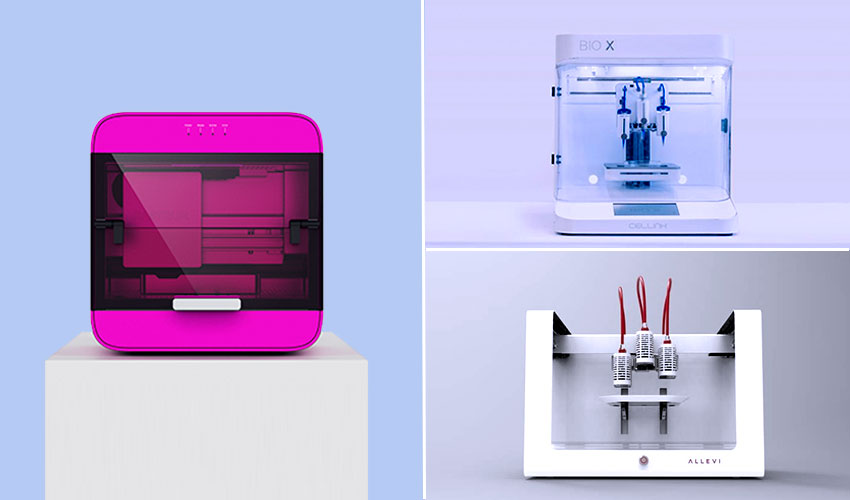 Printers3D Bioprinters: The Main Manufacturers on the MarketIf you are interested in the role of 3D printing in the medical sector, you have almost certainly heard of bioprinting. This technique is unique in that it allows for the creation of cellular structures, made from specially designed bioinks…