News
What Were the Post-Processing Trends in 2022?
Every year post-processing solution manufacturer PostProcess Technologies unveils a study on the post-processing market including trends, challenges and opportunities for users. In this 4th edition for 2022, the results are constant from previous years: post-processing remains a
- 3 min read
- News
- Six more stories
Every year post-processing solution manufacturer PostProcess Technologies unveils a study on the post-processing market including trends, challenges and opportunities for users. In this 4th edition for 2022, the results are constant from previous years: post-processing remains a time-consuming step that needs be more automated while still offering sufficient quality for the end parts. Moreover, it seems clear that users are becoming increasingly sensitive to Environment, Health and Safety (EH&S) issues. Depending on the 3D printing process used, it would seem that personal safety is an increasingly important concern, especially when it comes to handling powders. Finally, the manpower required for post-processing is another growing issue – users would like to shift it to higher value-added tasks. There is a perceived need for automation of certain processes, a need that is found throughout the additive manufacturing market.
For the fourth consecutive year, PostProcess Technologies surveyed a number of additive manufacturing users around the world to understand their uses of post-processing in 2022 as it is such a key step in the 3D printing value chain. This year’s study shows that more than half of the respondents employ at least two printing processes. And, as in previous years, three stand out: extrusion (54%), photopolymerization (48%) and powder bed fusion (37%). Not surprisingly, print support removal, resin removal and de-powdering are the three of the most used post-processing methods in the market – at 54%, 42% and 35% respectively.
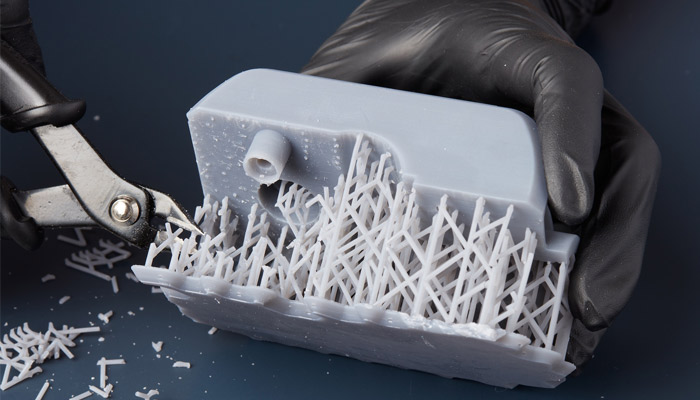
Removal of 3D resin printing supports (photo credits: Formlabs)
What are the Most Demanding Post-Processing Processes?
As you know, each 3D printing technology comes with its own advantages and limitations, whether in terms of process, compatible materials or post-processing. The PostProcess study looks at some of these limitations, depending on the 3D printing technology used. For example, for vat photopolymerization, the majority of respondents say that current post-processing techniques are acceptable but could be problematic in the future, much more so than other technologies. This is because they consider the removal of excess resin to be laborious and messy.
More from the desk
Six other notes from the rest of the bench.
 MaterialsNew glass 3D printing technique developed at ETH ZurichToday, additive manufacturing works with multiple different materials, yet glass is one of those materials that remains difficult to work with. Only a few groups of researchers around the world have attempted to produce glass objects using 3D printing technologies.…
 NewsFormnext 2025 Finalists Highlight Cutting-Edge 3D Printing InnovationsThe shortlist for the Formnext Awards 2025 has been unveiled, showcasing some of the most innovative applications and technologies in additive manufacturing. This year’s finalists reflect the industry’s growing emphasis on speed, sustainability, and education, with new 3D printin
 GuidesHyperflesh: The ultra-realistic, 3D printed masksBeginning in 2016, American artist Landon Meiert has been marketing and manufacturing his ultra-realistic masks under his brand ‘Hyperflesh’. Over the last couple months, he has been creating quite the buzz all over social media, following a video posted online…
 NewsTOP 5 VIDEOS: Open Heritage, exploring the world thanks to 3D printing technologiesThis week we found the top 5 videos about 3D printing and the way additive manufacturing is shaping our society. The technology has infiltrated many sectors, from medical to space! Check out our selection of the week to keep up…
 NewsTop 5 Videos: 3D Printing a Spacesuit for “A Thousand Suns”Welcome to our compilation of this week’s most compelling 3D printing highlights. We kick off this week’s edition with a video from BlackMilk Studio, featuring director Ruairi Robinson as he details the use of 3D printing to create the spacesuit…
 MaterialsScientists Succeed in Making PLA Material More DegradableAccording to a press release, researchers at the University of Bath have succeeded in making PLA even more degradable. Essentially, they have found that by incorporating sugar units into the polymers, they can be degraded more easily when exposed to…