News
Steakholder Foods Unveils Its New, Highly Marbled 3D Printed Beef Cuts
Recently, international deep-tech food company Steakholder Foods Ltd announced the release of a new, 3D printed meat cut called Omakase Beef Morsels. The richly marbled structured meat product is the first of its kind and was created using a specific 3D-bioprinting…
- 3 min read
- News
- Six more stories
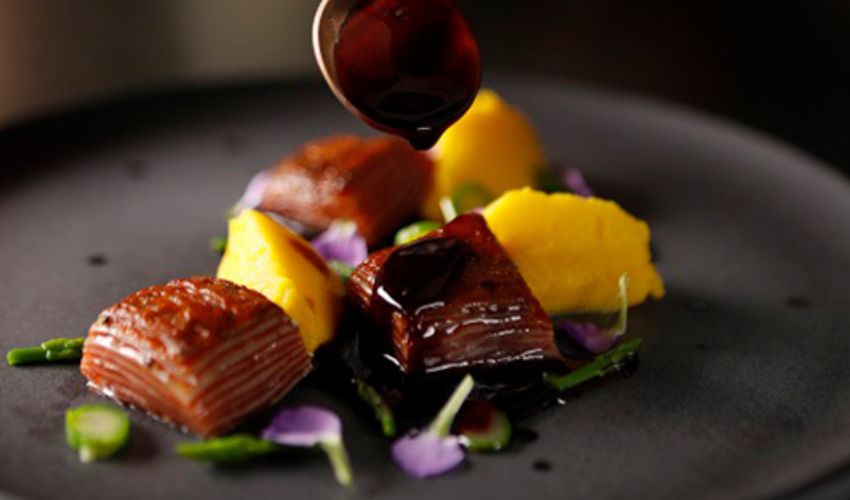
Recently, international deep-tech food company Steakholder Foods Ltd announced the release of a new, 3D printed meat cut called Omakase Beef Morsels. The richly marbled structured meat product is the first of its kind and was created using a specific 3D-bioprinting technology that was recently patented by the company.
As you might know, the use of 3D printing for the creation of foods has become a big thing over the last few months and it continues to expand steadily. Ever since the food industry discovered what benefits the use of additive manufacturing has in store, food companies keep on coming up with creative new ways to 3D print food. One of those companies is Israel-based Steakholder Foods. The food producer, formerly known as Meatech, has already been offering a variety of 3D-printed meat products, which have been produced by utilizing 3D printing technologies. Last year, for example, the company unveiled a bioprinted 3.67oz (104g) steak, which was at that time the largest cultured steak worldwide. The company’s latest achievement, the Omakase Beef Morsels, is an impressively structured meat cut, which was inspired by the famous Japanese Wagyu beef.
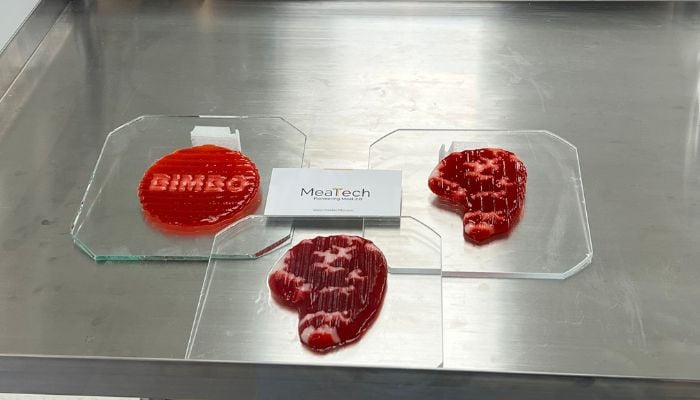
The Meat is created using two kinds of bio-ink
Creating The 3D Printed Cultured Beef Cut
To produce its slaughter-free meat products, Steakholter Foods uses a cutting-edge 3D bioprinting technology, which was developed by a team of the company’s house-own mechanical engineers and cellular biologists. The way the meat is created is that at first, two special kinds of bio-ink are produced using lab-cultured animal cells, one for muscle and one for fat. After that, the product is printed layer by layer, in which the two bio-inks are applied in a variety of different sequences. By having precise control over the application of both inks, the juiciness and marbling of the cut can be optimized. In addition to that, the technology allows the 3D printing of the product in any shape, width, and marbling ratio. The result is a delicate piece of tasty meat, that can be prepared for a delicious meal.
More from the desk
Six other notes from the rest of the bench.
 ApplicationsThe first 3D printed safety part for German railwayThe German Mobility Goes Additive (MGA) network, whose objective is to explore the adoption of additive manufacturing in mobility, has just approved the first 3D printed safety-related component for the railway sector. This is a metal brake suspension link, successfully…
 ApplicationsStratasys Showcases Automotive Applications at RAPID + TCT 2025While at RAPID + TCT 2025, one thing that was very obvious was the prevalence of applications on the show floor and in conference sessions. This follows a trend that we have seen for quite some time now, with companies…
 NewsIKEA Hacks: How to Transform Your Furniture With 3D PrintingWhen it comes to furniture and furnishings, Swedish giant IKEA still reigns supreme. One trend that has emerged around the brand in recent years is the concept of IKEA Hacks. But what is exactly? It’s actually quite simple: the idea…
 ApplicationsMicrofluidic 3D Bioprinting Allows a Better Reproduction of Cell StructuresAt the Stevens Institute of Technology in the United States, a team of researchers is currently working on the development of a bioprinting method based on microfluidics. This microfluidic bioprinting is a technique that manipulates fluids with characteristics in the…
 Materials3D Printing Elastomers Market Expected to Reach $1.389 Billion by 2030American research organization Report Oceans recently published a study in which it evaluated the growth of elastomers in the 3D printing market. The organization estimates that the elastomers market will reach 1.389 billion dollars within eight years, with an annual…
 GuidesHow to Take Advantage of the Benefits of Ceramic Additive manufacturing: Experts give their advice!Last year, SmarTech Analysis released its latest report on ceramic 3D printing, estimating that the technology will be worth approximately $4.8 billion by 2030. A real opportunity is gradually emerging for the industry, with additive manufacturing offering concrete advantages in&