News
SC Capelle Soccer Club’s 3D Printed Public Building Sets New European Standards
The construction industry is undergoing significant transformations due to the advancements in 3D printing technology, which are creating a multitude of new possibilities. In this field, additive manufacturing stands out for its cost efficiency, speed, and sustainability. COBOD,
- 3 min read
- News
- Six more stories
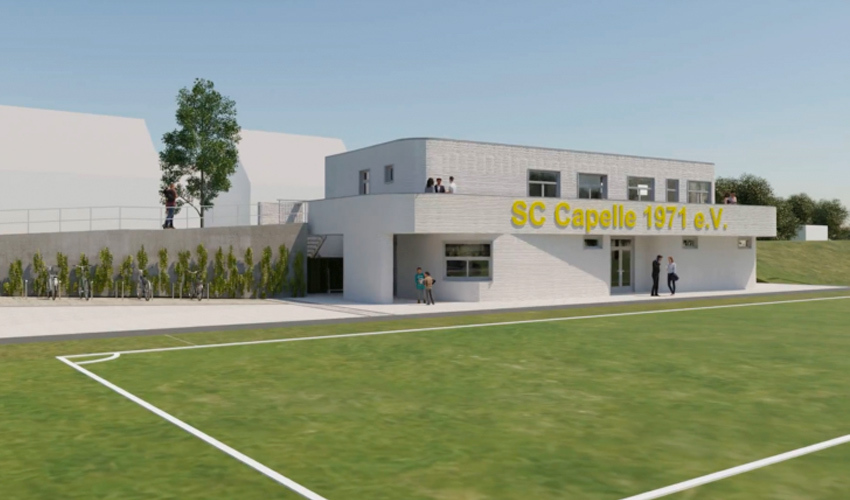
The construction industry is undergoing significant transformations due to the advancements in 3D printing technology, which are creating a multitude of new possibilities. In this field, additive manufacturing stands out for its cost efficiency, speed, and sustainability. COBOD, a company dedicated to intelligent construction, has made it their mission to promote this approach with their versatile printing robots. By using COBOD 3D printers in construction, it is projected that approximately 50% of construction work can be automated, leading to long-term reductions in carbon emissions. These printers have already been successfully employed in Europe’s first 3D printed buildings, villas in Dubai, wind turbines, and the largest 3D printed building in Heidelberg. The latest addition to this series is Europe’s first public 3D printed building, the soccer clubhouse of SC Capelle in Nordkirchen, which is being undertaken by the PERI Group.
In 2018, the PERI Group acquired a stake in the Danish company COBOD, resulting in a close collaboration between the two companies. For the construction of the clubhouse, the PERI Group relies on the COBOD BOD2 3D printer. This advanced printer is expected to complete the two-story clubhouse, measuring 25 x 15 x 10 meters, in just 140 hours. The soccer club will thus have approximately 330 square meters of usable space. The design of the clubhouse, created by the innovative architectural firm Steinhoff, has also received special attention. Not only does the clubhouse for SC Capelle from the 3rd league showcase groundbreaking technology, but it is also visually stunning. The combination of technology and aesthetic appeal represents the prevailing concept of progress, which extends beyond urban areas to rural regions as well. Mayor Dietmar Bergmann of Nordkirchen comments, “This initiative serves as a clear indication that small towns in rural areas can also drive innovation and future technologies. With the substantial financial support from the Ministry of the Interior of the State of North Rhine-Westphalia and the expertise of our project partners, we are realizing a construction project in Nordkirchen that not only garners attention locally but also beyond our region.”
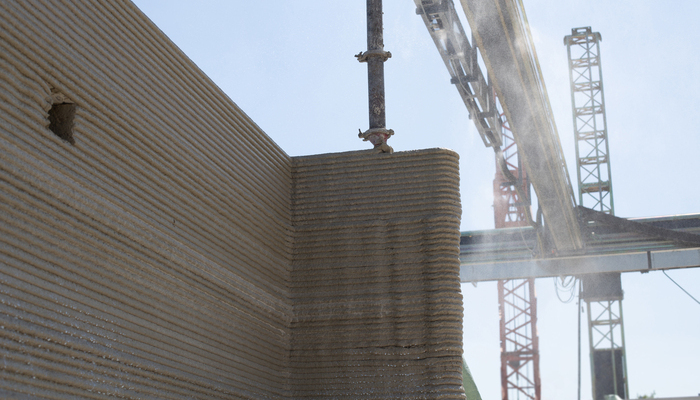
Europe’s first 3D printed public building is a testament to sustainability and innovation. (photo credit: PERI 3D Construction)
The 3D printer enables faster, more cost-effective, and environmentally sustainable construction. With additive manufacturing, issues like labor shortages and extended construction timelines are eliminated. Dr. Fabian Meyer-Brötz, Managing Director at PERI 3D Construction, emphasizes the sustainable usage of materials: “In light of significant challenges such as skilled labor shortages and stagnant productivity in the construction industry, 3D construction printing offers a much-needed solution to build faster, more affordably, and with reduced material consumption.” The concrete used, provided by Heidelberg Materials, is a cutting-edge building material that is 100% recyclable as a mineral substance. It is particularly well-suited for 3D printing due to its pumpability and extrusion properties.
More from the desk
Six other notes from the rest of the bench.
 NewsTop 5: How Do Concrete 3D Printers Work?Now that another week has come to an end and the next one is starting, once again we want to showcase the best 3D printing videos that came out. This time, start with a 3Dnatives original as we take a…
 Applications3D Printed Blood Vessels, A Step Towards Artificial OrgansThe shortage of organs available for transplantation remains a major issue: demand far exceeds supply. In the United States, there are more than 100,000 people on organ transplant lists, and some might wait years to receive one, if they survive…
 NewsTop 5 Videos of the Week: 3D printing at the Met Gala…This week we found the top 5 videos about 3D printing and the way additive manufacturing is shaping our society. The technology has infiltrated fashion, as seen by the 3D printed dresses at the Met Gala, not only this, it…
 MaterialsWhy Does 3D Printed Stainless Steel Corrode in a Marine Environment?Why is 3D printed 316L stainless steel prone to pitting corrosion in seawater? That is the question researchers from Lawrence Livermore National Laboratory have been diligently trying to answer. Their thorough study of this metal, utilized in naval applications, aims…
 PrintersHP Metal Jet; HP’s new metal 3D printing technologyEarlier this year the American company HP announced; it will indeed embark on the field of metal additive manufacturing. An announcement confirmed at the IMTS Chicago show. The manufacturer, now one of the largest resellers of professional 3D printers on…
 MaterialsFrom Idea to Application: How 3devo Accelerates Material Innovation with Filament Maker TWOSince 2016, the Dutch company 3devo has been developing innovative solutions to accelerate the research, testing, and development of polymer materials. Known for its compact, all-in-one extrusion systems featuring a signature vertical extrusion design, the company offers machines