Applications
3D Printed Blood Vessels, A Step Towards Artificial Organs
The shortage of organs available for transplantation remains a major issue: demand far exceeds supply. In the United States, there are more than 100,000 people on organ transplant lists, and some might wait years to receive one, if they survive…
- 3 min read
- Applications
- Six more stories
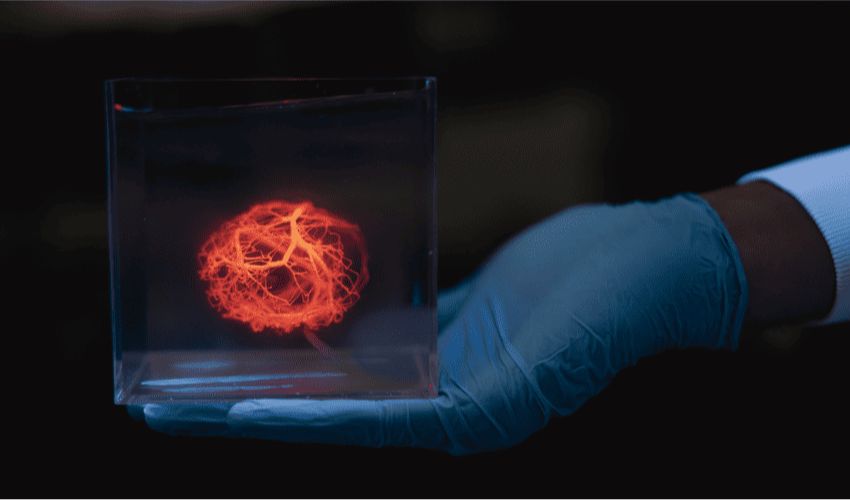
The shortage of organs available for transplantation remains a major issue: demand far exceeds supply. In the United States, there are more than 100,000 people on organ transplant lists, and some might wait years to receive one, if they survive the wait. Faced with this shortage and the risks associated with graft rejection, regenerative medicine is exploring innovative solutions. In particular, scientists are striving to create tailor-made organs, produced from a patient’s own cells, to respond more rapidly and efficiently to needs.
Researchers at Stanford University recently reached a key milestone. They developed an advanced technique enabling blood vessels to be designed and 3D printed with great precision and speed. This breakthrough addresses one of the major challenges in creating personalized organs from a patient’s cells.

Photo Credits: Freepik
Complex Blood Vessels Recreated Using 3D Printing
For an organ to function, blood must circulate from large arteries to tiny vessels, where it feeds the cells. Cells need to be very close to the capillaries to survive – sometimes less than a hair’s breadth away, especially in organs like the heart. In one cubic millimeter of heart tissue, there can be over 2,500 capillaries, all connected to each other before leaving the organ. As each organ has a unique shape, creating a suitable network of vessels is complex and slow. Until now, researchers have often used simple, standard vascular models, effective for small tissues but unsuitable for larger, more varied organs.
More from the desk
Six other notes from the rest of the bench.
 NewsWhat were the 3D printing trends of 2019?Are you wondering about the state of 3D printing in 2019? What to expect for 2020? Today, we look back on the trends that shaped the AM industry in 2019! Underlying all these trends is the fact that additive manufacturing…
 NewsHP strengthens its presence in the AM marketAt the RAPID + TCT fair in the US this past week, Hewlett-Packard (HP) announced that they would be strengthening their developments in 3D printing, with a Multi-jet Fusion machine. The company has unveiled various launches, including a program to…
 NewsWhen Every Minute Counts: 3D Scanning for RefineriesIn an oil or gas refinery, a leak, damaged pipe, or faulty valve can lead to colossal losses. The rule is simple: respond quickly, repair correctly, and avoid shutdown. But in an environment where corrosion, pressure, and hazardous substances are…
 News#3DExpress: What’s Next For Nexa3D, Nano Dimension & Velo3D?As the year winds down, the 3D printing world shows no signs of slowing. In this final edition of #3DExpress for the year, we bring you five headlines that captured our attention. The updates are a mixed bag—some promising, others…
 SoftwareWASP Unveils New Parametric Design Software AppWASP holds a significant position within the construction 3D printing sector. The company from Italy has introduced the WASP App, a parametric design software aimed at enhancing the user experience in crafting with clay. Clay has emerged as a primary…
 Newsadidas Unveils Its First Fully 3D-Printed Soccer Cleats3D printing in the world of athletic footwear is nothing new. Nike, PUMA, and ASICS, among others, have been experimenting with 3D-printed shoes and soles for years. But there is one area where none had fully taken the leap: soccer…