News
Air purifying bicycle wheel made with 3D printing
People switching from cars to bicycles is already an important step towards cleaner air, especially in big cities, where the pollution is reaching alarming levels. But what if we could take it a step further? What if your bicycle could actually…
- 3 min read
- News
- Six more stories
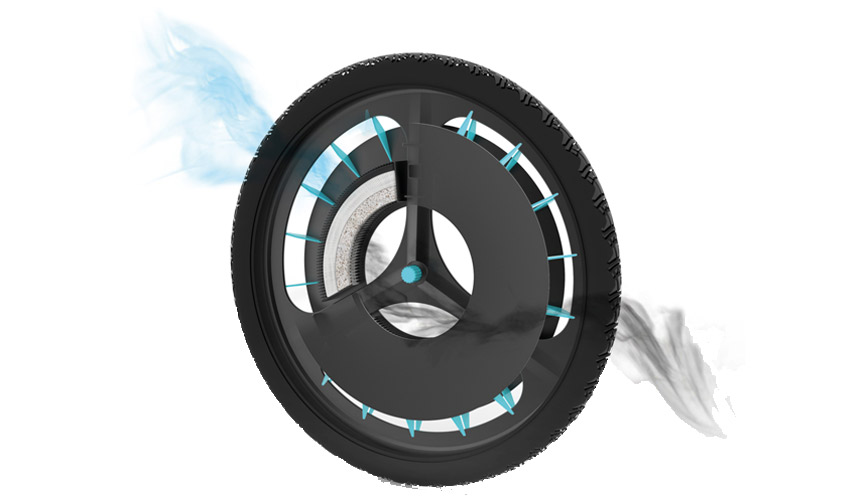
People switching from cars to bicycles is already an important step towards cleaner air, especially in big cities, where the pollution is reaching alarming levels. But what if we could take it a step further? What if your bicycle could actually help reduce pollution by purifying the air around it? London-based industrial designer, Kristen Tapping, invented just that! She designed Rolloe, a wheel that consists of three different filters that are capable of purifying the air from pollutants. Several parts of the innovative wheel are 3D printed. Using ABS, nylon and stainless steel, Kristen has developed 600 x 600 x 600 mm wheel prototypes, and hopes it will help reduce pollution in our cities.
Concerned about environmental issues, Kristen Tapping pointed out all the sources of pollution that can exist in our cities, sharing statistics that are not reassuring for our planet. For example, road transport is said to be responsible for 70% of nitrogen dioxide emissions and 30% of hazardous particulate matter in the air. A number of governments are reacting to this major problem by creating designated lanes for cyclists or by offering bicycles, electric or not, for city dwellers to rent. Recently, we saw how additive manufacturing has a major role to play in cycling, making it possible to build more efficient and comfortable two-wheeled vehicles, using less material and reducing logistical delays and transport. In the case of Rolloe, we see that 3D printing technology can also be used to purify the air via bike wheels.
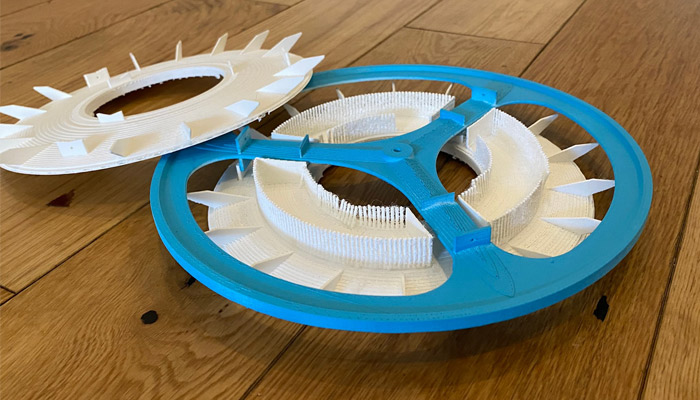
Kristen Tapping designed several prototypes using 3D printing (All image credits: Kristen Tapping)
Rolloe, a project to benefit the environment
The Rolloe wheel is composed of different parts that can be made with 3D printing or injection molding. It integrates two rims with ABS fins and a nylon disc, two thermoplastics that are highly resistant to shocks. To fabricate the axle, stainless steel was used. Inside the rim, the designer placed three different types of filters: the air is channeled through the inner cylindrical opening of the rim, then filtered and finally expelled through the outer fins. Air purification could be done at a rate of 0.665 m³ per kilometer.
More from the desk
Six other notes from the rest of the bench.
 MaterialsHow to Dry Your 3D Printing Filament and Avoid Moisture Build-UpThanks to its diverse benefits, 3D printing offers many opportunities for companies to break with their usual production routines and make them more efficient. But the technology does not come without its share of challenges. Many attempts fail due to…
 MaterialsRapid Fusion Talks Using Pellets for Large-Format Additive ManufacturingIf asked which two trends have been dominating the polymer 3D printing sector, the answer would be obvious: pellets and large-format additive manufacturing (LFAM). In recent years, we have seen machines getting larger for even more applications in sectors like…
 Applications3D Printed Lunar Regolith Bricks Can Withstand the Extreme Environments in SpaceSince the first space flight in the 1960s, humankind has dreamed of not just visiting the stars but of residing among them. Though living on the Moon or Mars might seem like science-fiction, it is actually something that is being…
 ApplicationsADDITIV Medical World Will Explore the Intersection of Healthcare and 3D PrintingAfter the success of our previous ADDITIV virtual events, which have brought together additive manufacturing professionals with key players in different industries, we are back once again. This time, join us on June 6th for ADDITIV Medical World, a half-day…
 ApplicationsHRE3D+, the second-generation of the world’s first 3D printed titanium wheelLast week Rapid + TCT 2019, one of the most important events in additive manufacturing, came to an end. The second-generation of the first 3D printed wheel made of titanium – the HRE3D+ on a 2019 Ford GT – was…
 NewsINDUSTRY From Needs to Solutions, the evolution of industry 4.0In the next few days, the 4th edition of INDUSTRY From Needs To Solutions will be held in Barcelona, since its inception the fair has collaborated in the growth of the so-called Industry 4.0. Between the 29th and 31st of…