Applications
Road Repairs with 3D Printing Technologies
In the world today there are 1.446 billion cars – that is, approximately one car for every five people. In order to keep transport running smoothly and efficiently and reduce nuisances like traffic and road closures, it is important to…
- 3 min read
- Applications
- Six more stories
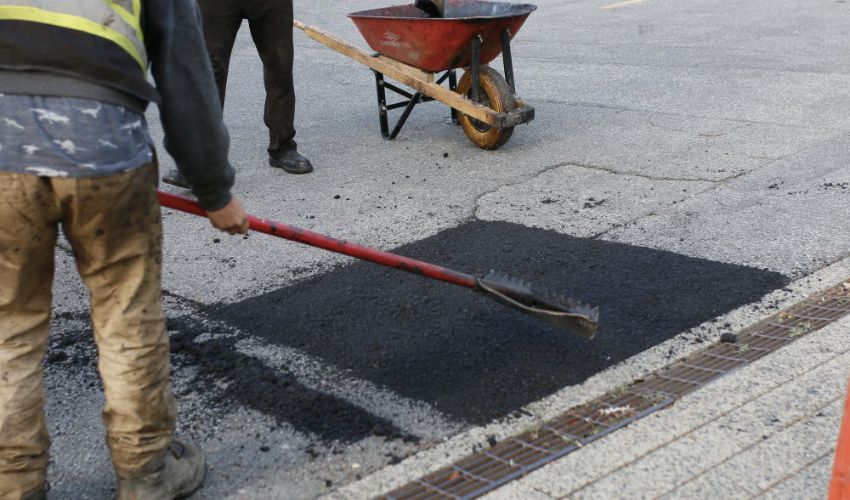
In the world today there are 1.446 billion cars – that is, approximately one car for every five people. In order to keep transport running smoothly and efficiently and reduce nuisances like traffic and road closures, it is important to have high quality roads. However, a threat is posed by cracks and potholes, which can damage vehicles and cause accident risks. Additive manufacturing could solve this problem by fixing these road defects, according to researchers from Hebei University of Technology in China, and Michigan Technological University, USA.
Traditional methods for pothole repair are various, and include cold, hot and jet patching. These methods have several disadvantages: human factors such as low automation, dependence on manpower, as well as a lack of preventative maintenance and material waste. 3D printing could provide an alternative with the application of 3D printing asphalt using extrusion technology – FFF. The repairs take several steps: obtention of 3D structural information of the problem, then rehabilitation of the issues. For the latter, the researchers offer two suggestions: in situ repairs, or treatment with prefabricated 3D structures. Finally, you would perform quality evaluation using tests.
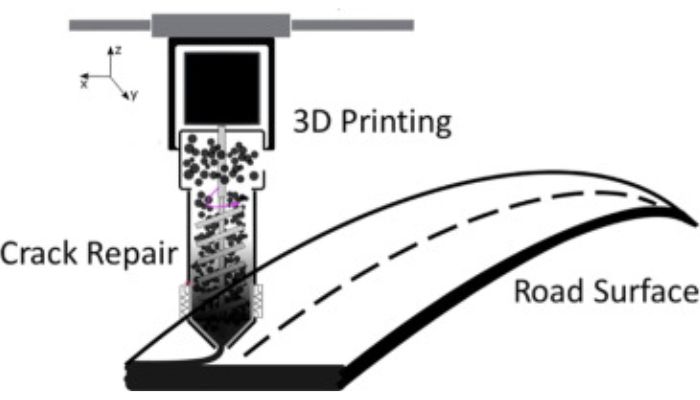
Photo credit: Richard Jackson et al., 3D printing of asphalt and its effect on mechanical properties
Why Use 3D Printing Instead of Traditional Methods?
3D printing offers a number of advantages over traditional methods; for example, the automation level can be increased by the combination of 3D scanning and 3D modeling, thus reducing manpower consumption and road closure duration. Also, this method can be applied to preventive maintenance, and the steps can improve repairs quality and reduce material waste. In terms of application, 3D technologies could be combined with traditional distress detection, either through distress detection then application of the printer or through the two steps being combined in an asphalt 3D printer. This could create the optimum treatment of potholes and ensure that they are detected while still in the early stages, saving time and effort.
More from the desk
Six other notes from the rest of the bench.
 Software#3DStartup: Exponential Technologies (xT) Optimizing Production Processes With AIOptimization of printer parameters is an area in additive manufacturing that is currently experiencing a surge of innovation. This is because in order for companies to scale production and add additional printers to their fleet, consideration must be given to…
 Applications3D Printed Soft Skin Pads Offer Enhanced Safety and Usability in RoboticsResearchers at the University of Illinois Urbana-Champaign have unveiled a cost-effective solution to equip robots with a human-like sense of touch. Leveraging the power of 3D printing technology, these innovative soft skin pads not only provide a gentle touch but…
 ApplicationsNew 3D Printed Chip Could Help Prevent Spread of Foodborne IllnessesWho has never seen the dreaded public health announcement from the USDA, “food recalled due to pathogens”? Whether E.coli, Salmonella, Listeria, Norovirus or any of the at least 31 pathogens known to cause foodborne illnesses, tracking and ensuring that these…
 NewsThe Sunflower Village: Using 3D Printing to Move Towards More Sustainable CommunitiesAs the construction industry reinvents itself to address growing global environmental issues, 3D printed buildings have been gaining momentum. Whether in the United States, the Netherlands or China, where the first 3D printed retractable bridge was installed, the use of…
 NewsAbu Dhabi F1 Grand Prix Features A 3D Printed FacadeIt is becoming increasingly common to see design projects that use additive manufacturing to create decorative structures for stores, clubs, and frequently trafficked areas to lend an elegant or upscale atmosphere. There have been standout recent examples such as Dior’s&hel
 News#3DExpress: Formlabs Shows Off More Realistic 3D Printed Teeth2024 is already well underway, and to start the year off on the right foot, we’re introducing a new article format that will be published every week: 3DExpress will take a look back at 5 news items that have marked…