News
Researchers Are Making Microstructures Using Ice 3D Printing
At Carnegie Mellon University, located in Pennsylvania, engineering researchers claim to have succeeded in 3D printing microstructures of ice. They plan to use these structures as sacrificial templates, allowing them to create internal channels or conduits with the highest finess
- 3 min read
- News
- Six more stories

At Carnegie Mellon University, located in Pennsylvania, engineering researchers claim to have succeeded in 3D printing microstructures of ice. They plan to use these structures as sacrificial templates, allowing them to create internal channels or conduits with the highest finesse and precision. With this ice 3D printing process, the researchers hope to develop useful applications for biomedical engineering, advanced manufacturing and art.
While we usually cover advances in the field of thermoplastics or metals, it is more rare to find innovations using water as a printing material! It was chosen by these researchers thanks to its biocompatibility and its ability to transform quickly and easily into ice. Of course, the downside to the using ice was that the team understandably faced many challenges in defining the 3D printing parameters.
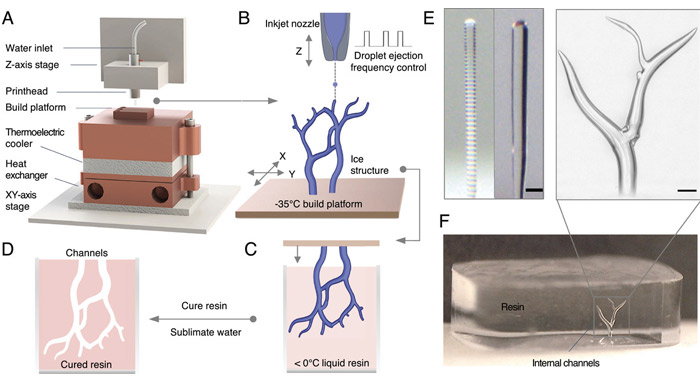
The developed manufacturing method (photo credits: Carnegie Mellon University)
The Ice 3D Printing Process
Akash Garg, a PhD student in mechanical engineering, and Saigopalakrishna Yerneni, a postdoctoral associate in chemical engineering, developed the ice 3D printing process. Specifically, they deposited water droplets on a cold build platform that was maintained at -35°C, allowing the water to be turned into ice extremely quickly. It took multiple iterations before they found the right printing trajectory, the speed of the nozzle movement and the droplet deposition frequency to be able to create smooth structures with well-defined geometries. All while providing a reproducible pattern. Thanks to the rapid phase change of water and the resistance of ice, the researchers were able to imagine all kinds of shapes without the need for supports.
More from the desk
Six other notes from the rest of the bench.
 NewsThe Impact of Additive Manufacturing on Nuclear Fuel TransportIn 2019, Orano Federal Services and the University of North Carolina at Charlotte explored the design of 3D-printed shock absorbers for containers used to transport spent nuclear fuel. However, the partners encountered several obstacles. Seven years later, the study has…
 SoftwareTopology Optimization vs. Generative Design: Which Modeling Tool Should You Choose?There is a constant race for even faster production, parts meeting higher demands and to surpass our current accomplishments. To achieve this, the products we manufacture have to be optimized in one way or another, so that they perform even…
 MaterialsRotterdam will have a 3D printed pedestrian bridgeIn Rotterdam, Netherlands, the first 3D printed pedestrian bridge is being built, and should be installed before the end of 2020. Currently, it’s a wooden footbridge that exists in the Kralingse Bos, soon to be replaced by a lightweight 3D…
 NewsECO 3D: The latest economic news in 3D printing for JulyProgress towards the future of 3D printing continues to grow, whether it be in the introduction of new, promising technologies, or within the production chain of a company who has implemented additive manufacturing to propel their production even further. In…
 ApplicationsThe ELAINE Project Is Researching Bioactive Bone Implants Made With 3D PrintingBones have a high degree of self-healing capacity. It is for that reason that with bone fractures, which may come about after a skiing accident, bicycle fall or mishap, the bones are usually able to grow back together themselves. Although…
 NewsTop 5 Videos: 3D Printing on an Offshore PlatformHello and welcome back to the top 5 videos of the week in the world of 3D printing! While you may rest assured we’ve got a whole range of interesting stories and takes from the industry. Join us as we…