News
The Complete Guide to Material Jetting (PolyJet) in 3D Printing
3D printing continues at a frantic pace, but the processes behind this technology are still unclear to some. After our articles on Selective Laser Sintering (SLS) and Fused Deposition Modeling (FDM) technologies, we now present Material Jetting. This process is…
- 3 min read
- News
- Six more stories
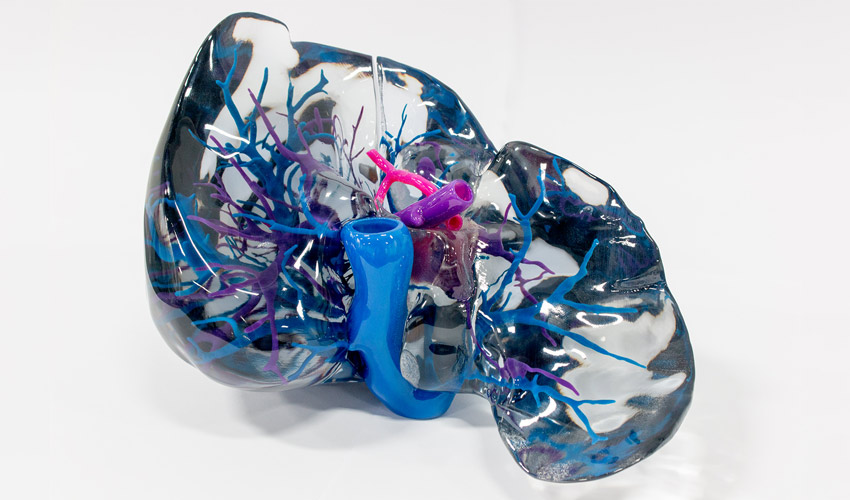
3D printing continues at a frantic pace, but the processes behind this technology are still unclear to some. After our articles on Selective Laser Sintering (SLS) and Fused Deposition Modeling (FDM) technologies, we now present Material Jetting. This process is known for enabling the creation of objects that combine several materials and colours. So how does it work exactly?
Material Jetting patented by Objet Ltd. in 1999 under the name of PolyJet (which merged with Stratasys in 2012), combines Inkjet technology and the use of photopolymers. Inkjet technology is used by conventional 2D printers on paper while photopolymers are materials that harden when exposed to ultraviolet rays. This technology has many benefits, including excellent resolution (up to 0.016 mm), smooth surfaces (no staircase effect unlike objects printed using FDM technology) and a wide choice of materials and colours for a relatively low cost and printing time.

How does Material Jetting 3D printing work?
Like any 3D printing technique, the process begins with the creation of the desired object using CAD software; it is then cut into several digital images, each corresponding to a layer of the object, via slicing software, also called the slicer. The STL file is then sent to the 3D printer for printing.
More from the desk
Six other notes from the rest of the bench.
 MaterialsGravity Industries & Ricoh 3D Partner On Human Flight ProjectRicoh 3D has announced they are partnering once again with Gravity Industries, this time with the goal of producing Gravity’s latest human flight project, the Electric Jet Suit. Having experienced great success with Gravity’s Jet Suit over the past four…
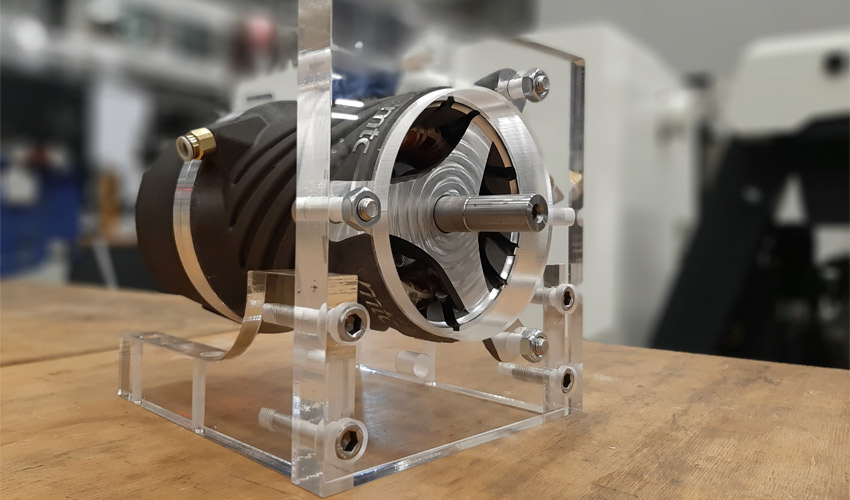 ApplicationsHas An English Research Center Found a Way to Commercialize a 3D-Printed Electric Motor?In England, the National Center for Additive Manufacturing (NCAM) has designed a 3D-printed electric motor, which they proclaim is the first of its kind. The motor consists of multiple 3D-printed parts. Furthermore, the motor has comparably more power, requires less…
 NewsAmerica Makes announces AM education challengeThere is no doubt that 3D printing is a technology that we will continue to see grow into the future; But when we discuss the future, it is important to remember who our future is, and that would be kids.…
 ApplicationsThe first 3D printed safety part for German railwayThe German Mobility Goes Additive (MGA) network, whose objective is to explore the adoption of additive manufacturing in mobility, has just approved the first 3D printed safety-related component for the railway sector. This is a metal brake suspension link, successfully…
 NewsTop 5 Videos of the Week: 3D printing realistic medial modelsThis week we found the top 5 videos about 3D printing and the way additive manufacturing is shaping our society. The technology has infiltrated many sectors, from medical to automotive! Check out our selection of the week to keep up with the innovations! This week we…
 ApplicationsVintage Jaguar restored with HP Jet Fusion 3D printing solutionBy now it is quite well known that the automotive industry is one of the sectors that take advantage of additive manufacturing the most. From Porsche 3D printing engine pistons for its famous 911 GT2 RS model to Lamborghini Sian…