Applications
Personalized Medicine Thanks to Volumetric 3D Printing and Semi-Solid Extrusion
3D printing is transforming drug manufacturing, offering customized solutions that improve treatments and the patient experience. Traditionally, bespoke medicines have been prepared using magistral preparations, a manual, laborious and error-prone process. However, 3D printing is
- 3 min read
- Applications
- Six more stories
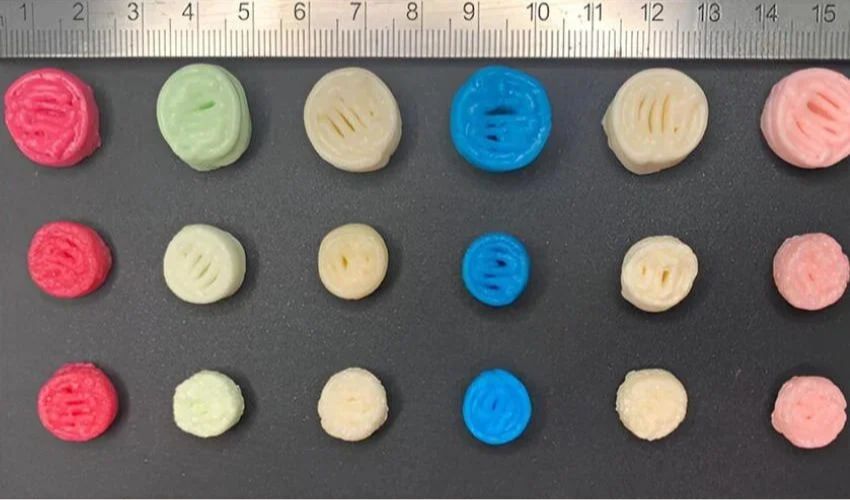
3D printing is transforming drug manufacturing, offering customized solutions that improve treatments and the patient experience. Traditionally, bespoke medicines have been prepared using magistral preparations, a manual, laborious and error-prone process. However, 3D printing is emerging as a promising technology in this field, overcoming these constraints by offering the possibility of producing medicines perfectly tailored to each patient’s needs. A recent study led by Lucía Rodríguez Pombo, a researcher at the University of Santiago de Compostela (USC), confirms the effectiveness of 3D printed personalized medication, particularly for pediatric patients.
The study, titled Clinical Implementation of 3D Printing for the Preparation of Personalized Medicines, focuses on the application of 3D printing in a clinical context for medicine manufacturing. Under the supervision of Professors Carmen Álvarez and Álvaro Goyanes, Lucía Rodríguez Pombo explores two main technologies: semi-solid extrusion and, for the first time in the pharmaceutical field, volumetric 3D printing.
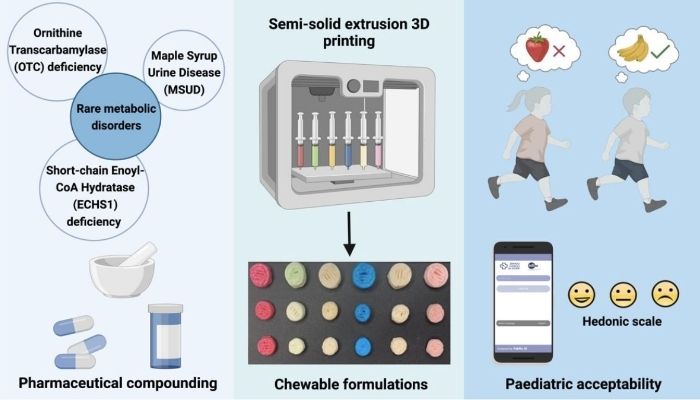
The 3D-printed drugs are designed with the patient’s needs in mind, and of course their taste preferences.
As part of this study, both techniques were evaluated for potential implementation in hospitals, highlighting their ability to produce personalized pediatric drugs, with shapes, flavors and dosages tailored to the specific needs of each patient. In particular, for the first time, two different formulations were integrated into a single printed drug, helping to improve compliance in children aged 6 to 14.
More from the desk
Six other notes from the rest of the bench.
 NewsWhat Not to Miss at RAPID + TCT 2025Rapid + TCT 2025 is opening its doors today! Once again taking place in Detroit, the event will bring together the leading voices in additive manufacturing over three days of innovation, networking and expert-led conferences. But with over 400 exhibiting…
 NewsTop 5: Could Recycled Filament Be the Future of 3D Printing?It is once again Sunday and with the end of the weekend also comes our weekly top 5 3D printing videos of the week! To start you off, check out Enable 3D’s interview with Reflow to learn more about recycled…
 SoftwareHyperganic makes a 3D printed rocket engine using AIThe German company Hyperganic, which we met last year, recently presented its 3D printed rocket engine prototype, designed entirely by artificial intelligence. The entire part was designed as a single block, integrating both the combustion chamber and the surface channels.&hellip
 Applications8 Reasons to Use 3D Printing for Space ExplorationHumanity has always dreamed of conquering space, and every technological advance brings us a little closer to this goal. Among these innovations, 3D printing has emerged in recent years as a major asset for the space industry. But contrary to…
 Printers3D Print ceramic pieces on your SLA 3D printerSix years ago, the American manufacturer Formlabs unveiled their first stereolithography 3D printer that was made to be accessible to as many people as possible, with a relatively low marketing price. Since then, the company has grown quickly, evolving their…
 PrintersZmorph Takes on the Professional 3D Printing MarketLast December, the Polish manufacturer Zmorph revealed its move away from the desktop printer market with the launch of its professional machines. The company introduced the Zmorph Fab, an all-in-one 3D printer with interchangeable heads to offer users milling, engraving…