News
Painting vs. Dyeing: Which Coloring Method to Choose for 3D Printing?
A wide variety of technologies can be found in the field of additive manufacturing including those able to directly 3D print parts in color. However, this is not the cast for all and most of them tend to create parts…
- 3 min read
- News
- Six more stories
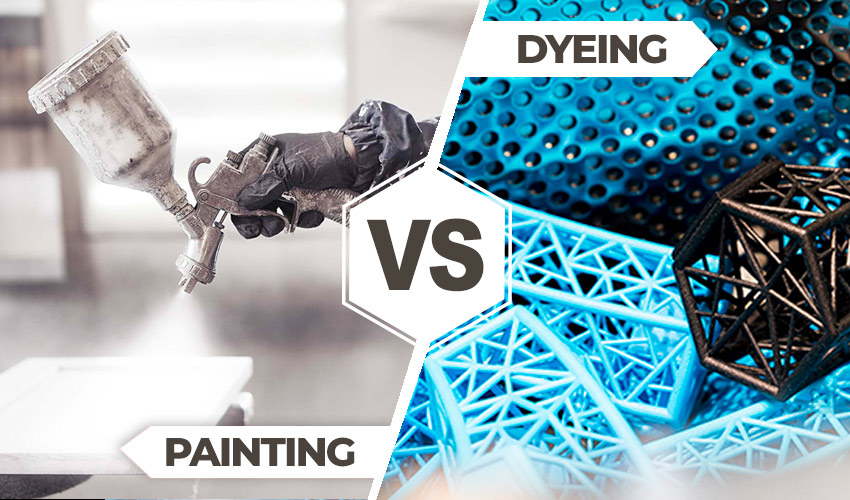
A wide variety of technologies can be found in the field of additive manufacturing including those able to directly 3D print parts in color. However, this is not the cast for all and most of them tend to create parts in a standard color and then color must be applied during post-processing. In fact, in many industries and applications, such as consumer goods, having colored parts can be an essential feature of final products. Therefore, implementing post-processing techniques that can apply color to newly printed models can greatly facilitate manufacturing processes. Two of the most widely used methods in 3D printing are painting and dyeing.
Although at first glance they may seem very similar, the truth is that, depending on the additive manufacturing technology used, materials and end uses, it will be more appropriate to use one or the other. It is worth mentioning again that there are some 3D printing technologies that allow you to create multicolor parts directly in the manufacturing process. These methods include material jetting (injection of material in the form of resin), binder jetting (injection of colored binder), and filament multiextrusion (printers with two heads that exchange materials). For all other polymer technologies, additional steps will be required to apply color to the final parts. To better understand the differences between dyeing and coating, here is a comparison of the two processes, with a focus on polymeric materials.
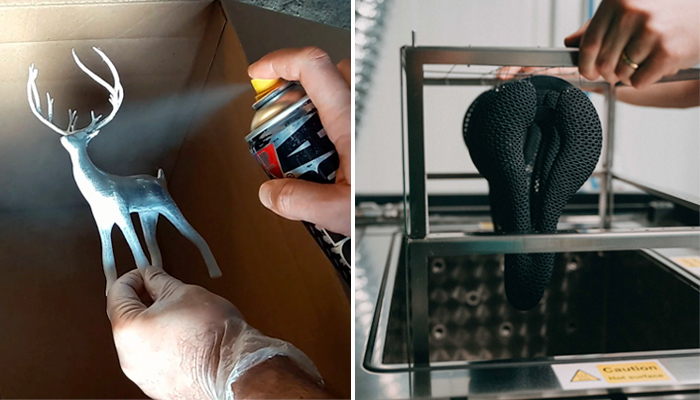
Painting (left) and dyeing (right) are common ways to color parts in post-processing for 3D printing
How Do Painting and Dyeing Compare?
Painting
Painting refers to the coloring of parts by applying acrylic paints or enamels. Depending on the final application of the part to be painted, one will opt for manual or automated painting. In any case, the process involves several steps, which take over in the last post-processing stage: application of a primer to prepare the surface, base coat (color) and finally clear coat (clear enamel) to protect the finished part. As for the manual process, although painting with brushes is possible, the most popular, even at the professional level, is spray painting since it allows for more uniform coloring.
More from the desk
Six other notes from the rest of the bench.
 News3D print the Tesla Cybertruck directly at homeWhy not 3D print your own Tesla Cybertruck? A smaller model of course. This was the idea of designer Roger Kappler who created a small-scale 3D model of the famous pickup truck that should be released in 2021. He started…
 SoftwareAI-powered AM software company Oqton raises $40MBased in the U.S. and Belgium, Oqton is a software company specializing in AI-powered solutions for the manufacturing industry, including additive manufacturing, and welding. The company just announced that it has raised over $40M in a Series A funding round…
 ApplicationsFather and son 3D print Lamborghini in their garageWhen a few days ago the giant automaker, BMW, presented to the world its new model of its 3D printable at home concept car, a father and a son had already started working on their very own project, making a…
 ApplicationsNASA Is Looking to Advance the Use of Metal 3D Printing for SpaceflightIt is common knowledge that additive manufacturing is extremely useful right here on Earth, but what about in outer space? For some time now, 3D printing has been considered to be one of the leading technologies for applications related to…
 GuidesTim Smith on GRX-810: NASA’s Breakthrough Superalloy for Additive ManufacturingJet turbine engineers need components that can survive some of the most extreme conditions imaginable, like emperatures exceeding 2,000 degrees Fahrenheit, and for years, no off-the-shelf alloy survived the task. The answer came from NASA Glenn Research Center in the…
 GuidesVandragon’s beautiful 3D printed boatsTino, also known as vandragon_de, has quickly gained popularity for his 3D printable boats. Starting his boating journey thanks to his son’s love for boats, he has quickly changed the 3D printing boat game. As we at 3Dnatives are always…