News
ORNL designs the first 3D printed nuclear reactor
At Oak Ridge National Laboratory (ORNL), a team of researchers is continuing its research to build a 3D printed nuclear reactor: they have designed the reactor core and intensified the entire additive manufacturing process to validate the reliability of the…
- 3 min read
- News
- Six more stories
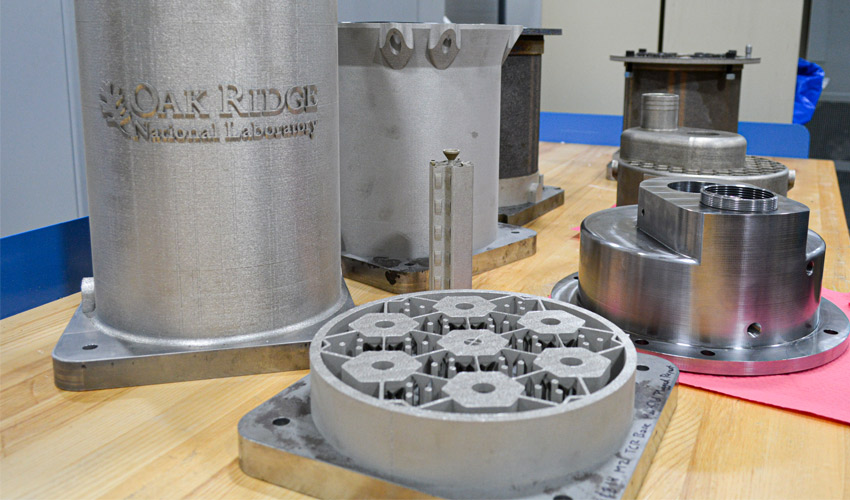
At Oak Ridge National Laboratory (ORNL), a team of researchers is continuing its research to build a 3D printed nuclear reactor: they have designed the reactor core and intensified the entire additive manufacturing process to validate the reliability of the 3D printed components. ORNL hopes to commission the first nuclear reactor of this type in 2023. This development would allow the nuclear sector to produce more advanced and sustainable energy systems.
In the field of energy, additive manufacturing makes it possible above all to validate concepts more quickly and to make efficient progress in the rapid prototyping phases; it also creates components that are more efficient and optimised in their shape and material use. The adoption of additive manufacturing is growing in every sector. If we focus solely on the nuclear sector, it’s true that additive manufacturing has taken more type to break thorough, although some initiatives do show that the sector is ready to leverage some of the benefits of AM.
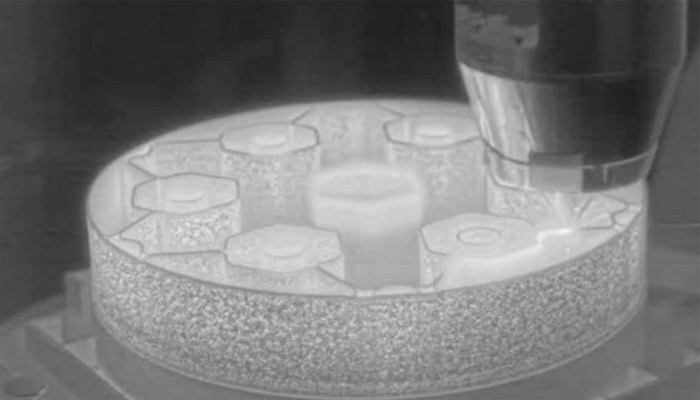
ORNL used a metal additive manufacturing process | Credits: ORNL, Energy Department
This is the case of the ORNL laboratory, which has been using 3D technologies for several years, on different projects and sectors. As part of the “Transformational Challenge Reactor Demonstration” (TCR) program, an initiative launched by the American laboratory to imagine more efficient, faster and cheaper energy systems, several tests were carried out. In just three months, the ORNL was able to design a prototype 3D printed nuclear reactor, thus demonstrating the agility of additive manufacturing. Thomas Zacharia, director of the laboratory, explains: “The nuclear industry is always forced to think about how we design, build and deploy nuclear power technology. DOE launched this program to seek a new approach to quickly and economically develop transformational energy solutions that deliver reliable, clean energy.”
More from the desk
Six other notes from the rest of the bench.
 NewsEPSRC has launched the DfAM network in the UK for greater collaboration on AM design researchThe Engineering and Physical Science Research Council (EPSRC) officially launched its Design for Additive Manufacturing (DfAM) Network in the UK last week. The project aims to bring together a community of DfAM academic researchers, industry and others in the field…
 PrintersGF Machining Solutions facilitates the manufacture of hybrid partsIn the manufacturing industry, different production methods are used depending on the type of part created. While additive manufacturing has proven its worth, whether for rapid prototyping or end-use part applications, it is still a method that is often complementary…
 ApplicationsFirst Critical Submarine Component With 3D Printed Impeller to be Installed in U.S. Navy VesselThe U.S. Navy continues to show its interest in additive manufacturing, especially for its submarines. This time, Curtiss-Wright’s EMS Division has announced that it has delivered what it considers to be the first submarine component with a 3D printed impeller…
 NewsTop 5: How Could 3D Printed Biocomposites Change 3D Printing?For this week’s Top 5, learn from five informative videos on additive manufacturing! First, take a look at 3D printed biocomposites, made with materials like cork, wood, bamboo, coconut, and even denim! Then, see how researchers at Georgia Tech are…
 ApplicationsToyota Hyper-F Concept Car Debuts with 3D Printed PartsIn the automotive industry, innovative approaches and exceptional features are essential to stand out from the competition. Advancements in development methods, materials, and design are key factors in this race. Toyota’s customization and development department is continua
 ApplicationsA 3D printed pulley can improve the performance of cyclistsThe Danish company CeramicSpeed and the Danish Institute of Technology (DTI) have worked together to produce a 3D printed titanium pulley for professional cyclists. The pulley is placed on the external gears of the gear shift and therefore subject to…