Printers
GF Machining Solutions facilitates the manufacture of hybrid parts
In the manufacturing industry, different production methods are used depending on the type of part created. While additive manufacturing has proven its worth, whether for rapid prototyping or end-use part applications, it is still a method that is often complementary…
- 3 min read
- Printers
- Six more stories
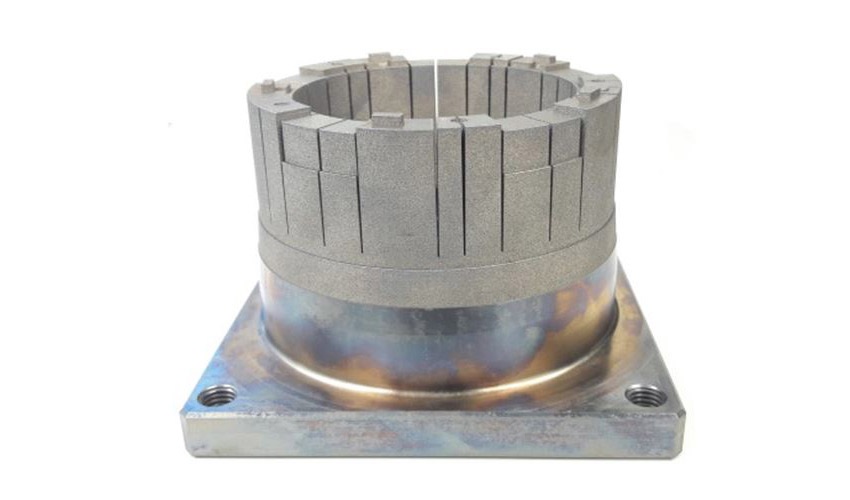
In the manufacturing industry, different production methods are used depending on the type of part created. While additive manufacturing has proven its worth, whether for rapid prototyping or end-use part applications, it is still a method that is often complementary to subtractive manufacturing processes. Indeed, current technologies do not yet allow for the design of large volumes and are often too slow. Additive manufacturing is preferred for parts with very complex geometries, small series, prototyping or tooling. However, it can be seen that more and more manufacturers are looking to combine the two production processes: known as “hybrid manufacturing”, it offers a number of advantages and is, in some cases, more viable from an economic view point.
Nevertheless, combining these two processes can generate some challenges. In most cases, the part is 3D printed and then post-processed and machined to obtain the final geometry or a better surface finish. This is often the case for very complex components that incorporate internal geometries, such as cooling channels, or anything that cannot be machined directly from a metal block. These geometries require steps such as supports removal, heat treatment, milling or even manual polishing to achieve a better finish. These are often time-consuming and expensive and should be kept to a minimum.
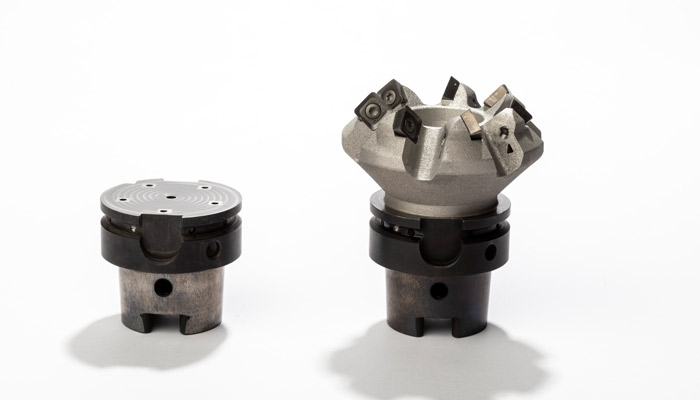
Hybrid cutting tool | Image via GF Machining Solutions
Therefore, the hybrid manufacturing process has been increasingly employed to create these so-called “hybrid” parts. This process consists not only of combining additive and subtractive technologies, but more precisely of printing directly onto a conventionally pre-machined preform. Indeed, metal 3D printing is a process that can be time consuming and costly. Therefore, industrialists are able to machine their preform and then create or add, thanks to additive manufacturing, characteristics that would be impossible to obtain using conventional processes. The result: reduced production time, limited costs, and retained technological benefits.
More from the desk
Six other notes from the rest of the bench.
 MaterialsKexcelled Talks Its Range of 3D Printing Materials and International ExpansionAs research into new additive manufacturing materials continues to advance, so do the suppliers of these materials. Kexcelled has established itself as a key player in the high-quality materials sector with a wide range of products including both filaments and…
 Applications3D Printed Prosthetic Limbs Help Ukrainians Live Normal Lives or Rejoin the FightAmidst the daily brutality of life in wartime, one is often forced to look for the silver linings to make a dismal situation a bit brighter. But it is from such tales of bravery and courage in the face of…
 NewsZoom in on Open-Source, 3D-Printed Camera EquipmentSome projects using 3D printing are so unique and original that we can’t help but tell you about them. This time, we turn our attention to the world of photography and the work of amateur photographer Nicholas Sherlock, who has…
 Materials3D printed metamaterials to control sounds and vibrationsA team of researchers from Viterbi University in Los Angeles has found a new way to control sound and vibrations through 3D printing. The team has developed 3D printed metamaterials that are able to block sound waves and mechanical vibrations…
 PrintersHP Talks About the Future of Additive ManufacturingWe are on the road just for you, reporting from Formnext, where we are talking with industry-leading manufacturers from the world of additive manufacturing, including global leaders such as HP 3D Printing, with its patented Multi Jet Fusion technology. We visited the…
 NewsTop 5 Videos: 3D printed orthopaedic implantsThis week we found the top 5 videos about 3D printing and the way additive manufacturing is changing production. The technology has infiltrated many sectors, from medical to automotive – check our selection of the week to keep up with the innovations! If you enjoy these, you&hell