News
Creating More Optimized Bicycle Saddles Thanks to Industry 4.0 Technologies
In the world of sports, cycling and 3D printing have been proven time and again to be a winning duo. This is especially the case in areas in which technology can play a key role in improving performance. One such…
- 3 min read
- News
- Six more stories
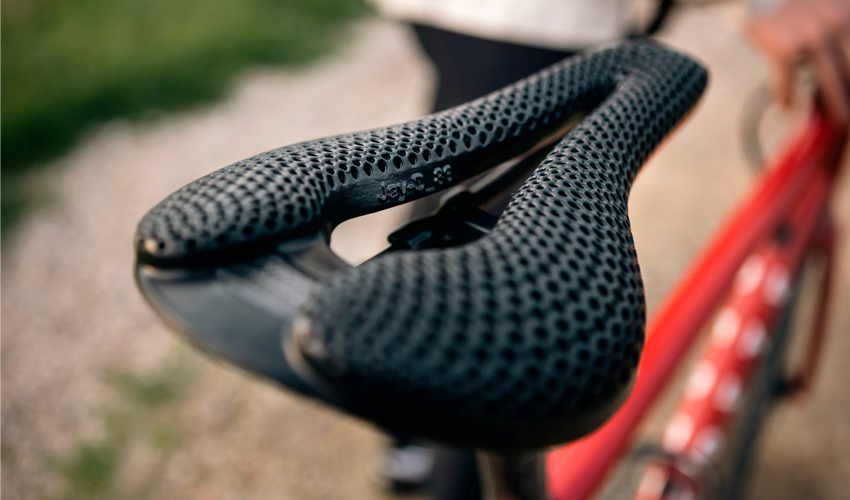
In the world of sports, cycling and 3D printing have been proven time and again to be a winning duo. This is especially the case in areas in which technology can play a key role in improving performance. One such example is in the design of bicycle saddles, which need to be optimized for the comfort, health and performance of the athlete. However, today’s companies often find it difficult to develop the right equipment to suit each user, and this is where additive manufacturing comes into play. As you may know, one of the main advantages of using AM is the ability to create customized parts adapted to the morphology of each person. For this reason, companies such as AMT or BASF 3D Printing Solutions have put their solutions at the service of bicycle manufacturers. This was the case for the Czech company Posedla which is dedicated to the creation of cycling equipment. It has taken advantage of the benefits of 3D printing, its materials and the corresponding post-processing for use by great athletes.
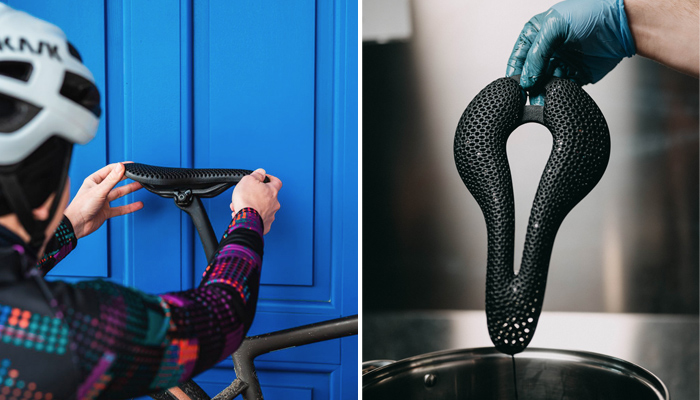
With the goal of creating optimized bicycle saddles, Posedla drew on the experience and expertise of companies dedicated to additive manufacturing. Using the individual characteristics of each rider, they were able to design and produce a fully customized saddle that is tailored to the rider’s anatomy, as well as riding form, flexibility and more. To do this, a test kit was sent to the user from which the necessary information, such as sit bones width and impression of the sitting area, was taken. Later, a three-dimensional model of the saddle is created through algorithmic modeling software. This is a clear example of the advances that can be seen in product customization, demonstrating that the consumer goods industry is undergoing substantial change.
Credits: Posedla
Making the Saddles
After obtaining the 3D model of the saddle, it is time to move on to manufacturing. In this case, Posedla opted for the solutions of three large companies in the sector: HP, AMT and BASF 3D Printing Solutions. For the printing process, they wanted to find a suitable method in a potentially scalable production, so HP’s Multi Jet Fusion technology was chosen. In terms of materials, they were looking for a flexible polymer that was both durable and UV resistant. Given these requirements, BASF 3D Printing Solutions, through its material brand Forward AM, proposed its Ultrasint® TPU01 flexible polymer. The combination of HP’s technology with Forward AM’s material enables the creation of structures with different stiffnesses. This provides solid support in the seat bone area, gradients with different parameters related to forward-backward movement in the saddle and a much softer saddle nose area.
More from the desk
Six other notes from the rest of the bench.
 NewsTurkish Aerospace Industries to Receive World’s Largest Electron Beam DED 3D PrinterAmerican company Sciaky, Inc. has announced that it will be delivering the world’s largest electron beam directed energy deposition (DED) 3D printer to Turkish Aerospace Industries (TAI). The customized 300 Series Electron Beam Additive Manufacturing (EBAM) system will be u
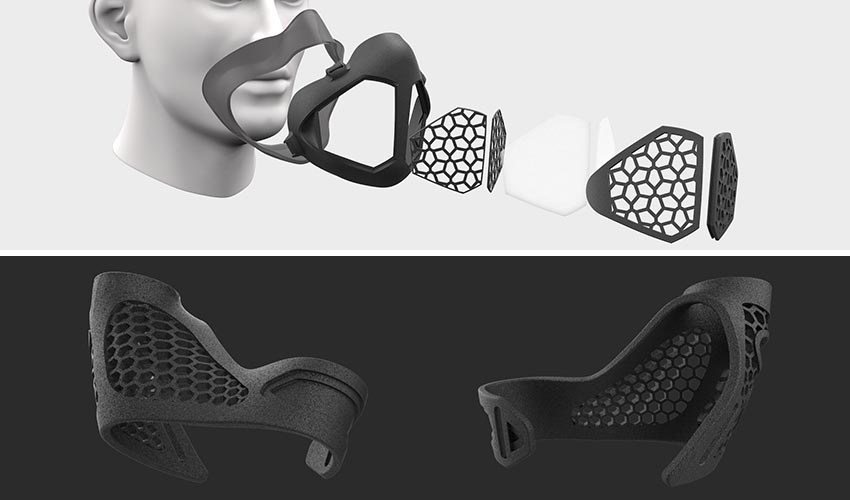 SoftwareShapeshift 3D on developing AM software for mass customizationShapeshift 3D develops software to streamline and digitize the production process from 3D scanning to 3D printing of customized wearables. One of the main benefits of additive manufacturing is that it enables a great degree of design freedom, meaning that…
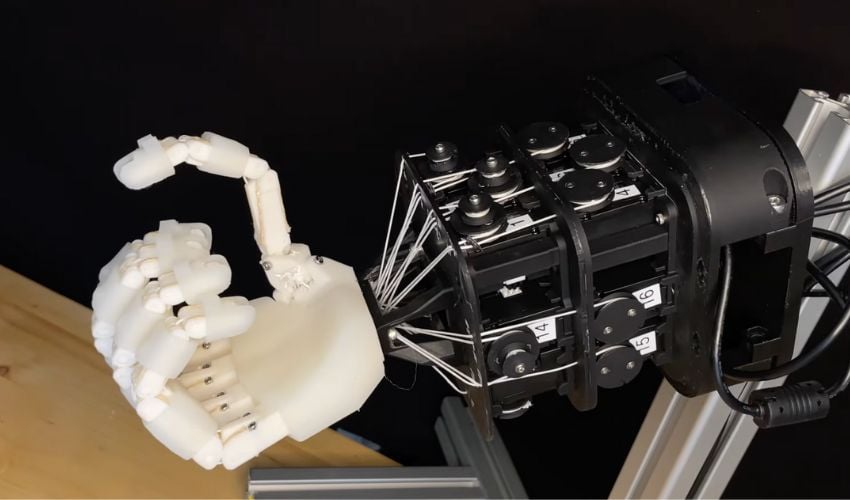 NewsResearchers Develop 3D Printed Biomimetic ‘Faive Hand’The synergy between additive manufacturing and the medical field is significantly growing. From crafting 3D printed blood vessels and implants to fabricating medication in pill form, these applications are expanding and causing a transformative shift in the medical sector. Throug
 Software3DEXPERIENCE Make, Dassault Systèmes’ on-demand AM platformAdditive manufacturing is revolutionising the industry by leading a real change in production methods: relocation of manufacturing resources, gains in terms of flexibility for the production of prototypes and small series in-house, reduction in lead times and costs, etc. However,
 News3D Printing Enables Customization in Packaging IndustryHaving penetrated numerous industries, additive manufacturing keeps bringing more and more possibilities to the companies that hurry to embrace this innovative technology. Marchesini Group S.p.A is among the ones who have taken advantage of 3D printing and is now reaping…
 NewsReinforcement of PLA For 3D Printing Using Plant WasteA recent study from an international group of researchers suggests that pineapple leaf fiber (PALF) could be used to reinforce polylactic acid (PLA). They tested two types of PALF (raw, and alkali-treated) combined with PLA, and results showed better ductility…