News
Researchers Develop More Nutritional and Appetising Method of 3D Printing Vegetables
Singaporean researchers have developed a novel method of 3D printing vegetables using food hydrocolloids. Previous three-dimensional food printing (3DFP) methods have largely relied on freeze-dried vegetable powders. This method, however, is centred around the use of fresh and fr
- 3 min read
- News
- Six more stories
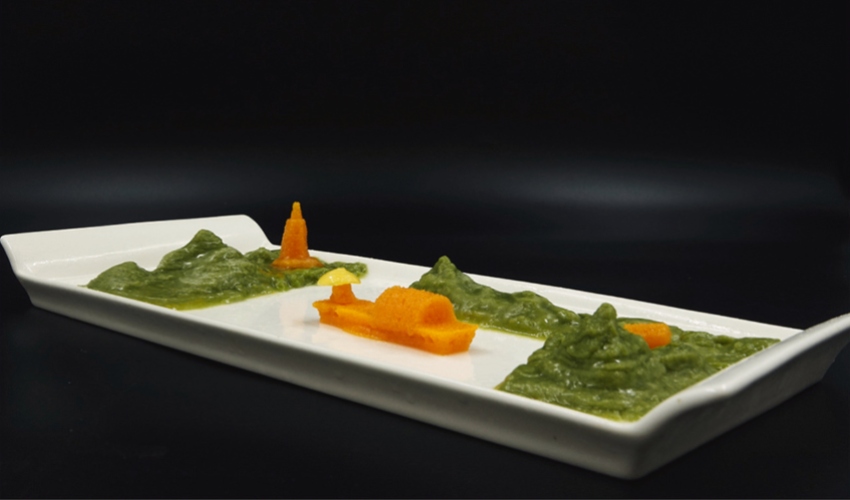
Singaporean researchers have developed a novel method of 3D printing vegetables using food hydrocolloids. Previous three-dimensional food printing (3DFP) methods have largely relied on freeze-dried vegetable powders. This method, however, is centred around the use of fresh and frozen vegetables to create “food inks” for 3D printers. The advantage of using fresh and frozen, rather than dried vegetables, is that it better preserves their nutrition and flavour. Additionally, this novel method of 3D printing food is cheaper than the majority of existing methods.
This discovery was the result of a collaboration between Nanyang Technological University, Singapore (NTU Singapore), Singapore University of Technology and Design (SUTD) and Khoo Teck Puat Hospital (KTPH). The research was targeted toward helping people with dysphagia. Dysphagia describes difficulty swallowing. This is a commonly experienced issue for elderly people and people suffering from debilitating illnesses. People suffering from dysphagia are confined to foods that are soft and safe to swallow. Therefore, they either require a restrictive diet, or food that has undergone textural modifications. In order to prevent malnutrition foods should also be visually pleasing to encourage a greater uptake.
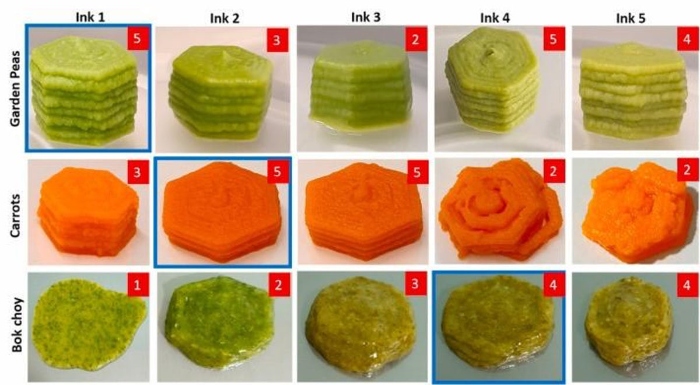
Researchers experimented with different levels of hydrocolloids to optimise the taste, texture and printability of the vegetable food inks.*
A hydrocolloid is a particle, or colloid, which has been mixed in water, or hydrated. Hydrocolloids are responsible for providing several common foods with the right viscosity, texture or structure. Traditionally, the powders used in food inks contain high levels of food additives, particularly hydrocolloids. While these are useful for stabilising the ink and making the printing process easier, a high concentration of hydrocolloids changes several aspects of the food, including the smell, taste and texture. This often causes the food to become considerably less appetising, which in turn can act as a deterrent and result in those suffering from dysphagia to reduce their food consumption, and in some cases even become malnourished. The research team thus wanted to find a way to limit the detrimental effects of hydrocolloids. They experimented with different levels of hydrocolloids in order to find the minimum amount that would still render the inks printable.
More from the desk
Six other notes from the rest of the bench.
 NewsAre 3D printed helmets becoming the norm?In the world of sports, additive manufacturing technologies can offer many benefits to athletes. Sporting equipment can be custom-made, geometrically more complex and made from smarter materials. Over time, manufacturers have understood the benefits of integrating 3D printing pie
 NewsThe Personalities Who Shaped the Additive Manufacturing Market in 2024As we approach the end of the year, it’s time to highlight the personalities who have shaped the 3D printing industry over the course of 2024. Whether leaders of major companies, innovators or researchers, these figures have helped transform the…
 NewsThe State of 3D Printing 2017, the maturing 3D printing marketThis week, 3D printing service company, Sculpteo, unveiled their third edition of “The State of 3D Printing 2017”. This report delves into the 3D printing industry, following the trends, strategies and insights, to see just how much the world of…
 ApplicationsBreakthrough in the Treatment of Burn and Cancer Patients with 3D Printed Wound DressingsAdditive manufacturing is making significant strides in the medical industry, revolutionizing the production of prostheses, implants, and surgical planning. In a notable breakthrough, researchers at the University of Waterloo have utilized 3D printing technology to address the ne
 MaterialsAll You Need to Know About Polypropylene (PP) for 3D PrintingToday’s additive manufacturing sector is characterized by a wide variety of materials, from plastics and metals to ceramics and concrete. If we look at the family of polymers, the diversity is great, with many thermoplastics that are more or less…
 PrintersThe Metal 3D Printer Manufacturers From Around the WorldMetal additive manufacturing encompasses a whole range of processes that are becoming increasingly popular with manufacturers. For several years now, industry giants have been equipping themselves with solutions to produce high-performance, lighter, customized parts that consume