News
Are 3D printed helmets becoming the norm?
In the world of sports, additive manufacturing technologies can offer many benefits to athletes. Sporting equipment can be custom-made, geometrically more complex and made from smarter materials. Over time, manufacturers have understood the benefits of integrating 3D printing pie
- 3 min read
- News
- Six more stories
In the world of sports, additive manufacturing technologies can offer many benefits to athletes. Sporting equipment can be custom-made, geometrically more complex and made from smarter materials. Over time, manufacturers have understood the benefits of integrating 3D printing pieces in their equipment as a means to offer more functionality and higher performance. This has been demonstrated by leading companies such as Adidas – the company developed 3D printed soles for its running shoes – or Riddell, which developed 3D printed liners for its helmets.
In fact, helmets are one of the sports equipment that have developed most in recent times. Riddell, HEXR, and Kupol, have all integrated additive manufacturing to their design process. The companies have explained before that one of the key reasons for adoption is the great amount of protection that can be added. For example, HEXR creates helmets that have a 3D printed curved honeycomb structure made from PA 11 that can absorb shocks much more effectively. The structure is perfectly adapted to the wearer’s head because it is modeled according to its shape. In the case of Riddell, the helmet liners are made using Carbon technology, which enables elastomer lattice structures – known to handle high impact shocks very well – to be 3D printed and customized to fit an athlete’s head perfectly.
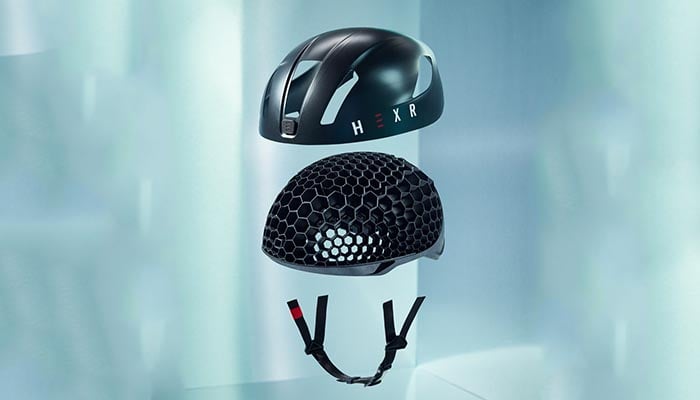
HEXR creates helmets that have a 3D printed curved honeycomb structure | Credits: HEXR
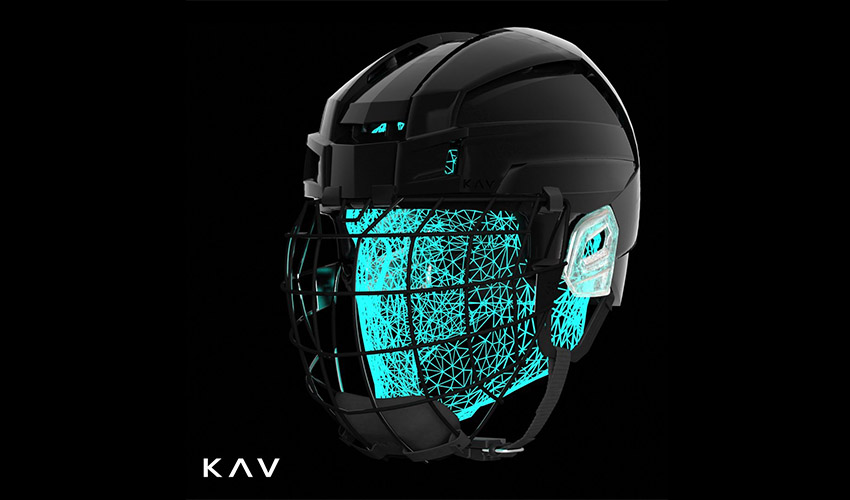
KAV, a startup based in California, manufactures helmets for hockey players, and uses 3D printing technologies too. Just like other sports companies, its mission is to provide protective equipment that is also high performing. It decided to use 3D printing as part of its design workflow and manufacturing process after identifying the lack of personalization and size variation in traditional hockey helmets. However, KAV also aims to make its helmets accessible to most, and for this reason it uses FDM technology. In the case of Riddell for example, using Carbon’s CLIP technology, which is similar to SLA, is expensive.
More from the desk
Six other notes from the rest of the bench.
 ApplicationsCould 3D Printed Food Help People with Difficulty Swallowing?3D printed food is nothing new. Several companies, like Steakholder Foods and Forma Foods, have 3D printed meat and fish alternatives. Others have 3D printed chocolate and reconstituted fruits and vegetables. An international team of researchers at the University of…
 NewsPrinTracker; A system to identify 3D printers from the created 3D partAt the University of Buffalo in New York, a team of researchers developed a 3D printer identification system. This would be able to identify the machine at the origin of a particular 3D printed piece. The system is called PrinTracker,…
 ApplicationsRocket Lab launches rocket with a 3D printed engineJust over two years ago, the California based startup ‘Rocket Lab’ announced that they had developed the world’s first battery-powered rocket. This same Electron rocket is now here, and incorporates a 3D printed Rutherford engine with with the aim of…
 NewsTCT Asia 2025: Experience the Next Era of Additive Manufacturing at the Event!Industry events play a crucial role in advancing additive manufacturing by connecting innovators, showcasing breakthroughs, and fostering collaboration. As one of Asia’s leading AM exhibitions, TCT Asia 2025 will bring together experts, businesses, and cutting-edge technologies t
 SoftwareTop Additive Manufacturing Workflow Software SolutionsThe increasing integration of 3D printing across industries has brought about a pressing need: the effective management of diverse additive manufacturing workflows. In response, specialized Manufacturing Execution System (MES) software tailored for 3D printing has emerged. The pr
 Applications3D Technology Helps Battle Against Childhood CancerAt the INCLIVA Health Research Institute of the Hospital Clínico de Valencia in Spain, a research team has used 3D technology to learn about the behavior of certain tumors that cause childhood cancers. Specifically, they analyzed the application of digital…