News
MIT 3D Prints Water Filters Inspired by Manta Rays
Biology has long been a source of design inspiration—think of Leonardo da Vinci’s flying machine, a contraption with wings inspired by bats. Today, engineers continue the practice, often integrating models inspired by nature into 3D printed designs. In a new…
- 3 min read
- News
- Six more stories
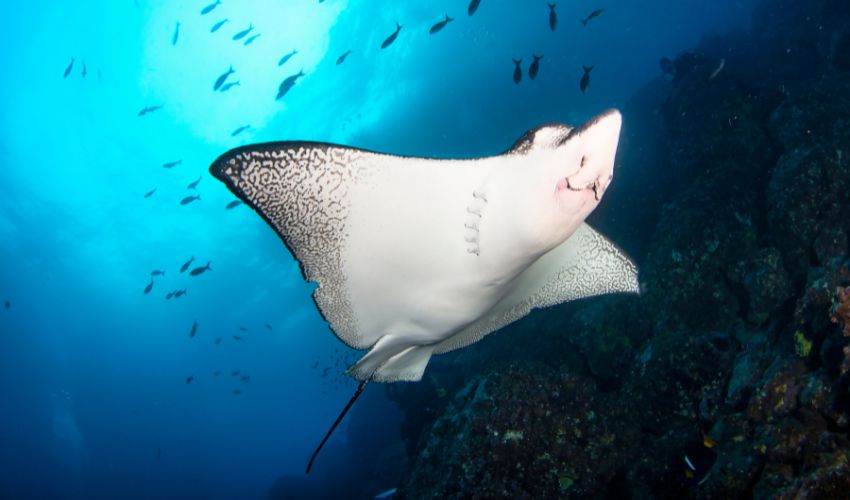
Biology has long been a source of design inspiration—think of Leonardo da Vinci’s flying machine, a contraption with wings inspired by bats. Today, engineers continue the practice, often integrating models inspired by nature into 3D printed designs. In a new project, the Massachusetts Institute of Technology (MIT) 3D printed water filters inspired by manta rays. By deriving design principles from the rays, which go beyond traditional filtration systems, the team created manta ray-inspired water filtration devices.
Manta rays are filter-feeders, which means they strain their food from mouthfuls of seawater. MIT engineers realized that one family of manta rays in particular—the mobula ray—filters its food in a way that could be adopted in industrial water filters. These aquatic creatures swim with their mouths open through plankton-rich regions of the ocean, catching plankton in their gullets while water streams into their mouths and out through their gills.
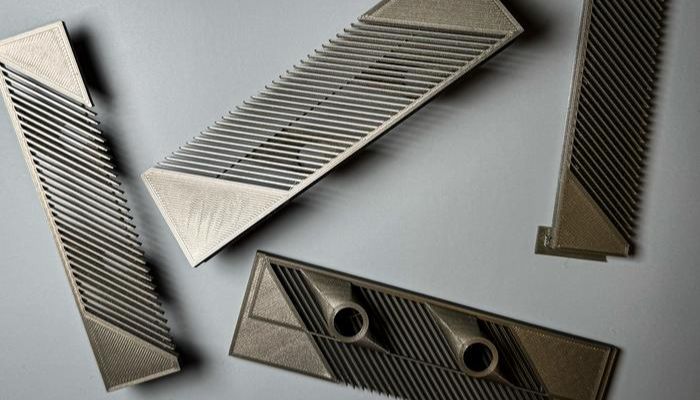
MIT’s 3D printed filtration devices inspired by mobula rays (Photo credits: Jennifer Chu, MIT)
So what stops plankton from flowing out of the manta’s mouth through the gills? The mobula ray’s mouth is lined on either side with comb-like structures called plates that draw water into the ray’s gills. The MIT team believes that due to the dimension of these plates, incoming plankton may bounce off of them, flowing deeper into the manta’s cavity. The gills also absorb oxygen from the outflowing water, allowing the ray to breathe while feeding. One of the authors of the study, Anette “Peko” Hosoi, explained, “We show that the mobula ray has evolved the geometry of these plates to be the perfect size to balance feeding and breathing.”
More from the desk
Six other notes from the rest of the bench.
 NewsOptomec’s 3D-Printed Electronics Solution Boosts 5G Signals By 100%Analysis from Bank of America posits that wireless infrastructure deployment cycles have traditionally lasted just about a decade. Meaning we are approaching 3 years into the current cycle, leaving more than seven years of 5G investment opportunities ahead. The use…
 NewsIndigenous Housing Project in Canada Uses 3D ConstructionIndigenous communities across Canada face one of the country’s most urgent housing crises. Although indigenous people comprise just 5% of Canada’s overall population, they account for 35% of individuals experiencing homelessness, according to a 2020-2022 government report. In res
 MaterialsA Closer Look at 3D Printing Materials: Ceramics and Organic MaterialOver the years, additive manufacturing has grown exponentially. And currently there are many different 3D printing technologies that allow objects to be built depositing of layers one by one. At first, printing materials were scarce, but gradually and through research…
 MaterialsFrom Crops to Concrete: Turning Corn Waste Into 3D-Printed Construction MaterialThe promise of construction 3D printing has long focused on speed and automation. Increasingly, a new advantage is taking center stage. Instead of standardized, carbon-heavy cement, researchers are exploring bio-based and locally sourced alternatives. The Mexico-based collective
  ApplicationsA Network of 3D-Printed Blood Vessels to Facilitate TransplantsAt the Israel Institute of Technology, Technion, scientists have created a network of 3D-printed blood vessels that would be able to supply the necessary amount of blood to an implanted tissue. Still in the research stage, this project could have…
 MaterialsWhat Are the Characteristics of Alumina in 3D Printing?Alumina, also known as aluminum oxide, is a technical ceramic material that occurs naturally in bauxite, a rock that also contains iron oxide. Bauxite is typically purified using Bayer’s process, which extracts a white powder that can then be transformed…