News
Used cooking oil from McDonald’s is transformed into 3D printing resin
At the University of Toronto, a team of researchers has recovered used cooking oil from a local McDonald’s and turned it into a high-resolution biodegradable 3D printing resin. For one litre of used oil, they obtained 420 mL (14 oz)…
- 3 min read
- News
- Six more stories
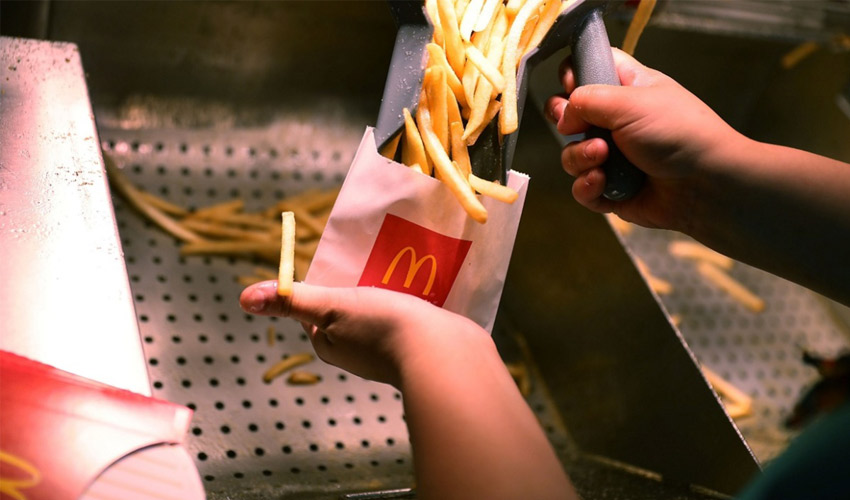
At the University of Toronto, a team of researchers has recovered used cooking oil from a local McDonald’s and turned it into a high-resolution biodegradable 3D printing resin. For one litre of used oil, they obtained 420 mL (14 oz) of liquid resin which they used to 3D print several butterflies. The resin they created did not crumble or melt above room temperature. This project is a good example of how 3D printing technologies can be used to give value to our food waste.
Apart from the fact that it is far from healthy, frying oil has some environmental impacts too, especially after it’s been used to fry. Today, it is thrown down our sinks, causing clogged pipes due to the accumulation of grease. However, there are initiatives to recycle it. The fast food giant McDonald’s has committed to reusing its frying oil to create biofuel. A total of 35,000 litres (9,245 gallons) are processed each month, saving 420,000 litres (11,0950 gallons) of crude oil per year. The initiative began in India, where it has been a great success. Projects such as this one can attract more attention to these issues, often forgotten by consumers.
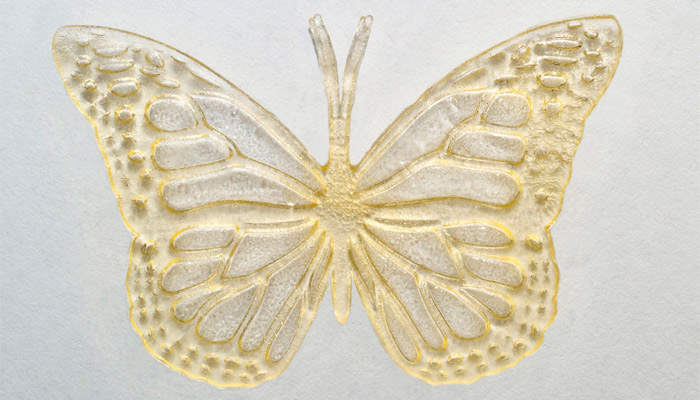
One of the 3D printed butterflies | Credits: Don Campbell
Creating McDonald’s 3D printing resin?
The University of Toronto professors behind this project started from a simple observation: most plastics are made from man-made synthetic components that are much more difficult for nature to assimilate. Andre Simpson, a professor in the university’s Department of Physical and Environmental Sciences, explains: “If plastics are a problem, it’s because nature has not evolved to process man-made chemicals. Because we use what is essentially a natural product – in this case fats from cooking oil – nature can handle them much better.“
More from the desk
Six other notes from the rest of the bench.
 Applications$1.8M in Funding Given to 3D Print ‘Organ-on-a-Chip’ to Eliminate Animal TestingIn pharmaceuticals, the development of new treatments involves a long series of tests and strict government scrutiny. The arduous journey from theory to drug approval is fraught with challenges. One of the biggest is undoubtedly the current testing methods that…
 MaterialsJohns Hopkins APL Looks at Machine Learning for LPBFResearchers at The Johns Hopkins University Applied Physics Laboratory (APL) have developed a new approach that integrates 3D printing with machine learning, specifically for laser powder bed fusion (LPBF). Essentially, the model allows them to create simulations useful for verif
 NewsMeet McLaren’s New Artura Hybrid Supercar with 3D Printed CoresA few days ago, luxury carmaker McLaren introduced its latest concept: its first high-performance hybrid supercar, the McLaren Artura. Engineered to combine technology, design and unmatched performance, the hybrid car is a compendium of innovation, and of course, additive manufac
 News3D Printed Eiffel Tower Made From Ocean Waste Marks Olympics in CzechiaOn Friday, July 26th, 2024, the Paris 2024 Summer Olympic Games officially opened! And since then we have seen incredible feats of prowess from athletes the world over in about 40 sports. But of course, not everyone can make it…
 ApplicationsWorld’s First 3D Printed Water Taxi Is Also Largest 3D Printed BoatFrom kayaks to super yachts, additive manufacturing has been making waves in the maritime sector. Though 3D printing is often discussed for its usefulness in helping make parts while at sea or for making parts that have been disrupted by…
 News3D Printing Startups of the Year 2017Every month, 3Dnatives interviews 3D printing startups that are working on something innovative in the 3D printing sector. These startups range from manufacturer Markforged, to metal 3D printer manufacturer Desktop Metal, to bio-printing firm Aspect Biosystems. We summarised the