Printers
Integrating FGF Technology to Meet Industrial Needs
Large-format additive manufacturing (LFAM) by direct pellet extrusion, also called FGF (Fused Granular Fabrication), is a technology that until recently required not only a large investment, but was also not easy to make profitable and presented certain limitations in terms&helli
- 3 min read
- Printers
- Six more stories
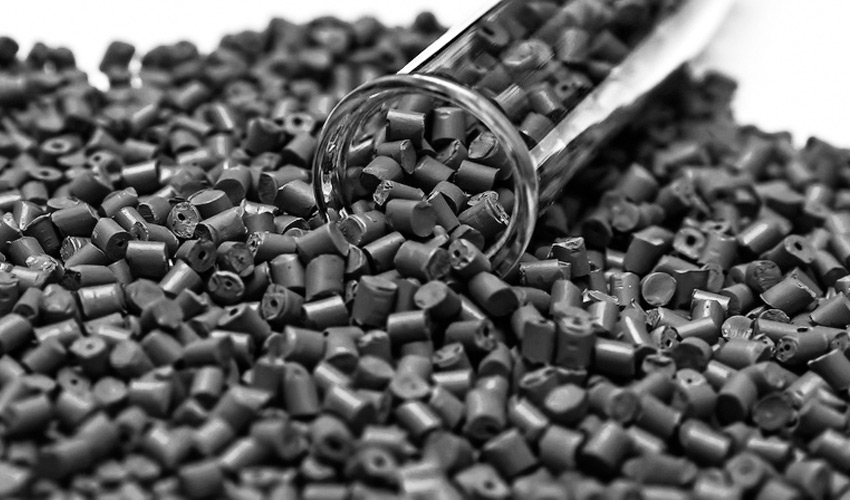
Large-format additive manufacturing (LFAM) by direct pellet extrusion, also called FGF (Fused Granular Fabrication), is a technology that until recently required not only a large investment, but was also not easy to make profitable and presented certain limitations in terms of design and finishing. This production method consists of depositing molten plastic pellets on a printing bed layer by layer to gradually create the 3D object. To do this, the plastic pellets are fed to the extrusion head, which heats and presses them until a homogeneous molten plastic mass is obtained. In this sense, higher system performance results in higher build speed but a lower surface finish, and vice versa.
Discovery 3D Printers, the additive manufacturing division of CNC Bárcenas, specializes in the development of professional solutions based on FGF technology. According to its CEO, Francisco Bárcenas: “The growing and diverse market demand has driven us to offer increasingly customized solutions that are also more economical, so that more customers can access this technology”. In fact, the company, which is located in Valdepeñas (Ciudad Real, Spain), launched the Super Discovery 3D Printer in 2016, a machine with FGF additive manufacturing technology pioneer in Europe. The machine had an initial volume of 3.25m3 (1.3×2.5x1m), and its first customer was Navantia, as part of its “Shipyard 4.0” strategy.
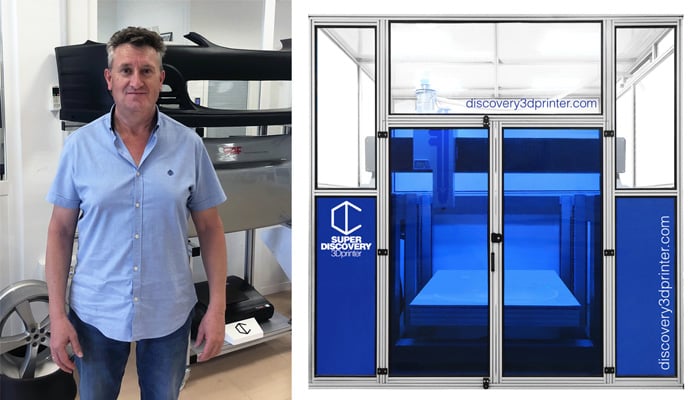
On the left, Francisco Bárcenas. On the right, the Super Discovery 3D Printer. (Photo Credits: Discovery 3D Printers)
Seeing the needs that existed in the market and the requests by some customers, in 2019 the company opted to develop models of higher production (up to 10kg per hour) and volume, reaching 11.25m3. Through this, it has managed to create the largest 3D printer in Europe to date. During this period, Francisco explains: “Several of our customers mentioned to us some important challenges related to the finishing of some final parts and tooling – such as molds – that were carried out by machining processes. We have been manufacturing CNC milling machines since 2009, and we considered merging both additive and subtractive manufacturing technologies”.
More from the desk
Six other notes from the rest of the bench.
 ApplicationsRubble to Rockets: Utilizing Scrap Metal and Machine Learning for On-Demand 3D PrintingLast week, we explored how the Defense Advanced Research Projects Agency (DARPA) is pushing the boundaries of additive manufacturing, and the momentum is not slowing down. On June 4th, the Worcester Polytechnic Institute (WPI) announced a $6.3 million grant from…
 NewsADDLAB, the 3D printing laboratory at the heart of Decathlon innovationA few days ago, the French brand Decathlon inaugurated its first store concept of the future, which integrates an ADDLAB laboratory and is located in Villeneuve d’Ascq, the north of France. Called Decathlon DX, the 800 square meter store shows…
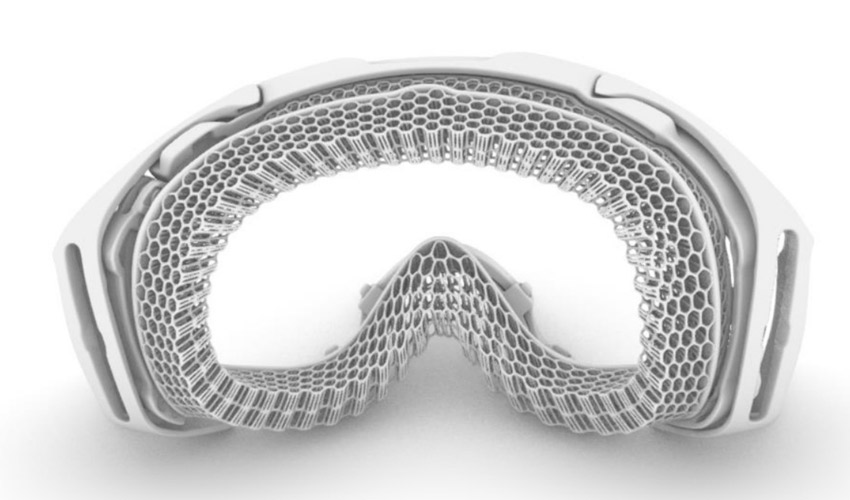 NewsOECHSLER Rethinks Ski Mask Design with 3D printingIncreasingly, companies are seeing the benefits of using 3D printing in sports. Another company has entered the ring. German company OECHSLER, which specializes in the development and manufacture of high-tech products and systems, recently turned its attention to the design&helli
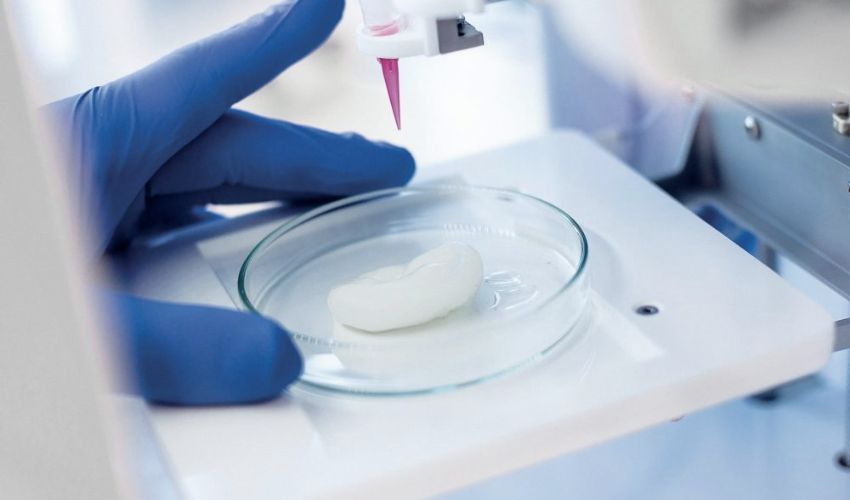 ApplicationsUsing Cancer Cells And Computer Modeling, Researchers Have Optimized 3D BioprintingResearchers in a multi-university collaboration between the University of Waterloo, Canada, University of Swansea, and University of St Andrews, both UK, have conducted experiments on 3D bioprinted cancer cells over a period of 11 days, to compare to results from…
 SoftwarePrint&Go Acquires Astroprint in Order to Improve User ExperienceThe additive manufacturing market is constantly changing. This can be shown by the fact that one of the most prominent trends in recent years includes the merging of organizations and the signing of collaboration agreements and even the purchase of…
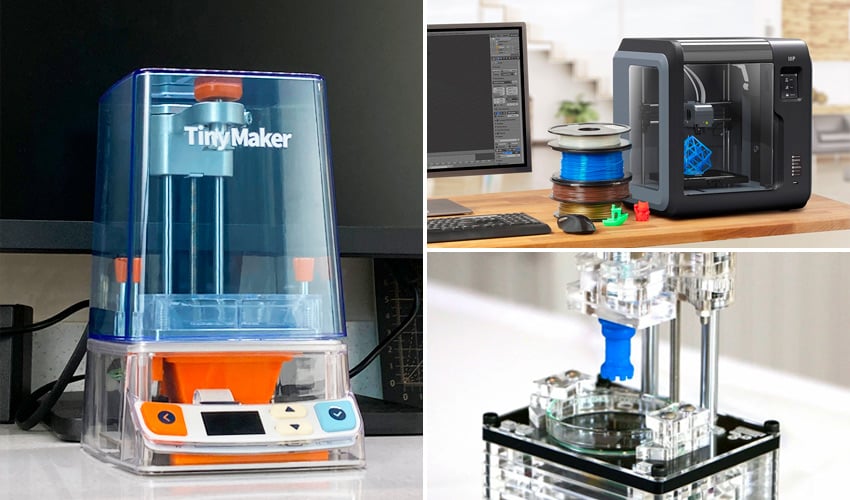 PrintersWhat Mini 3D Printers Are Available on the Market in 2023?3D printing is becoming increasingly popular. Not only is additive manufacturing on the rise at an industrial level, but many are also trying their hand at 3D printing at home. The problem with this is that some printers are very…