News
Injection 3D Concrete Printing: Are We Moving Towards the Manufacturing of More Complex Structures?
In Germany, researchers from the Technical University of Braunschweig are working on the development of a new concrete 3D printing process. Instead of currently available technologies, they are relying instead on injection to design more complex shapes. To accomplish this,&hellip
- 3 min read
- News
- Six more stories
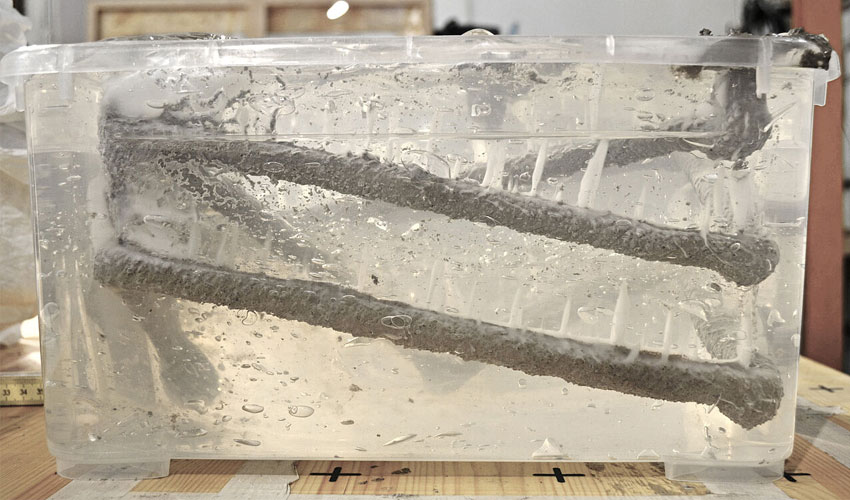
In Germany, researchers from the Technical University of Braunschweig are working on the development of a new concrete 3D printing process. Instead of currently available technologies, they are relying instead on injection to design more complex shapes. To accomplish this, the reasearchers are injecting a fine-grained concrete into a non-hardening carrier liquid (a suspension of crushed limestone to be exact). The latter acts as a matrix that supports the structure; injection 3D concrete printing could thus make it possible to imagine intricate designs which would be impossible to produce otherwise.
When it comes to 3D concrete printing, we often think of extrusion: a robotic arm deposits successive layers of material until the final structure is obtained. This is the most widespread process to date. However, some players are interested in using injection 3D concrete printing, which consists of depositing a fluid material in another material with specific properties. The first material is maintained in a stable way in the second one, which allows users to create more complex structures. For example, French start-up Soliquid, which has developed a process for printing concrete parts in a gel matrix. One of the co-founders, Amaury Thomas, is a co-author of this study.
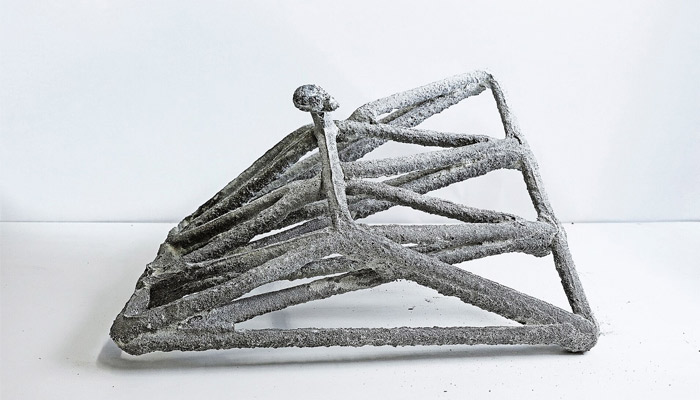
Injection concrete 3D printing would allow for more complex designs (photo credit: TU Braunschweig)
In their work, they explain that Injection 3D Concrete Printing (I3DCP) could be classified into three categories: injection of a fine-grained concrete into a non-hardening carrier liquid; injection of a non-hardening suspension into a fine-grained concrete; injection of a fine-grained concrete with specific properties into concrete with different properties. The team chose the first category and therefore injected their material into a liquid, in this case into ground limestone.
More from the desk
Six other notes from the rest of the bench.
 NewsAll You Need to Know About Cold Spray Additive ManufacturingThe various additive manufacturing technologies available today can seem endless, though they often fall into one of about seven categories, but not all of them. Take, for example, cold spray additive manufacturing. Cold spray is a technique which involves the…
 NewsTop 5: Choosing A 3D Printing Material With Dassault SystemesHello everyone, and welcome back to our Top 5 of the week! We have an exciting selection of 3D printing video content for you as always, from Dassault Systemes and material choices to the use of additive manufacturing for consumer…
 MaterialsBIO INX Launches New, Ready-to-Print Bioink Resin for DLP 3D PrintingThis week, the Belgian startup BIO INX launched a game-changing new material: BIORES INX, a gelatin-based bioink resin developed for digital light processing (DLP) 3D printing. Bioprinting with DLP has been limited because of the lack of biocompatible and biodegradable…
 NewsApple 3D Prints the Hinge for Its First Foldable Phone: The iPhone DuoLast week, Apple unveiled the iPhone Duo, its first foldable phone. Many people online are comparing it with Samsung’s Galaxy Z Fold8. For the additive manufacturing sector, however, the main development lies in a critical foldable-phone part: the hinge. The…
 GuidesVOJD Studios combines 3D printing & craftsmanship of fashion & luxuryAdditive manufacturing allows for a high level of customisation, which is harder to achieve with traditional design methods. Some interesting advantages have especially show up in the medical sector. However also in jewellery and fashion, where end consumers are looking for tailo
 GuidesInside the World’s First Successful 3D Bioprinted Human Cornea TransplantIn October 2025, Rambam Health Care Campus in Haifa, Israel, marked a world first with the successful transplantation of a fully 3D bioprinted corneal implant, created entirely in the lab from living human cells. Developed by Precise Bio, the implant was…