News
HyFAM Combines Additive and Formative Manufacturing to Create Complex Parts 20 Times Faster
What if it were possible to combine additive and formative manufacturing in a single system? While many machines can change tool heads, offering hybrid production, a team of researchers from the Johns Hopkins Whiting School of Engineering has developed a…
- 3 min read
- News
- Six more stories
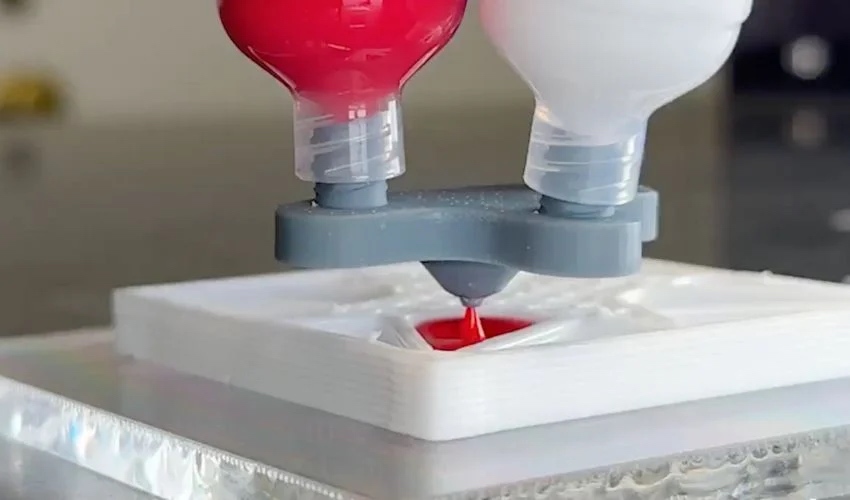
What if it were possible to combine additive and formative manufacturing in a single system? While many machines can change tool heads, offering hybrid production, a team of researchers from the Johns Hopkins Whiting School of Engineering has developed a method that combines quality and speed. Called Hybrid Formative-Additive Manufacturing (HyFAM), this hybrid approach uses an extrusion system to 3D print complex geometries that can then be filled by molding or casting. The marriage of these two processes is particularly advantageous: it is possible to create complex shapes with greater detail where required, while at the same time being able to fill less precise areas more efficiently.
As we all know, 3D printing still faces a number of obstacles, including speed and defects such as inefficient filling, warping and internal voids. Indeed, while additive manufacturing offers a high level of detail, this is not always required throughout the part. Team member Nathan Brown explains: “Additive manufacturing offers significant detail, but when you use a small nozzle to achieve it, the entire process slows down. This becomes a real hinderance [sic] in parts with large internal features and widely-varying feature sizes.”
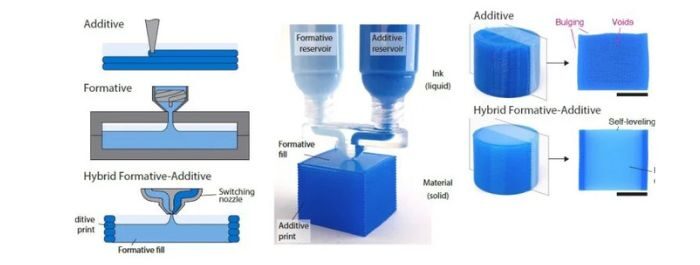
The HyFAM method combines the advantages of additive manufacturing with those of formative manufacturing
The researchers, led by Professor Jochen Mueller, have therefore developed an extrusion system with two reservoirs: the first is used to deposit the desired material layer by layer, like an FDM 3D printer. The second is used to fill the model created with another material. This filling stage can be used for one, several or all layers.
More from the desk
Six other notes from the rest of the bench.
 Applications3D Printed Devices for Sleep Apnea TreatmentWhen someone has sleep apnoea, their breathing stops repeatedly during sleep. Physiologically speaking, the front wall of the pharynx falls onto the back wall and closes the airways. Then, the body reacts to this emergency with an adrenaline rush, causing…
 NewsVivobarefoot 3D Prints Customized, Sustainable Shoes at the Click of a ButtonDid you know that 25 billion pairs of shoes are produced every year, with around a quarter of which only last a year and then end up in landfill? Indeed, it is certainly no secret that the fashion industry is…
 NewsWill Adidas Launch a Completely 3D Printed Sports Shoe With “Climamog”?New launches are often accompanied by a mixture of excitement and uncertainty. In this case, it’s the uncertainty that prevails, fueling a good deal of speculation. On Friday, September 13, photographer Tyler Mansour posted intriguing images on social networks of…
 GuidesForust Corporation designs interiors with 3D printed woodForust Corporation is a wood technology company that leverages 3D printing to create beautiful and sustainable interior design pieces. The company’s goal is to manufacture with wood but without damaging our planet’s ecosystem. Forust Corp. was created by the founders of&hel
 NewsBMW Supports Olympic Athletes With 3D PrintingSince the early 1990s, BMW has been using 3D printing technology to design its vehicles more efficiently, faster and lighter. Starting from the idea of a car or motorcycle to prototypes and finished spare parts – AM offers a wide…
 ApplicationsScientists Create New Technique for 3D Printing in MicrogravitySpace has always fascinated humanity, and the colonization of Mars and the Moon remains a major goal. To achieve this, it is necessary to process local resources under the conditions present there. 3D printing shows impressive potential in this area,…