News
How does a concrete 3D printer work?
In recent years the role of additive manufacturing in the construction industry has become increasingly important. In particular, concrete 3D printers have been continuously gaining popularity among architects and construction firms. After water, concrete is the most widely used
- 3 min read
- News
- Six more stories
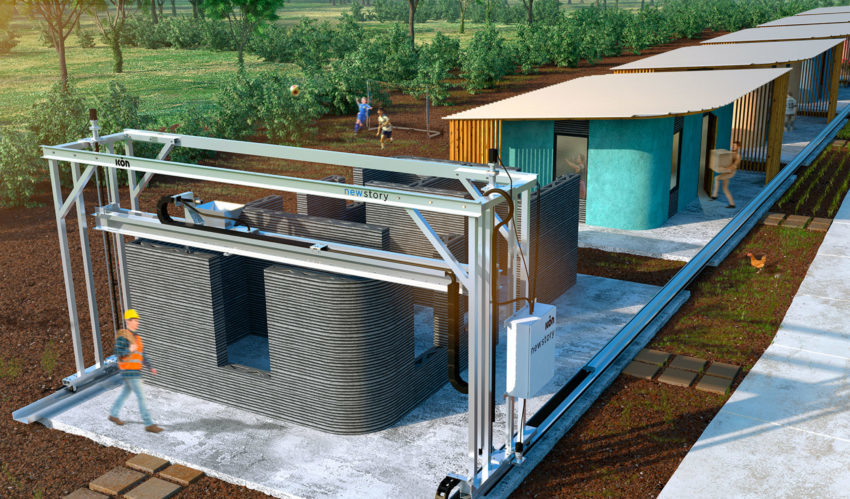
In recent years the role of additive manufacturing in the construction industry has become increasingly important. In particular, concrete 3D printers have been continuously gaining popularity among architects and construction firms. After water, concrete is the most widely used substance in the world. Concrete is a composite material that consists of water, cementitious compound, and aggregate (fine and coarse particles of sand, gravel, crushed stone, and similar substances), all of which exist in abundance. As such concrete is an inexpensive, and thus very popular, material. However, concrete 3D printers themselves are expensive. Machines designed for construction tend to be priced anywhere from around $180k to over $1M. Nonetheless, there are several benefits of using a concrete 3D printer rather than traditional manufacturing methods. It is faster, cheaper, safer, and more efficient. A concrete 3D printer not only produces minimal waste, but also significantly reduces the number of active participants needed on site as well as the length of supply chains. Moreover, using a concrete 3D printer, construction can be completed to a significantly higher degree of resilience and geometric complexity.
A standard concrete 3D printer functions very similarly to a standard FDM printer. This is primarily because both technologies are based on material extrusion. As such their processes strongly resemble each other: first a digital 3D model is created using a 3D modelling software; the model is then sliced and translated into G-Code; the G-Code then guides the printhead which deposits material pumped from a cement mixer in layers until the final piece is produced. A typical concrete 3D printer is designed to additively manufacture parts though material extrusion, consisting of a robotic arm, with one end attached to the printhead, and the other either to a gantry or crane-like robotic arm system. Depending on the type of concrete 3D printer its design, ability, and process varies. Each has distinct benefits and drawbacks depending on the desired application. The build volume, print-resolution, practicality, and efficiency of a concrete 3D printer will vary depending on its system, technology, manufacturer, and intended applications.
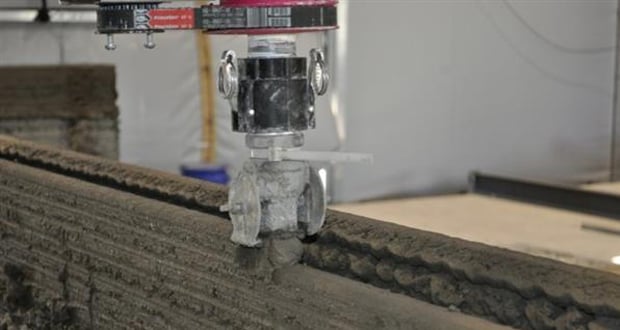
Concrete 3D printing saves cost and time (Photo Credit: Mike Jazdyk)
Gantry Concrete 3D Printer
The term gantry comes from the gantry-style overhead structure which supports the printer. While this kind of concrete 3D printer is a popular choice for commercial construction projects, they are rarely used for smaller projects, largely due to the sheer size and associated limited portability, as well as the technical effort required to set up and dismantle them. This type of concrete 3D printer typically operates on a cartesian coordination system consisting of x, y and z axes. These axes are defined by the rails and beams of the supporting structure. The x-axis corresponds to the length of the rails that move the printer forwards and backwards, while the y-axis corresponds to the length of the rail carrying the printhead and connecting the pillars, which in turn are defined by the z-axis and move up and down.
More from the desk
Six other notes from the rest of the bench.
 NewsDragons brought back to life thanks to 3D technologiesTake a tour of London this summer and visit Kew Gardens, where you can admire The Great Pagoda, an octagonal ten-storey tower designed in 1762 and recently restored with 3D technology. It has just reopened to the public today: the…
 NewsFormula 1 releases new range of 3D printed perfumesFormula 1 is releasing a new collection of fragrances, the F1 Fragrances Engineered Collection, which includes a range of five luxury scents. Back in 2019, Formula 1 had launched its first line of fragrances using metal 3D printing technology, in…
 NewsA recap of the TCT show 2018 highlightsThis year’s TCT show 2018 went down in September bringing together 10.000 professionals, from 60 different countries across 20 key industries from the automotive to healthcare etc. Over the 3 day event in Birmingham the visitors got to experience various…
 NewsThe 3D Printed Hana Table Combines Originality and SustainabilityThe use of 3D printing in interior design is gaining popularity. One company in particular that is leading in this field is Aectual. Based in the Netherlands, the organization’s mission is to extend the life cycle of products, increasing their…
 News3D Printed Facade Becomes Eye-Catching Part of Amsterdam Shopping StreetIn the Netherlands, traditional craftsmanship has met innovative technology in an unexpected place. Rotterdam-based studio RAP has taken on the task of designing a façade for a boutique in Amsterdam. And this is not just any boutique, but a luxury…
 News3Dsimo multi-functional; from creative toys to professional toolsThe European producer 3Dsimo entered the market back in 2013 and specialises in their 3Dsimo multi-functional tools. The company is behind the world’s first multi-material 3D pen and have kept developing their products ever since. Now they cover categories and…