Software
How Can ChatGPT Facilitate Design in 3D Printing?
As we know, the use of artificial intelligence in our daily lives is becoming more and more accessible. In fact, more and more companies are developing AI software for all kinds of fields and utilities. One of the most popular…
- 3 min read
- Software
- Six more stories
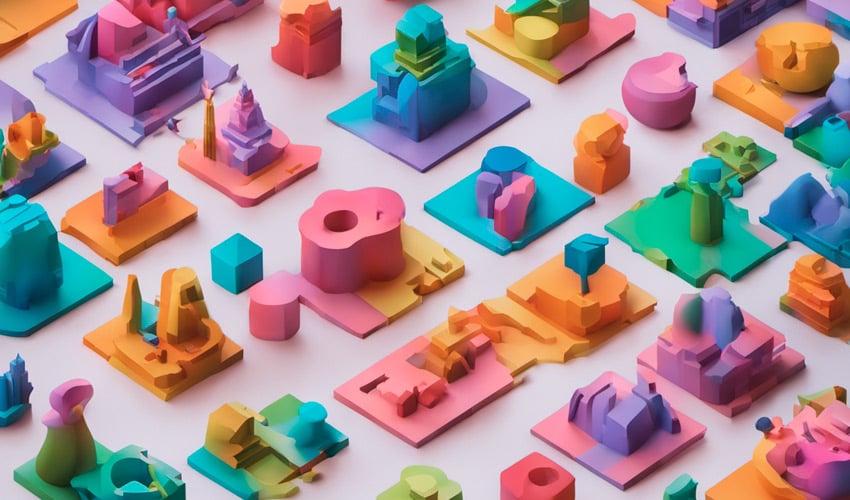
As we know, the use of artificial intelligence in our daily lives is becoming more and more accessible. In fact, more and more companies are developing AI software for all kinds of fields and utilities. One of the most popular is ChatGPT, an advanced AI program that is able to answer questions and solve problems in a human-like manner. Its development is based on a massive set of text data that allows it to formulate direct and useful answers naturally and in a matter of seconds. In addition, one of its capabilities includes the generation of codes based on specific requests. This is why ChatGPT can also be implemented in the 3D printing sector for various applications, such as the design of 3D models.
With these technological advances, AI is opening the door to a multitude of new applications in all kinds of industries. In the case of additive manufacturing, it is interesting to learn how it can be used to generate STL files to aid the design process. To do this, ChatGPT uses a form of input called a prompt, which is the instruction provided by the user. As expected, the quality of the output will depend on the information provided and its degree of specification. Thus, the more context or additional information provided, the more optimal the response generated by ChatGPT will be, especially when creating 3D models. We took a look at how this process of combining two technologies – 3D printing and artificial intelligence – is carried out.
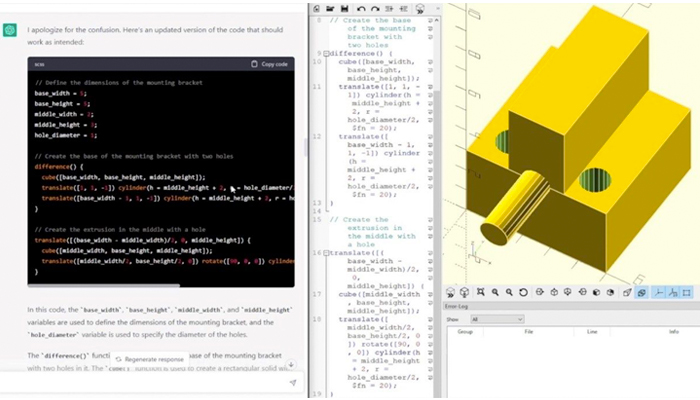
Example of a “prompt” provided to ChatGPT for the creation of a 3D model (photo credits: Raise3D)
ChatGPT and Design for 3D Printing
The first way to use ChatGPT in the design of 3D printing models is to formulate a prompt with the instruction to create an STL file. This type of file is universally used in additive manufacturing and is characterized by generating meshes based on triangular shapes. It is also a human-readable format if generated as ASCII .STL, facilitating the interpretation of ChatGPT output. When creating it using AI, patience will be required, as information will have to be added progressively to the program to achieve the optimal model. After several attempts and corrections, we will gradually obtain a more detailed result of the mesh. Something to keep in mind is that the program could stop at the point where it is generating a file that is too large. If that happens, just add “Continue” as an instruction and the software will continue from where it left off.
More from the desk
Six other notes from the rest of the bench.
 NewsTop 5: How Cold Spray Technology Offers Faster Additive ManufacturingHello everyone, and welcome to our top 5 videos of the week! As always, we have an exciting and educational select of 3D printing video content for you. This week’s range from cold spray technology for additive manufacturing, an interview…
 NewsStudy Suggests Benefits of 3D Bioprinting In Plant Cell ResearchA recent study from North Carolina State University experimented using 3D bioprinting to produce plant cells in order to assess the use of the method in biological research. They produced Arabidopsis- (thale cress; often used in genetic research) and soybean…
 ApplicationsLotus Theory 1 Features 3D Printed HeadrestsCar manufacturer Lotus Cars has just unveiled its new car, the Theory 1, a 1,000-horsepower concept car that is impressive for its low weight, design, and performance. It’s an experimental development that seeks to explore the possibilities and demonstrate the…
 ApplicationsRelativity Space’s Terran 1 Successfully Lifted Off But Did Not Reach OrbitA few years ago, we introduced you to the Terran 1, Relativity Space’s almost entirely 3D printed rocket. Built using directed energy deposition (DED) and powder bed fusion, this spacecraft was an industry first. Moreover, according to the manufacturer, it…
 Guides#3DStartup: Synteris Optimizes the 3D Printing of Technical Ceramics3D printing has revolutionized many industries thanks to its ability to create complex, customized geometries using a variety of materials. Among these, ceramics have emerged as a very attractive option due to their properties (high wear resistance, thermal stability, corrosion&h
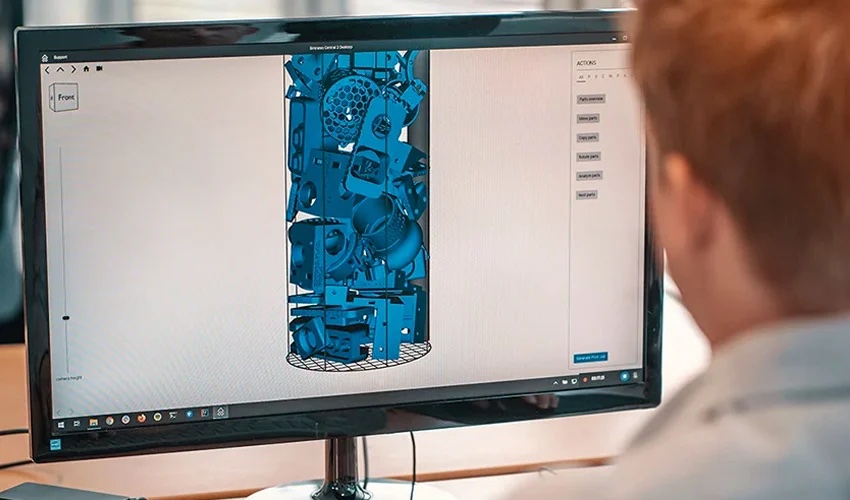 NewsNesting in 3D Printing Helps Optimize SpaceModeling is a key step in additive manufacturing, especially when it comes to the creation of complex parts. In the 3D printing sector, there are a number of CAD programs available for 3D printing. With a growing market, players in…