Applications
Harvard Researchers Develop Microbial Ink to 3D Print Living Materials
What if you were told that 3D printing is getting closer and closer to revolutionizing science? A team of researchers at Harvard University and Brigham and Women’s Hospital is rising to the challenge. Recently, they developed a microbial ink or…
- 3 min read
- Applications
- Six more stories
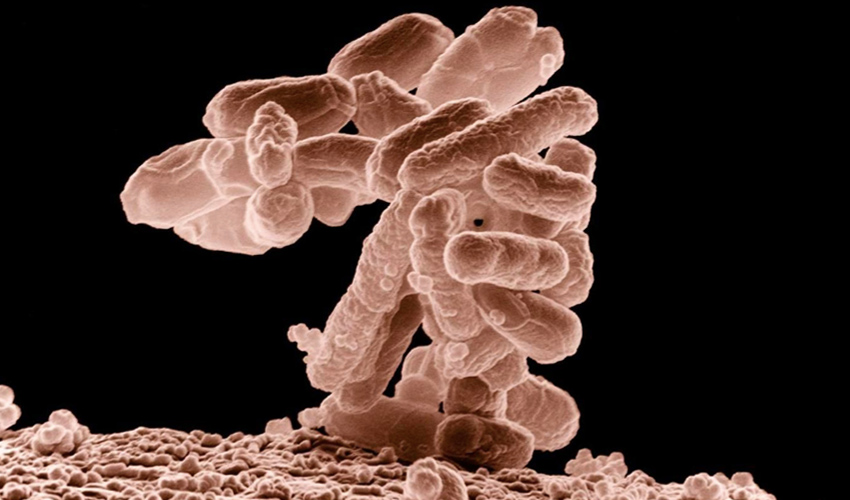
What if you were told that 3D printing is getting closer and closer to revolutionizing science? A team of researchers at Harvard University and Brigham and Women’s Hospital is rising to the challenge. Recently, they developed a microbial ink or hydrogel to 3D print living materials. According to the researchers, the innovative material would be able to release drugs or remove chemical contaminants from the environment. This could lead to a revolution in cancer research or advanced applications in outer space. The results of the project were published in the journal Nature Communications in the article, Programmable microbial ink for 3D printing of living materials produced from genetically engineered protein nanofibers by Duraj-Thatte et al., where they explained the development process that they carried out over several years, until they were able to demonstrate the effectiveness and opportunities offered by this technology in science.
Today we are witnessing a growing synergy between biology and materials engineering, where the implementation of additive manufacturing is also coming into play as a key tool. We have already seen the success story of the University of Colorado, which developed a 3D printable material capable of mimicking complex biological tissues. Or the scientists who created a novel bioink out of ulvan, a type of seaweed, that they believed would promote wound healing. This time, experts from Harvard University created programmable microbial inks from genetically modified protein nanofibers.
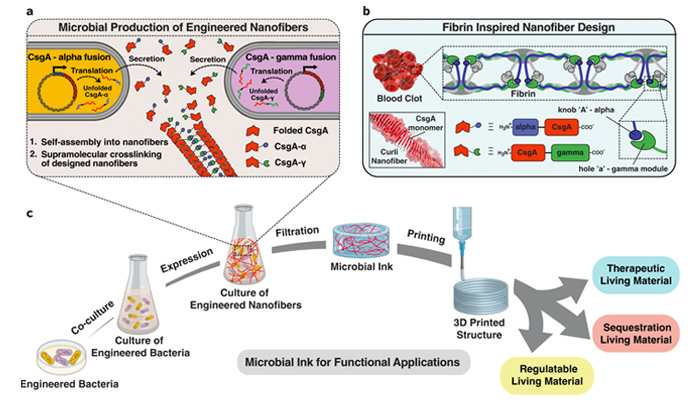
Photo Credits: Harvard University / Brigham and Women’s Hospital
Microbial Ink to 3D Print Living Materials
With the idea in mind, the researchers incorporated the bacteria Escherichia coli (also called E.coli) and modified protein nanofibers into the ink. E.coli is a bacterium belonging to the enterobacteria family, which is found in the microbiota of the gastrointestinal tract of homeothermic animals, as well as in humans. A mixture of alginate and E. coli was 3D printed on a calcium chloride surface. This is because the alginate molecules cross-link on this base to form a solidified gel. Regarding the fabrication process itself, in the published article the researchers commented, “Although inkjet printing, contact printing, screen printing, and lithographic techniques have been explored to print microbes, extrusion-based bioprinting has become one of the most widely used techniques due to its simplicity, compatibility with a variety of bioinks, and cost-effective instrumentation.”
More from the desk
Six other notes from the rest of the bench.
 NewsDora Goodman’s Open-Source 3D Printed CamerasDora Goodman is a Budapest-based company specialising in open-source 3D printed cameras. Goodman started redesigning cameras using wood as a hobby. A few years later, having found her vocation, Goodman quit her job and pursued her dream full time. The…
 NewsWhat Is Additive Manufacturing?Far from being a gadget or simply a trend, additive manufacturing is a technological revolution hailed as part of the fourth industrial revolution. As its name suggests, this process works by adding materials. Layers of materials are successively deposited on…
 NewsLas Vegas Raiders stadium torch, the world’s tallest 3D printed structure?Dimensional Innovations is a Kansas-based design, technology, and fabrication firm with a national presence. Using a large-scale additive manufacturing solution developed by Thermwood Corporation, Dimensional Innovations was able to build a 93 feet tall structure. Unveiled a coup
 NewsUpNano develops high-resolution desktop 3D printing for micro partsUpNano is a young company based in Vienna that has recently developed a high-resolution microscale 3D printing technology. Based on the 2-photon polymerization process (2PP), the new technique is capable of producing plastic parts with a volume ranging from 100…
 NewsMeasurement In Real Time: Researchers Develop 3D-Printed InsolesDid you know, the American Podiatric Medical Association (APMA) surveyed 1,000 US adults and found that 77% of Americans have experienced foot pain? Now, 3D-printed insoles are set to provide relief. The new development by researchers at the Swiss Federal…
 MaterialsADDITIV Metals World, the Virtual Event Dedicated to Metal Additive ManufacturingAfter the success of last year’s ADDITIV virtual events, which brought together thousands of additive manufacturing professionals, with key players in different industries, the leading virtual event platform for additive manufacturing is back once again. This time, we’