News
Formnext 2023: What Are the Major Trends in Additive Manufacturing?
Once again, it’s time for us to give you our thoughts on Formnext 2023. The show closed its doors last Friday, leaving behind thousands of hours of exchanges between professionals and manufacturers, dozens of product launches and announcements of new…
- 3 min read
- News
- Six more stories
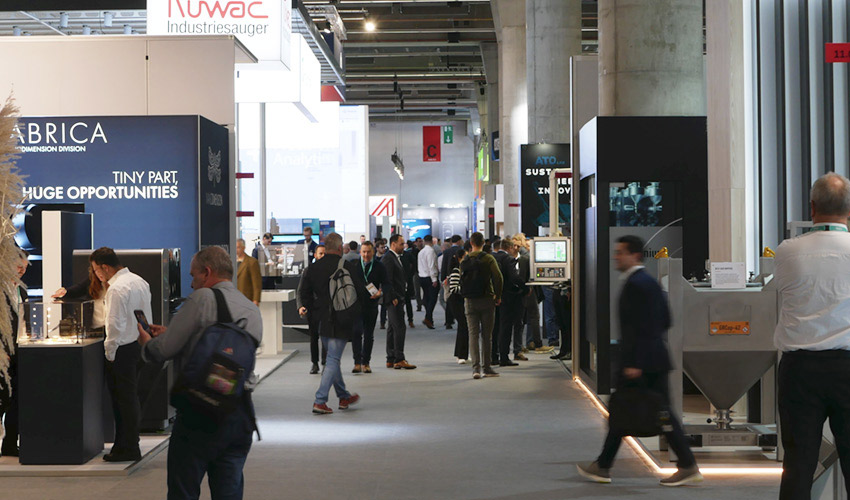
Once again, it’s time for us to give you our thoughts on Formnext 2023. The show closed its doors last Friday, leaving behind thousands of hours of exchanges between professionals and manufacturers, dozens of product launches and announcements of new partnerships, and hundreds of machines to be repacked. And what’s certain is that this year’s event once again could be deemed a success, reaching some of the pre-sanitary crisis figures despite the current geopolitical context. In total, 859 exhibitors answered the call including 60% international companies, addressing verticals such as medical, transport and defense. But what were the main trends at Formnext 2023? What were the main takeaways?
Compared to 2022, this year’s Formnext had more exhibitors – fifty to be precise. Moreover, there were 32,851 visitors to the show, an increase of 11.1% from last year. The four halls showcased numerous machines, particularly hybrid solutions. It’s clear that more and more manufacturers have taken the strategic step of combining additive manufacturing with machining or other more traditional manufacturing processes. We already knew this, but this Formnext confirmed the complementary nature of these means of production. The integration of additive manufacturing is taking place within a more global lens, and manufacturers are looking for all-in-one solutions. This is why machines capable of rapidly changing tool heads were more numerous, as were robotic arms.
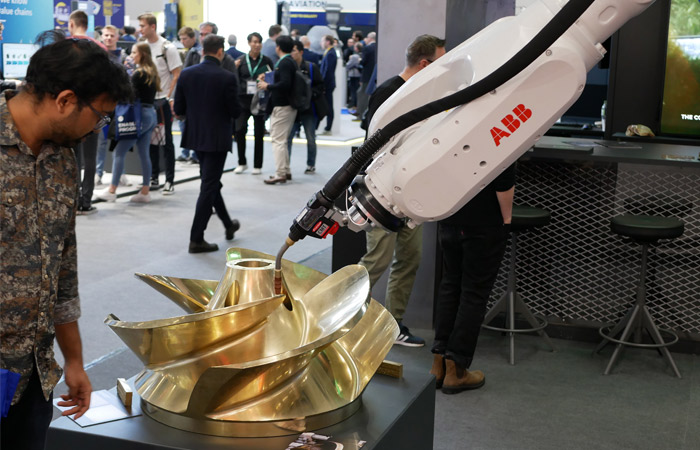
Robotic arms were in abundance this year
We also spotted a manual injection press: HoliMaker was presenting its HoliPress, a machine that melts plastic granules and injects them into your mold. It can be used with 3D-printed molds, demonstrating the complementary nature of the two manufacturing processes (a sentiment shown by many at the show as we saw more and more 3D printing applications for casting and molds), and is compatible with a very wide range of pellets. Furthermore, on the pellet side, we’ve seen a lot of buzz around pellet 3D printing this year, with a few more dedicated machine manufacturers than in previous editions.
More from the desk
Six other notes from the rest of the bench.
 ApplicationsIsraeli Doctors Have Made a Potential Medical Breakthrough for Brain Cancer Thanks to a 3D-Printed TumorResearchers at Tel Aviv University have successfully made an active and viable glioblastoma tumor, an aggressive form of brain cancer, using 3D printing. Though it may seem counter-productive, the team believes that this will be a new way to treat…
 ApplicationsSakuu Announces the Launch of its 3D Printing Platform to Make Solid State BatteriesCan you imagine an AM platform that could 3D print your electric car battery? This is the dream that the American company Sakuu – formerly KeraCel – hopes to achieve by the end of 2021. In partnership with Musashi Seimitsu…
 NewsUK Government plans to become a 3D printing leader post-BrexitAs a Brit, I am not currently very confident in my country’s economic state. We have voted to leave the area that supplies the majority of our trade, butchered the talks leading to our exit from the EU, and have…
 ApplicationsNAVSEA Partners with Johns Hopkins APL to Advance AM for Critical MissionsFor critical military applications, metal additive manufacturing has been questioned for concerns over porosity, mechanical reliability and reproducability. However, those issues have proved to be addressable, and defense organizations from around the world have gone on to adopt
 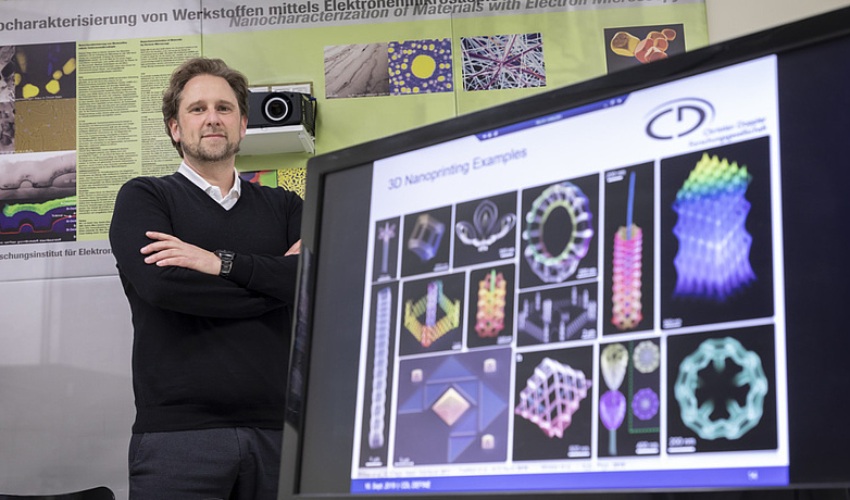 ApplicationsTU Graz Achieves Breakthrough in 3D Printed Optically Active NanostructuresResearchers Harald Plank, Verena Reisecker, and David Kuhness from Graz University of Technology have achieved a significant breakthrough in the production of 3D nanostructures, ensuring their precise shape and size to attain desired optical properties. The key to this success&he
 ApplicationsGerman Railway Operator Deutsche Bahn Marks 10 Years of 3D PrintingDeutsche Bahn (DB) is celebrating ten years of 3D printing, highlighting how the technology has moved from experimental use to a core pillar of its maintenance and supply chain strategy. Since 2015, the German rail operator has expanded its additive…