Applications
ETH Zurich 3D Prints Human Muscle in Microgravity
While bioprinting usually takes place in controlled Earth-based labs, researchers at ETH Zurich have taken the technology to new heights, quite literally. In a new experiment, the Swiss team successfully 3D printed human muscle tissue during parabolic flights that simulate&hellip
- 3 min read
- Applications
- Six more stories
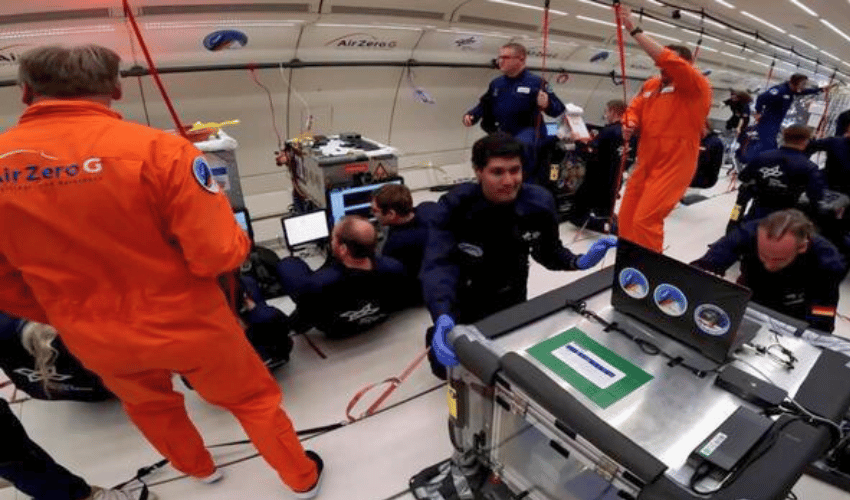
While bioprinting usually takes place in controlled Earth-based labs, researchers at ETH Zurich have taken the technology to new heights, quite literally. In a new experiment, the Swiss team successfully 3D printed human muscle tissue during parabolic flights that simulate the weightlessness of space. Previous experiments aboard the International Space Station (ISS) have demonstrated 3D printing of polymers, cartilage, and even vascular tissues, but never human skeletal muscle.
The work builds on earlier efforts to print biological materials in microgravity, expanding the potential of space-based biomanufacturing. By focusing on living muscle tissue, the ETH Zurich team brings new precision to tissue modeling for drug testing, disease research, and potentially long-term astronaut healthcare. Because muscle degradation is one of the most severe effects of extended spaceflight, creating accurate muscle models is essential for studying and mitigating this loss. Published in Advanced Science, the study showcases how the accuracy of 3D bioprinting improves once gravity is removed from the equation.
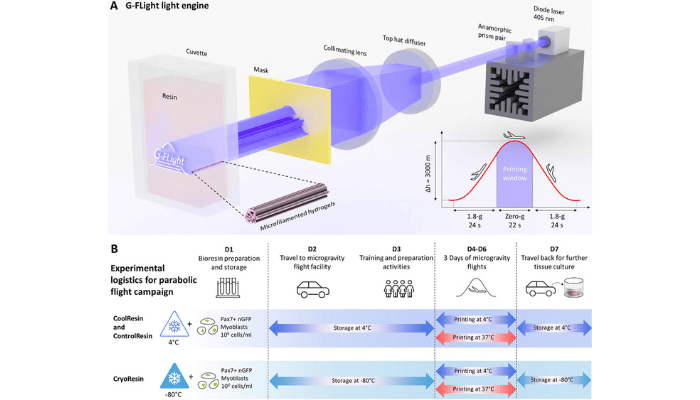
Diagram of the G-FLight bioprinting system and workflow, showing laser-based printing of bioresins and the experimental process used during parabolic flight. (Photo credit: ETH Zurich)
Why Print in Zero Gravity
Recreating the complexity of human tissue with 3D printing has always been limited by one persistent factor: gravity. On Earth, soft bio-inks made of hydrogels packed with living cells tend to collapse or deform before solidifying, which compromises the accuracy of the printed structure. Cells can also settle unevenly during printing, reducing the biological realism of the resulting tissue. Microgravity changes that.
More from the desk
Six other notes from the rest of the bench.
 Applications3D Printed Thrusters to be used for NASA’s First Voyage to the Moon’s South PoleAgile Space Industries, a company known for its additively manufactured propulsion technologies, has been selected by Astrobotic’s Griffin Mission One (GM1) team to develop 3D printed thrusters and axial engines for the Griffin lunar lander. The Griffin lunar lander will…
 MaterialsSUNLU and INSLOGIC Unveil the FilaDC i10, a Filament Cabinet That Dehumidifies Without HeatDamp filament is a familiar problem in FDM printing. Hygroscopic materials such as PA, PETG and TPU pull water out of the air, which shows up as popping during extrusion, stringing, weak layer adhesion and inconsistent surface finish. The usual…
 Applications3D Printing at the Heart of the “Ferrari” MovieReleased on December 14 in Italy, Michael Mann’s “Ferrari” takes place in the heart of Modena, a city renowned for its automotive past. Based on Brock Yates’ 1991 biography “Enzo Ferrari: Man and Machine”, the film delves into the life…
 GuidesDigitizing the Smile: Ben Wynne on the Future—and Ethics—of Automated DentistryAnyone who has swapped traditional braces for clear dental aligners knows the appeal: aligners are much more comfortable and inconspicuous, compared to wires in your mouth. As this consumer preference for a more discreet orthodontic experience drives a massive market…
 NewsUnderstanding and Choosing the Best File Format for 3D Printing: The Complete GuideIn the world of 3D printing, choosing the right file format is a crucial step in guaranteeing the quality and efficiency of your prints. But a multitude of formats available, it can be difficult to know which one is best…
 ApplicationsLightForce Orthodontics 3D prints customisable ceramic bracesThe dental sector has kept reinventing itself since the introduction of 3D printing technologies! And one company that caught our eye is LightForce Orthodontics. Based in Boston, it provides a digital platform to orthodontists to fully personalise 3D printed dental…