News
Detecting Defects in Metal 3D Printing Using Sound
At the École Polytechnique Fédérale de Lausanne (EPFL), a team of scientists has been studhing the issue of defects in metal 3D printing, particularly when using a laser process. Their aim is to develop a method based on the analysis…
- 3 min read
- News
- Six more stories
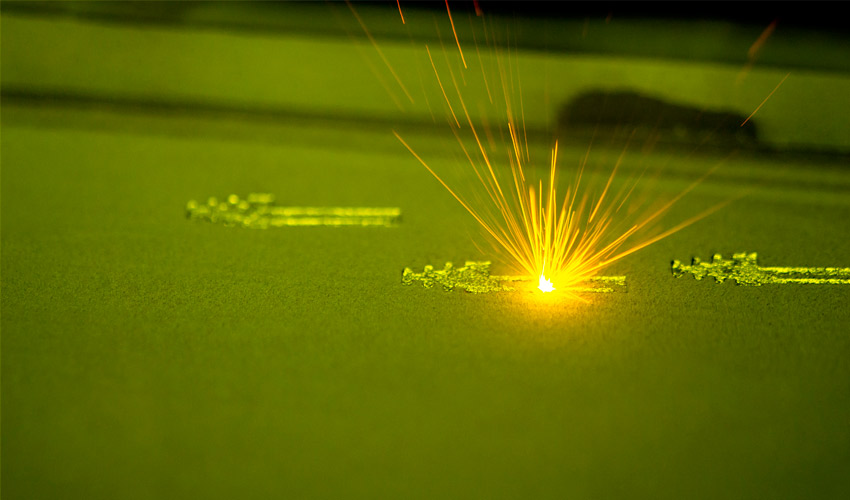
At the École Polytechnique Fédérale de Lausanne (EPFL), a team of scientists has been studhing the issue of defects in metal 3D printing, particularly when using a laser process. Their aim is to develop a method based on the analysis of 3D printer sounds, in order to anticipate printing errors and thus enable better results. They therefore studied the sounds emitted by a machine during a flawless process and those of a 3D printer that showed faults during printing. In collaboration with the Paul Scherrer Institute (PSI) and the Swiss Federal Laboratories for Materials Science and Technology (Empa), EPFL placed a microphone in the printing chamber to detect shifts in the acoustic signal as the metal powder changed state.
The detection of printing errors is not new, and numerous projects have been developed in recent years to guarantee reliable and repeatable results. This process generally relies on algorithms capable of drawing conclusions from situations that are already known. As a result, they are often imperfect and require extensive testing. By relying on a sound-based technique, the EPFL scientists aim to overcome this constraint.
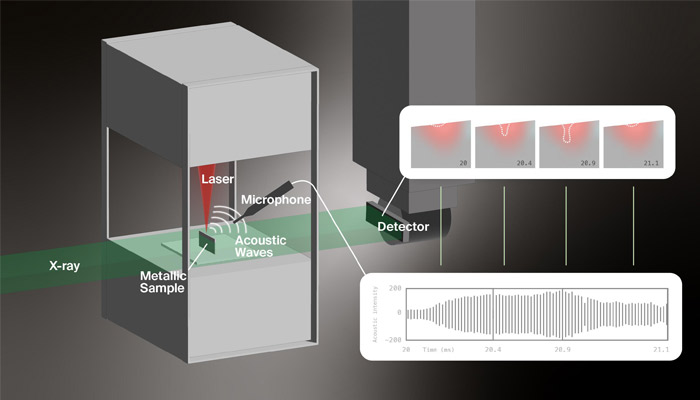
Graphic representation of the experimental device for monitoring printing defects – 2023 EPFL / Titouan Veuillet – CC-BY-SA 4.0
In laser powder bed fusion, a thin layer of metal powder is heated to form the desired object, layer by layer. The material passes through different phases – solid, liquid and gaseous – creating a molten bath. The EPFL explains: “Occasionally, due to variables such as the laser’s angle or the presence of specific geometrical attributes of the powder or of the part, the process might falter. These instances, termed “inter-regime instabilities”, can sometimes prompt shifts between two melting methods, known as “conduction” and “keyhole” regimes.”
More from the desk
Six other notes from the rest of the bench.
 GuidesRyan T. Watkins Talks DfAM for Better Spacecraft Performance at AMUG 2025AMUG 2025 will be taking place soon on March 30 – April 3 in Chicago, Illinois. And one of the clear highlights is, as always, the keynote speeches, including one from Ryan T. Watkins, PhD, a research engineer at NASA…
 NewsInside 3D Tour: Behind the Scenes at Massivit’s Headquarters and Additive Manufacturing FacilitiesAt this point, it seems likely that you have already heard of Inside 3D Tour, the series of videos in which 3Dnatives visits major manufacturers or distributors in the 3D printing industry to learn firsthand how different additive manufacturing methods…
 Materials3D Printed Infant Masks Are a Success Story for Silicone in the Medical SectorThe use of additive manufacturing for the production of medical devices has increased rapidly in recent years. While the global market for 3D printing in healthcare reached a volume of $2 billion in 2021, it will double by 2026 to…
 ApplicationsTU Graz Achieves Breakthrough in 3D Printed Optically Active NanostructuresResearchers Harald Plank, Verena Reisecker, and David Kuhness from Graz University of Technology have achieved a significant breakthrough in the production of 3D nanostructures, ensuring their precise shape and size to attain desired optical properties. The key to this success&he
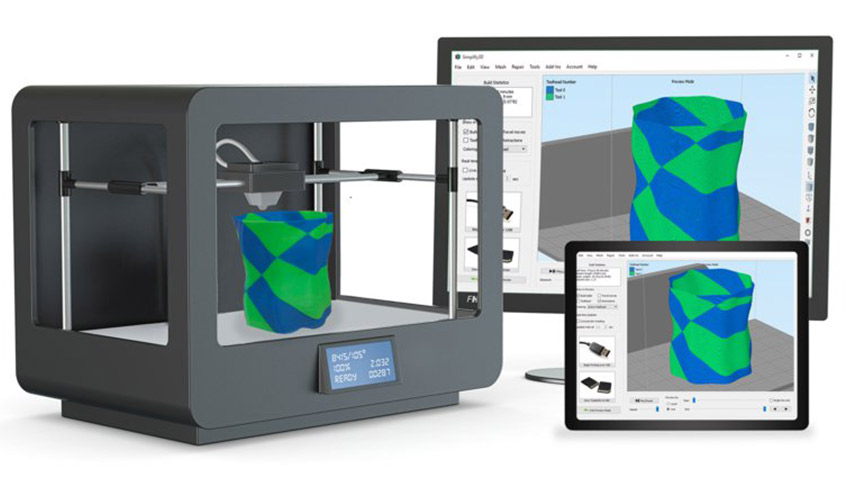 SoftwareSimplify3D, a Slicer for Professionals?Simplify3D is a slicer designed to help you import a model from online platforms, modify it to your liking, and send it to your 3D printer as G-code so that the object can be printed. Although some programs, such as…
 News3D printed Proximity Dress for social distancingIn a future where electronics are predicted to be embedded in everyday objects, what kind of clothes will we wear? How will we socialize in our world when we are supervised by technology? These are the questions Dutch-based high-tech fashion…