Materials
Desktop Metal adds pure copper to its range of materials
While going public a few weeks ago, US manufacturer Desktop Metal announced the addition of pure copper to its range of materials compatible with its Studio System solution. Known for its excellent thermal and electrical conductivity, copper could enable the…
- 3 min read
- Materials
- Six more stories
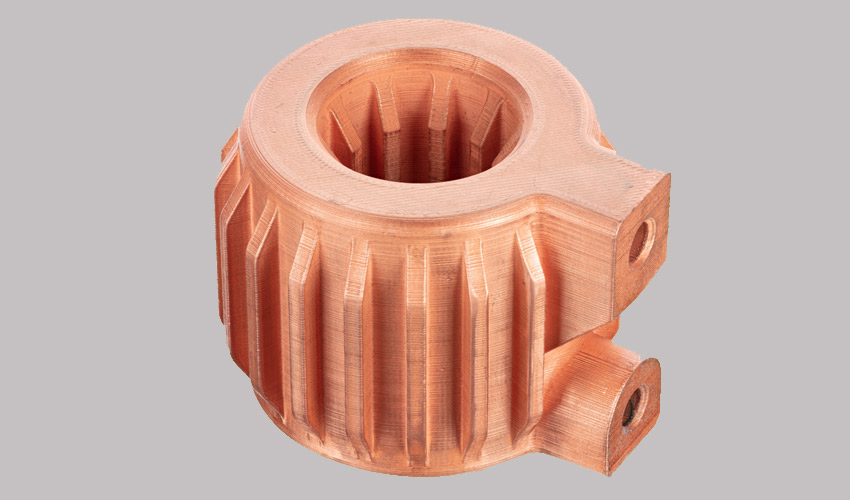
While going public a few weeks ago, US manufacturer Desktop Metal announced the addition of pure copper to its range of materials compatible with its Studio System solution. Known for its excellent thermal and electrical conductivity, copper could enable the creation of high value-added parts for a number of industries such as energy, automotive and electrical applications. This pure copper is an addition to the range of materials the company already offers, namely 4140 chromoly steel, H13 tool steel, 316L and 17-4 PH stainless steel.
In the metal additive manufacturing market, it is not easy to find solutions capable of printing pure copper: instead, they generally offer chromium-zirconium copper. Indeed, the use of a laser makes the manufacture of pure copper parts much more complicated. On the other hand, the Studio System machine uses a process similar to MIM, based on the extrusion of a plastic that contains metal powder. Therefore, it can print pure copper parts, just like Markforged’s Metal X machine, which showcased its capabilities in this space at the beginning of the year.
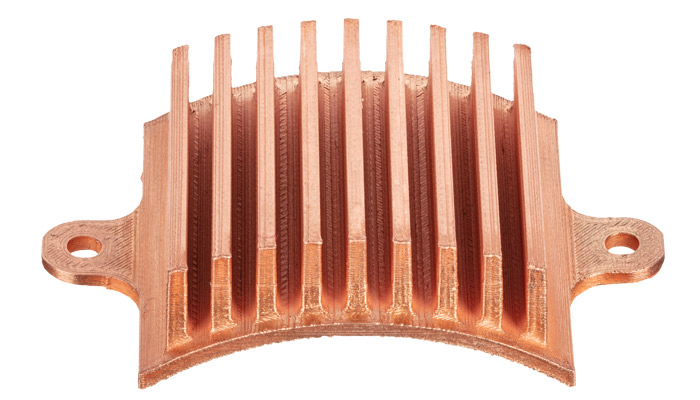
A 3D printed pure copper heat exchanger printed in 3D in pure copper | Photo Credits: Desktop Metal
Jonah Myerberg, Technical Director and co-founder of Desktop Metal, explains: “Known for its excellent thermal and electrical conductivity, copper is a highly sought-after material for a wide range of industries and applications, from heat exchangers and electrical components for heavy industry to consumer products. Whether for heat sinks, electric motor and power system components, or resistance welding electrodes, 3D printed copper on the Studio System is an ideal choice for the manufacture of parts with complex geometries“. As you can see, this addition to the range of compatible metals is particularly interesting for applications that require high heat resistance or electrical conductivity. It is therefore hardly surprising that the first parts created are electrode holders, heat exchangers or bus bars.
More from the desk
Six other notes from the rest of the bench.
 NewsFabric8Labs Raises $19.3M in Series A Funding and Aims to Commercialize Unique Metal TechnologyFabric8Labs, an additive manufacturing (AM) startup from San Diego, has announced the closing of a $19.3 million Series A financing round. The startup hopes that the money will help to accelerate commercialization of its proprietary AM process, allowing them to…
 PrintersChizzle, the new 3D scanning tool with a modeling surfaceChizzle is a new tool that makes it easier than ever to create objects from clay, thanks to a connected modeling surface and a 3D scanner. The startup has recently started its crowdfunding campaign, hoping to give a solution to…
 ApplicationsXYZprinting’s SLS Technology: An Ideal Choice for Drone ManufacturingTEKEVER is a Portuguese company that designs and manufactures maritime surveillance drones for the defense and security sectors. Since 2001, it has been developing unmanned aerial systems (UAS), offering more precisely a range of three products, the AR3, AR4 and…
 NewsTop 5 Videos: What Are the Different Industrial Post-Processing Techniques?It’s Sunday again which means it’s time for the top 5 3D printing videos! For this week, first, check out the video from Ridge Systems which looks at six common post-processing techniques for professional 3D printed parts. Next, follow the…
 Guides3D startup of the month: MarkForged, making waves in additive metal manufacturingEach month we present the 3D startup of the month, choosing startups that are revolutionizing the 3D printing industry in their own way. For this month’s startup of the month, we met with MarkForged’s CEO Greg Mark to learn more…
 ApplicationsMITRE and ONR Collaboration Propels Maritime Defense with 3D Printed Hopper DroneIn a collaboration between MITRE, a US federally funded research and development defense organization, and the Office of Naval Research (ONR), the development of a small uncrewed aerial vehicle (UAV) has marked a significant leap forward in maritime innovation and…