Applications
DARPA Invests Millions to Predict the Lifespan of 3D Printed Parts
Last week, Texas A&M University announced that a team of its faculty members will receive a $1.6 million grant to develop a system for accelerating the process that determines the quality and lifespan of 3D printed components used by the…
- 3 min read
- Applications
- Six more stories
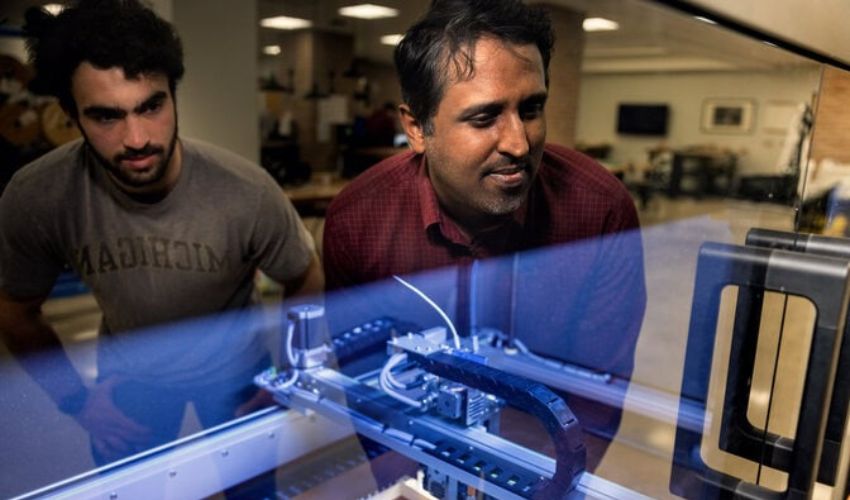
Last week, Texas A&M University announced that a team of its faculty members will receive a $1.6 million grant to develop a system for accelerating the process that determines the quality and lifespan of 3D printed components used by the military. Essentially, they aim to deliver a game-changing promise: it currently takes a supercomputer an average of 18 months to evaluate one 3D printed part and accurately predict its lifespan, but now, researchers at Texas A&M want to reduce that period to just three days.
The funding for the research comes from the U.S. Defense Advanced Research Projects Agency (DARPA), and it was delegated by the Structures Uniquely Resolved to Guarantee Endurance (SURGE) program. SURGE challenges the current machine-centric approach to part qualification in the additive manufacturing industry, advocating instead for a shift toward evaluating individual parts. The program strives to enable on-demand, globally distributed production, allowing any geometry to be manufactured on any machine, anywhere in the world. Significantly, SURGE also seeks to ensure that these parts meet durability standards under expected service conditions.
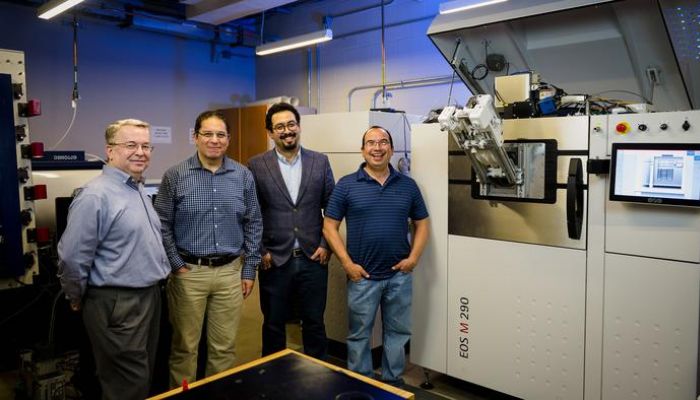
From left to right, members of the Texas A&M team Dr. Ibrahim Karaman, Dr. Alaa Elwany, Dr. Mohsen Taheri Andani and Dr. Raymundo Arroyave, next to a metal 3D printer. Photo Credit: Leon Contreras/Texas A&M Engineering
One critical part of achieving that goal is shortening the time it takes to evaluate a part’s lifespan. By evaluating a part in three days with a laptop, compared to 18 months with a supercomputer, parts can be created and deployed faster, encouraging the use of additive manufacturing in critical applications. This could mean more 3D printers at Department of Defense (DoD) bases, and millions of dollars in savings for the DoD. If the Texas A&M team’s approach is utilized, it has the potential to impact the additive industry as a whole.
More from the desk
Six other notes from the rest of the bench.
 NewsStay Up to Date With our Exclusive Formnext Page!Formnext – Where ideas take shape. With this iconic slogan, organizer Mesago presents what is probably the most important event of the year for additive manufacturing. This year, more than 500 exhibitors from the world of additive manufacturing are expected…
 ApplicationsRoBoat 3D printed autonomous boats in AmsterdamA team of researchers at MIT’s Computer Science and Artificial Intelligence Laboratory (CSAIL) are working with the Institute of Advanced Metropolitan Solutions in Amsterdam on a project called RoBoat. The goal is to create a system of autonomous boats that…
 ApplicationsCaracol Partners with Additive Engineering Solutions for Aerospace and DefenseThe aerospace and defense industry is increasingly turning toward additive manufacturing because the technology can offer custom, highly optimized solutions for complex applications. Due to the growing demand, more and more partnerships are emerging between different companies, w
 NewsORNL Develops Novel Extrusion System for Single-Stream, Multi-Material 3D PrintingWe’ve been talking a lot about multi-material printing lately, and for good reason. The technology is advancing rapidly on both the maker and professional sides, from Bambu Lab’s and Prusa’s latest multi-material desktop systems to more experimental approaches. Now, researchers&h
 NewsUrwahn Bikes presents its limited edition copper-plated 3D printed bikeThe German bike manufacturer, Urwahn Bikes has partnered with Schmolke Carbon, specialized in the fabrication of carbon fibre bike parts to develop a 3D printed frame for its racing bike. This is not the first time Urwahn Bikes has worked…
 NewsWEBINAR: How to Overcome the Supply Chain and Labor Crisis With 3D Printing?We do not know how long the current mix of supply chain and labor issues will last, especially considering the number challenges countries have been facing worldwide. And for many the question is how can companies continue to outperform during…