News
Could 3D Printed Tennis Balls Be the Future of Sustainable Play?
Tennis balls don’t last forever. Their lifespan depends on the type of ball and style of play: pressurized balls typically last one to three weeks for moderate, recreational use, but only one to three hours in constant, competitive play. Over…
- 3 min read
- News
- Six more stories
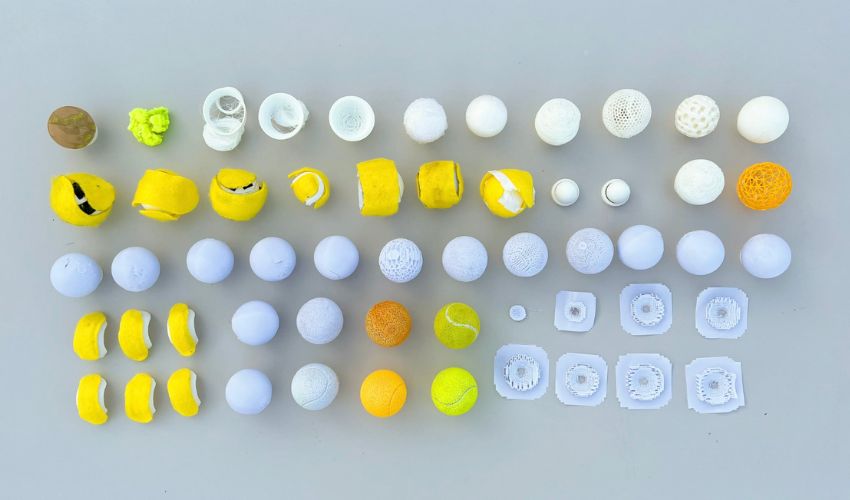
Tennis balls don’t last forever. Their lifespan depends on the type of ball and style of play: pressurized balls typically last one to three weeks for moderate, recreational use, but only one to three hours in constant, competitive play. Over time, repeated impacts cause the felt to wear down and the internal pressure to drop, resulting in a lower, inconsistent bounce. The environmental impact is significant. More than 300 million tennis balls are produced globally each year, and after their short lifespan, most end up in landfills, where they can take up to 400 years to decompose. To address this issue, Noé Chouraqui, a third-year Product and Industrial Design student at Central Saint Martins, developed POINT, a 3D printed tennis ball made from eco-friendly materials. Durable and fully recyclable, these balls aim to offer a sustainable alternative—and could even earn approval from the International Tennis Federation (ITF) for official match use.
To create POINT, Chouraqui conducted extensive testing, trying out different filaments, internal lattice structures and printing parameters using software like Fusion 360 and BambuLab Studio. In an interview with Dezeen, he explained that the material he used was a filament called High Resilience PLA (PLA-HR), which is made from plant-derived materials, primarily corn starch. After creating multiple iterations, he was able to create a ball with a precise balance of strength, bounce and durability. Now, he has a unique and highly effective patented design. Along with the ball, Chouraqui designed cardboard tubes for sustainable packaging.
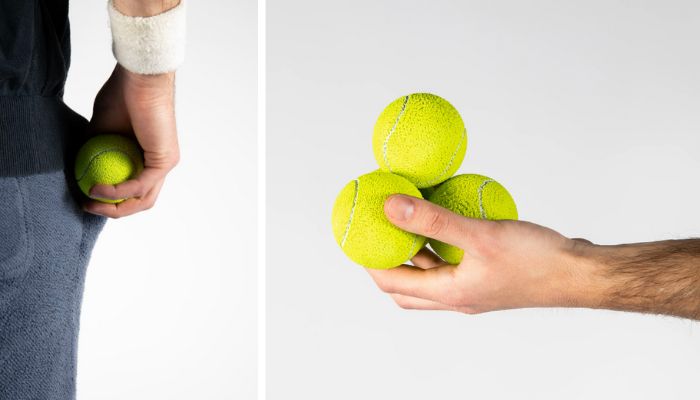
The neon yellow POINT tennis balls mimic the look of classic tennis balls.
Jamie Capel Davies, Head of Science and Technical at the ITF, tested the POINT balls officially. Currently, the ITF Technical Commission is reviewing POINT’s data, considering adjustments to regulations to potentially accept sustainable alternatives in official matches. According to Chouraqui, the prototype showed “promising aerodynamic performance closely matching conventional tennis balls.”
More from the desk
Six other notes from the rest of the bench.
 ApplicationsUT Austin Researchers Create Functional, 3D Printed Knee JointThis summer, the University of Texas at Austin published an exciting innovation in 3D printing, which has the potential to revolutionize the next generation of medical devices and flexible electronics. Researchers at the university, funded by the US Department of…
 GuidesThe top Canadian Maker Faires for DIY fans in 2018We put together a list last week with the biggest Maker Faires in the US. This time we will take a look at what is worth checking out outside the states, crossing over to the top Canadian Maker Faires. First…
 NewsXJet appoints Nobel Prize winner to lead pioneering applications & materialsXJet announced today the appointment of Professor Dan Schechtman to lead its Scientific Advisory Board. Winner of the 2011 Nobel Prize in Chemistry for the discovery of quasicrystals, Shechtman’s role will be to help steer XJet’s material and application development…
 Materials3D printed planes will be lighter and fly furtherHRL Laboratories have made a breakthrough; a way to reliably 3D print high-strength aluminum alloys. You’re hungry. The baby’s crying. The picturesque sites of Australia that the travel company promised you has been exchanged for some corrugated steel and a…
 ApplicationsNASA Develops 1000 Times Stronger Metal Alloy Using 3D PrintingA team of researchers at NASA has developed a new metal alloy called GRX-810, that is 1000 times stronger than any previously developed alloy. Probably even more interesting is the fact that for this project, the team of professionals relied…
 NewsLegendary Vish develops 3D printed fish from plantsFollowing the many developments in the space of 3D printed meat, it’s the turn of fish! A team of Danish students has developed a project called Legendary Vish that aims to offer a vegan alternative to salmon in Europe. They…