Applications
Meet CoroNaspresso, the COVID-19 Test in a Coffee Capsule
Testing for COVID-19 with a coffee capsule and a pan? This is the original idea of a scientist from the University of Wageningen in the Netherlands. Hoping to reduce the cost of COVID-19 detection tests currently offered on the market,…
- 3 min read
- Applications
- Six more stories
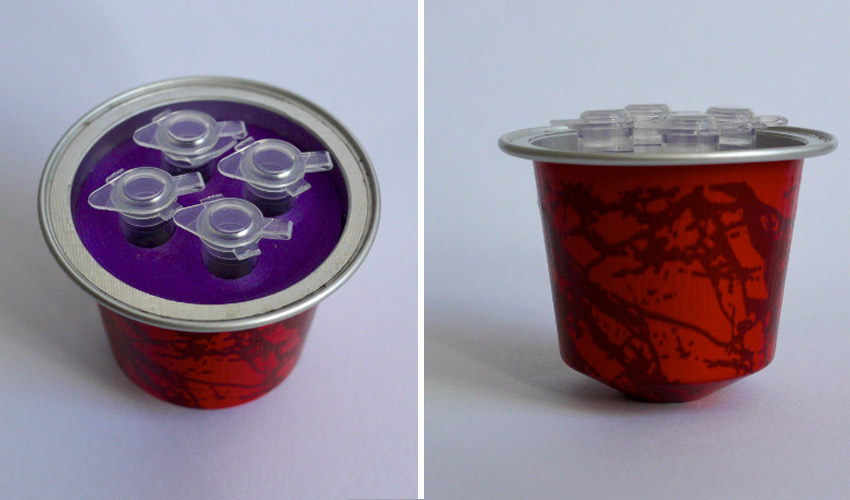
Testing for COVID-19 with a coffee capsule and a pan? This is the original idea of a scientist from the University of Wageningen in the Netherlands. Hoping to reduce the cost of COVID-19 detection tests currently offered on the market, he used an empty aluminum coffee capsule and turned it into a small chemical reactor. What makes this project particularly interesting to us is that he 3D printed a plastic holder that can hold 4 tubes to perform the tests. Called CoroNaspresso, this new screening method could increase the number of tests performed each day while facilitating the process. It would cost about 24¢ (0.20€).
Vittorio Saggiomo is an Italian chemist in the Bionanotechnology group at Wageningen University in the Netherlands. Last March, he tackled the problem of centralized PCR testing, explaining that the means of screening should nowadays be easier to do as well as cheap in order to produce tests in large quantities. To do this, he relied on loop-mediated isothermal amplification (LAMP), a low-cost technique for detecting certain diseases. It can be performed at a constant temperature (65°C) and no laboratory equipment is required. Specifically, the saliva sample is heated and, using pH indicators, changes color if Sars-CoV-2 is present. Vittorio Saggiomo explains, “The color change is very striking: negative samples are pink and positive ones are yellow.” But how do you maintain a constant temperature while remaining accessible?
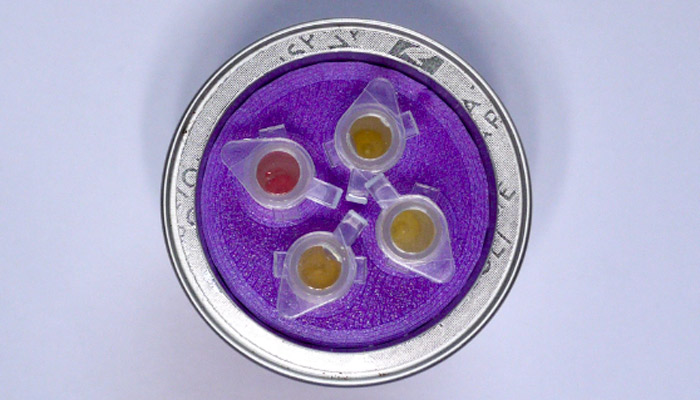
Positive results are yellow (photo credits: Vittorio Saggiomo)
CoroNaspresso, between coffee and 3D printing
This is where the coffee capsule comes in: an everyday product, it served as a container that could be dipped into a pot of boiling water. The capsule is filled with a phase change material, specifically RT64HC, a wax that melts between 63 and 65°C (145.4-149°F). It is an inexpensive material (about €13 or $15 per kilo) whose melting/solidification process takes about 25 minutes (5 grams for 1 liter of water). A 3D-printed holder holds the 4 tubes of 200μl containing the saliva samples. Few details are given as to the 3D printing itself, we just know that PLA was used. The part seems uncomplicated and accessible to anyone with an FDM 3D printer at home. The use of additive manufacturing is most probably in part a reflection of the logic behind the test that puts an emphasis on ease of use and execution but also for mass production: as the part is quite small and not very complex, one could easily print dozens of them in one go.
More from the desk
Six other notes from the rest of the bench.
 NewsCarbon Launches ‘Next Generation’ of 3D Printers with M-SeriesThe new year continues with launches from some of the leading brands of additive manufacturing. This time, Carbon, has announced the launch of its new M-series printers, the M3 and the M3 Max, which it claims will leverage the next…
 NewsAurora Labs uses its Rapid Manufacturing Technology to print metal 55 times fasterThe Australian metal 3D printer manufacturer Aurora Labs has recently revealed successful test results of its metal additive manufacturing process Rapid Manufacturing Technology (RMT). This came after the company closed a $5 million round of investment (before costs) from institu
 NewsInside 3D Tour: Visiting XJet’s Headquarters and Manufacturing Plant in IsraelStill not familiar with the Inside 3D Tour video series? In it, we visit the major manufacturers in the 3D industry to learn first-hand how different 3D printing methods are developed. The goal? To understand what processes the most cutting-edge…
 NewsVoices AMplified RAPID TCT 2023: Who Was Exhibiting?Now that the show has wrapped up, you can check out our new series, Voices AMplified, made in collaboration with SME, the main organizer of RAPID + TCT 2023, the largest additive manufacturing trade show in North America. Through these…
 ApplicationsReplacing Metals With High-Performance Polymers in Industrial ApplicationsIn traditional manufacturing, metal is praised for its strength, corrosion resistance and durability, among other properties. And while that will never change, the rise of the use of additive manufacturing with high-performance polymers has brought about an astonishing developmen
 Guides3D Printed Engines: Industry Projects and Miniature ModelsThe term engine, according to the Oxford English Dictionary, simply means ‘a machine with moving parts that converts power into motion’. With such a widely-encompassing definition, this term can be applied to any number of different sectors and applications, and…