Applications
CORAL: A 3D Printed Ingestible Capsule to Sample Your Gut Microbiome
The gut microbiome is a complex ecosystem of bacteria, viruses, fungi and parasites that resides in the intestines. Shaped by both diet and environment, each person’s microbiome is unique. This ecosystem interacts with the digestive, immune, nervous and endocrine systems,…
- 3 min read
- Applications
- Six more stories
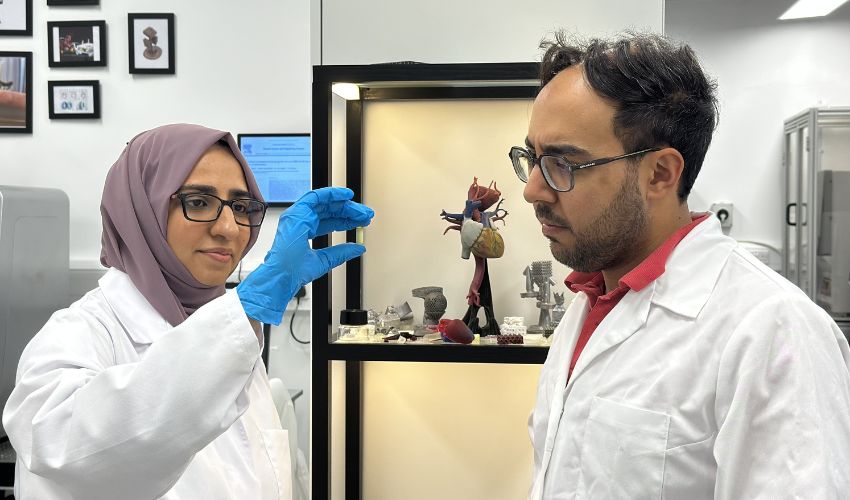
The gut microbiome is a complex ecosystem of bacteria, viruses, fungi and parasites that resides in the intestines. Shaped by both diet and environment, each person’s microbiome is unique. This ecosystem interacts with the digestive, immune, nervous and endocrine systems, though many of these relationships remain only partially understood. To advance research in this area, a team from NYU Abu Dhabi has developed a 3D printed capsule known as CORAL (Cellularly Organized Repeating Lattice), designed to collect microbial samples from the small intestine as it travels through the digestive tract. This new tool aims to help researchers better understand how the gut microbiome influences overall health.
The NYU Abu Dhabi team wants to explore the small intestine’s microbiome because traditionally, gut microbiome studies have relied on fecal samples, which primarily represent microbes from the large intestine. This leaves the small intestine largely unexplored, despite it being the site of many crucial interactions between the body and microbes. The study’s co-author Hanan Mohammed explained, “The bacterial communities in the gut profoundly influence immunity, metabolism, aging, and overall health. CORAL’s potential lies in enabling earlier disease detection, tracking how therapies are working, and ultimately developing new microbiome-based treatments that restore balance where it’s lost.”
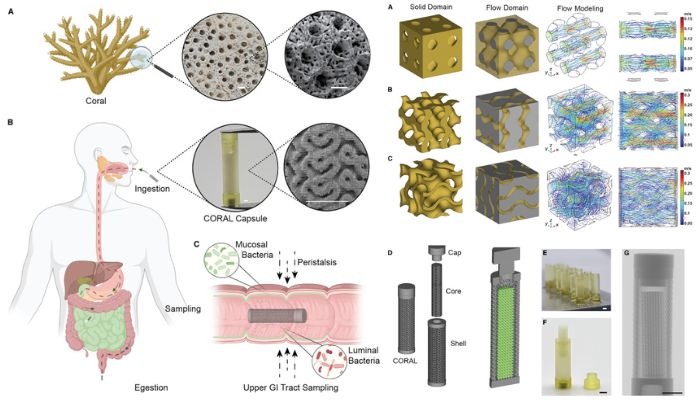
Conceptual design of the CORAL capsule for microbial sampling in the small intestine (left) and design and fabrication of CORAL capsules (right)
CORAL: Inspired by Marine Corals
The creators of the CORAL capsule took their inspiration from marine life. Made from inert resin, the capsule has a texture like marine corals, which support diverse microbial life thanks to their porous structure. These pores increase its surface area, allowing it to passively capture microbes. The research team therefore created a geometric triply periodic minimal surface (TPMS) pattern, designed to trap bacteria, for CORAL. 3D printing was critical to achieving the design. The study notes: “Fabricating microscale TPMS-based structures is a challenge. However, recent advancements in additive manufacturing (3D printing) have enabled the production of intricate, self-supporting TPMS architectures at nanoscale resolutions.”
More from the desk
Six other notes from the rest of the bench.
 MaterialsPLA vs ABS: Which Material Should You Choose?When it comes to 3D printing polymers, it can be hard to decide which one to use. This is the case for pretty much any 3D printing technology, but especially for beginners or hobbyists using FDM/FFF 3D printing for whom…
 PrintersWhat Are the Current ELEGOO 3D Printers on the Market?As 3D printing gets more popular, so do cheaper desktop solutions which allow more and more access to the technology. One such company which has been gaining in popularity for its cheap but reliable printers is ELEGOO. Founded in 2015,…
 NewsThe Role of 3D Printing in Interior DesignAs we see 3D printing used in more and more industrial sectors, the question remains: what role does it play in everyday life? Is it able to influence our everyday environment? Looking at the use of 3D printing in interior…
 Software10 Reasons Why DfAM Matters in 3D PrintingAt this point, if you are involved with additive manufacturing, you know just how important design is for the creation of a part, with modeling being the first step in any 3D printing process. Enter Design for Additive Manufacturing, or…
 NewsTop 5 Videos: EnvisionTEC success story, and moreThis week we found the top 5 videos about 3D printing and the way additive manufacturing is changing production. The technology has infiltrated many sectors, from medical to automotive – check our selection of the week to keep up with the innovations! If you enjoy these, you&hell
 Materials3D Printing Plastics: Complete Materials Guide 20263D printer plastic is the most widely used material category in additive manufacturing, available in filament, powder, and resin form across a range of technologies. The 3D printing plastics market is projected to grow from USD $2.36 billion in 2025…