Materials
Why Choose Composite 3D Printing? Experts Give Their Advice!
Today, there are many materials compatible with additive manufacturing, from thermoplastics to metals, ceramics and photosensitive resins. They offer a wide range of properties to meet the requirements of multiple sectors such as aerospace, automotive, or medical. Looking at the&
- 3 min read
- Materials
- Six more stories
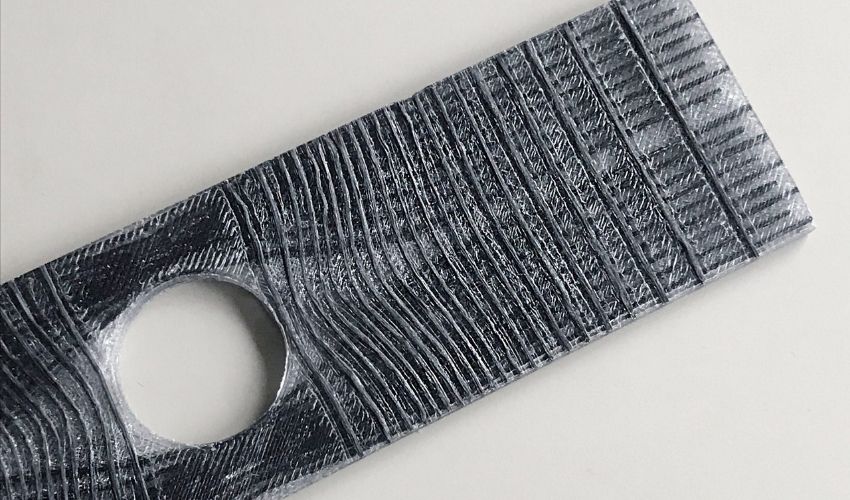
Today, there are many materials compatible with additive manufacturing, from thermoplastics to metals, ceramics and photosensitive resins. They offer a wide range of properties to meet the requirements of multiple sectors such as aerospace, automotive, or medical. Looking at the family of polymers, composites, or fiber-based reinforced materials, can also be found. Available in powder or filament form, these materials offer more interesting mechanical characteristics than traditional polymers, such as better rigidity, impact resistance, lightness, and more. As a result, more and more companies are starting to rely on composite materials in additive manufacturing. But how can you integrate composite 3D printing into your production chain? Which material should you choose? We met with 3 experts in the sector who answered our questions about composite 3D printing!
Our first expert is François Edy, technical manager of the Kimya Factory. This is the additive manufacturing service offered by the ARMOR group. Today, François ensures the quality of manufactured parts, production deadlines, and advises customers. Here we focus on his work with composite additive manufacturing using extrusion, and more specifically on composite filaments. The second expert is Fedor Antonov, the CEO and co-founder of Anisoprint, a leading manufacturer of continuous fiber 3D printing solutions. Last but not least, Farbod Nezami, one of CIKONI’s managing directors, brings our panel of experts full circle. CIKONI is a specialized engineering service provider for lightweight design, focusing on the hybridization of additive manufacturing and load path reinforcements via fiber reinforcements.



Composite materials in 3D printing
A composite material is a material reinforced by a fiber, which gives it additional mechanical properties. This base material is called a matrix and could be one of a wide range of polymers on the additive manufacturing market.This results in a mixture of materials with superior properties for example they are typically stronger and stiffer. The most popular composite materials include carbon fiber and glass fiber. Parts made from carbon fiber or CFRP (carbon fiber reinforced plastic) are strong yet lightweight. These properties make CFRP a popular material for a wide range of applications. For example, in the aerospace, automotive and sporting goods industries. Glass fiber reinforced plastics (GFRP) in contrast are not quite as robust as CFRP, but their chemical resistance and dielectric properties make them ideal for applications in the electrical industry.
More from the desk
Six other notes from the rest of the bench.
 NewsSandhelden Creates Sustainable Bathroom Collections by 3D Printing SandIn addition to the classic materials that are used in additive manufacturing, such as PLA , ABS or metals , there are more and more experimenters and researchers who create new possibilities. As early as this year, we were able to report on the ideas of using soy and cellulose as
 Printers3Dnatives Lab: Testing the Formlabs’ Fuse 1 SLS 3D PrinterRecognized as a leading player in the field of resin 3D printers, Formlabs announced a few months ago that it was taking its first steps into the industrial world of SLS 3D printing with the Fuse 1. This machine represents…
 NewsGerman manufacturer EOS acquires Vulcan LabsThe German manufacturer, EOS, producer of systems for the additive manufacturing of components in metal and polymers has announced the acquisition of Vulcan Labs. Vulcan Labs spun out of Stratasys last year. The spin-off from Stratasys specialises in powder bed…
 ApplicationsDirect Sound 3D Printing Could Print Implants Inside Your BodyConcordia University researchers developed a new platform technology that uses ultrasonic waves to create complex and precise objects. The researchers have succeeded in using sound to solidify liquid into plastic. This so-called direct sound 3D printing could make it possible&hel
 Guides#3DStartup: Phase3D and its Real-Time Inspection Solution for 3D PrintingA key issue in the additive manufacturing industry is the quality of the final parts. Depending on the 3D printing technology used and the intended application, this could be more or less affordable. Furthermore, when it comes to powder bed-based…
 ApplicationsUW-Madison Engineers Achieve Zero Gravity 3D Printing of RAMStudent engineers at the University of Wisconsin-Madison have taken a giant leap toward self-sustaining space exploration by successfully 3D printing Random Access Memory (RAM) devices in zero gravity. This achievement, realized in March 2024, represents a significant advancement