Materials
Closed-Loop Additive Manufacturing Could Be Possible Thanks to ORNL Research
As the climate crisis becomes more and more evident, sustainability has become a key driver of innovations in technologies. And additive manufacturing is certainly no different. Most recently, researchers at the Department of Energy’s Oak Ridge Laboratory have developed an&
- 3 min read
- Materials
- Six more stories
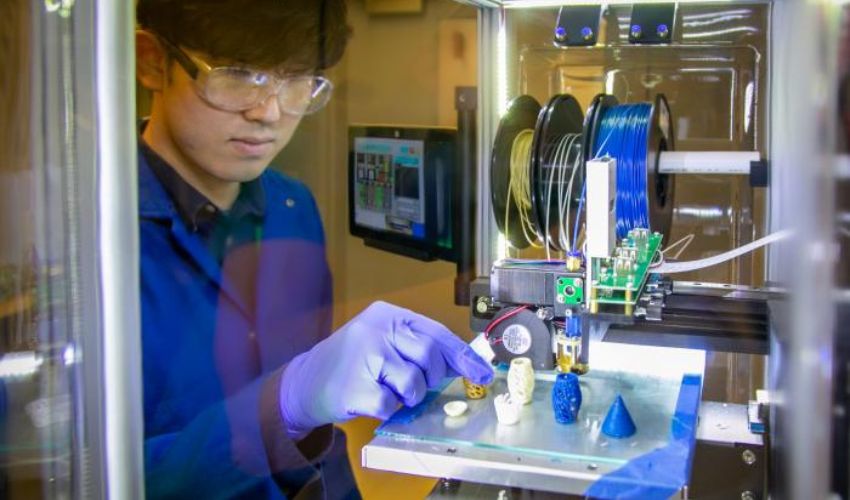
As the climate crisis becomes more and more evident, sustainability has become a key driver of innovations in technologies. And additive manufacturing is certainly no different. Most recently, researchers at the Department of Energy’s Oak Ridge Laboratory have developed an upcycling approach that allows for discarded plastics to be reused in FFF 3D printing. This thus would allow for fully closed-loop additive manufacturing, officially ensuring that there is no waste in the process. The team hopes that this easily-adoptable and scalable method will lead to a global reduction of plastic waste as well as cut carbon emissions from plastic production.
The ORNL is one of the leading institutes that is researching the usage of additive manufacturing, namely for more effective energy policies in the USA. Previously, we also told you about another of their projects for 3D printed solar batteries. This latest research, shows as well their drive not only to adopt 3D printing for more sustainable policies, but to make AM itself more sustainable. The results were published in the article “Closed-loop additive manufacturing of upcycled commodity plastic through dynamic cross-linking” in Science Advances and were written by Tominori Saito, Sungjin Kim, Anisur Rahman, Arif Arifuzzaman and Edgar Lara-Curzio.

ORNL polymer scientists Tomonori Saito, left, and Sungjin Kim (photo credits: Genevieve Martin/ORNL, U.S. Dept. of Energy)
This topic especially has been of particular interest within the AM industry. Notably, how to use AM to promote the idea of a circular economy, a model of production and consumption which aims to reuse, repair and recycle products for as long as possible, reducing waste to a minimum. 3D printing is often chosen as a key technology for a circular economy as during production, depending on the technology used, it does not generate waste. The lead author, Tomonori Saito of ORNL’s Chemical Sciences Division, commented on the importance of the work, noting, “This effort demonstrates a closed-loop for manufacturing plastic items, potentially with higher value and performance, using only existing plastic waste in one of the most accessible areas of additive manufacturing.”
More from the desk
Six other notes from the rest of the bench.
 Guides#3DStartup: Viewpointsystem on Using AM for Their Smart GlassesVienna-based start-up Viewpointsystem has been working intensively on a solution to bring man and machine closer than ever before. The result: forward-looking smart glasses made with scientific know-how in the field of optics. However, what exactly is the contribution of…
 NewsTop 5 of the Week: A 3D printed robotic arm and much more!This week we found the top 5 videos about 3D printing and the way additive manufacturing is shaping our society. The technology has infiltrated many sectors, from medical to automotive! Check out our selection of the week to keep up with the innovations! This week we…
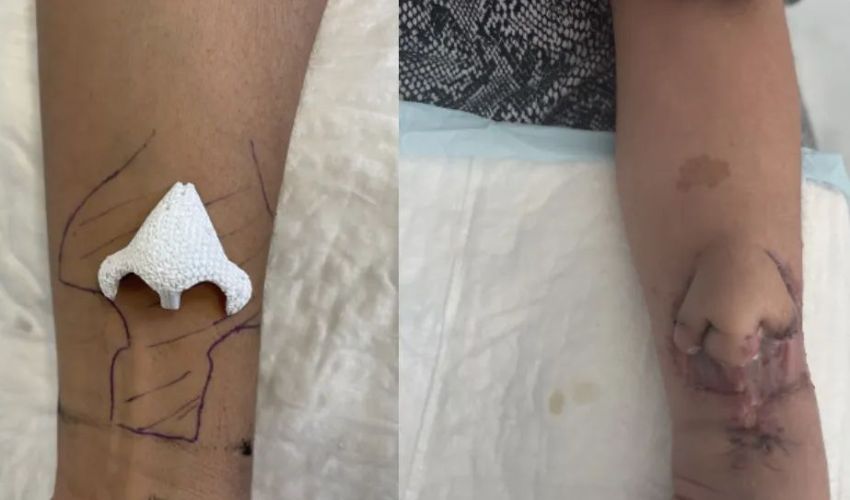 ApplicationsBioprinted Nose Graft Used For Reconstructive Surgery3D printing has been applied to reconstructive surgery to create a nose graft for a patient who underwent intense cancer treatment. This amazing feat happened occured at IUCT Oncopole (University Cancer Institute of Toulouse), a cancer care, research, and training…
 NewsUpNano introduces new micro-scale 3D printing technologyUpNano is a young company based in Vienna that has recently developed a high-resolution micro-scale 3D printing technology. Based on a 2-photon polymerization process (2PP), the new technique is capable of producing plastic parts with a volume ranging from 100…
 NewsThe Airlements Project Promises Lightweight and Insulated 3D Printed Walls3D printing is revolutionizing the architecture and construction industry in various ways, offering unique designs, lighter materials, and the ability to create structures that were previously considered impossible using traditional methods. Today, we would like to introduce you
  MaterialsAlloy Enterprises Secures $26 Million Funding to Fuel Expansion of 3D Printed Aluminum Parts ProductionAlloy Enterprises, a leading company specializing in additive manufacturing, has recently announced the successful completion of a Series A funding round, raising an impressive $26 million. The funding round was oversubscribed and led by Piva Capital, with participation from Unle