Applications
Bioprinted Nose Graft Used For Reconstructive Surgery
3D printing has been applied to reconstructive surgery to create a nose graft for a patient who underwent intense cancer treatment. This amazing feat happened occured at IUCT Oncopole (University Cancer Institute of Toulouse), a cancer care, research, and training…
- 3 min read
- Applications
- Six more stories
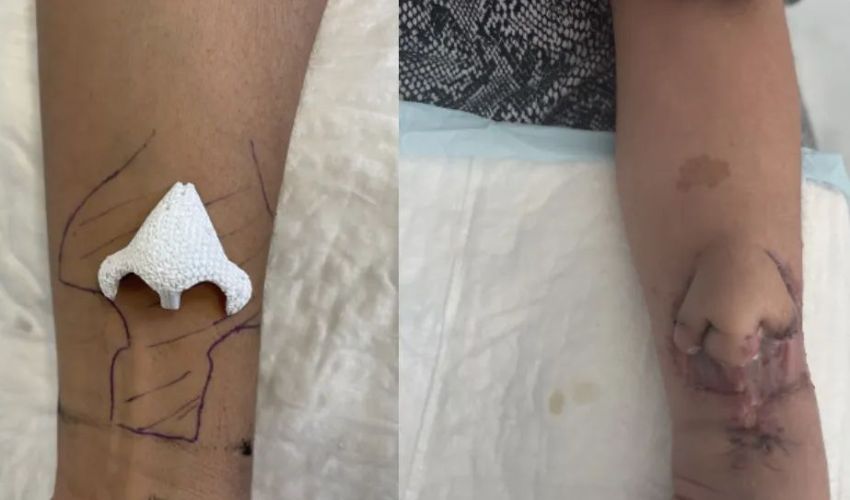
3D printing has been applied to reconstructive surgery to create a nose graft for a patient who underwent intense cancer treatment. This amazing feat happened occured at IUCT Oncopole (University Cancer Institute of Toulouse), a cancer care, research, and training center with 1800 workers located in Toulouse, France. The treatment was carried out by the ENT and Cervico-Facial surgery teams of the Toulouse University Hospital and the Claudius Regaud Institute, according to a press release. Scientists and medics used a 3D printing solution from CERHUM to create the nose for a patient.
The patient received treatment in 2013 for nasal cavity cancer (squamous cell carcinoma) with radiotherapy and chemotherapy, resulting in the loss of much of the nose and facial palate. She spent almost four years without a nose, struggling with wearing a prosthesis. For this revolutionary treatment, she had a 3D printed nose implanted onto her forearm, where it was grown before being removed and revascularized (blood flow restored) and implanted onto her face.
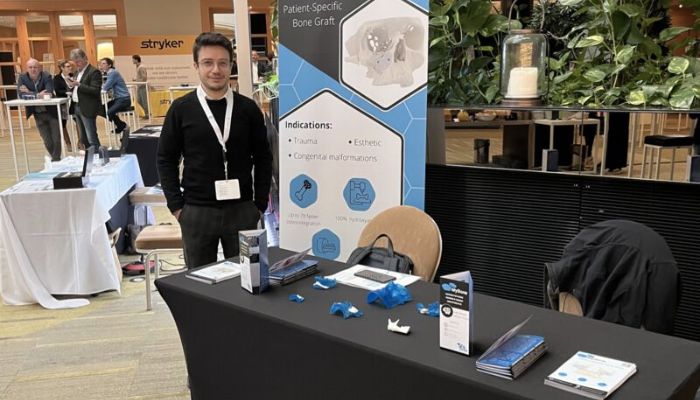
CERHUM were recently at the Belgian Maxillofacial Surgery Congress to promote the MyBone solution (photo credit: CERHUM on LinkedIN)
In July 2022, the bone graft was first implanted into the patient’s forearm in order for vascularization to begin. Two months later, the ‘colonization’ (the integration within the skin) of the medical device was complete. The final stage was the transplantation of the device to the nasal area and successful revascularization using microsurgery. Anastomozation (the creation of a surgical connection between blood vessels) was performed on the vessels of the skin of the arm and those of the patient’s temple.
More from the desk
Six other notes from the rest of the bench.
 NewsAdditive manufacturing is gradually growing in the Oil industryThe consulting firm GlobalData recently published a study on additive manufacturing in the Oil & Gas industry, which reveals that the sector is expected to reach $32 billion worldwide by 2025, and over $60 billion by 2030. These are very…
 MaterialsEverything You Need To Know About Silicon Nitride in 3D PrintingOne of the strengths of additive manufacturing is its compatibility with a wide range of materials, from polymers to metals, including concrete and even food pastes. The technology is also increasingly being used with ceramics, especially in their technical variants.…
 SoftwareStep-by-Step: How to Use AI 3D Model Generators for 3D PrintingArtificial intelligence is becoming an integral part of our daily lives, whether we welcome it or not. Its ability to optimize workflows, predict outcomes, and adapt in real-time is driving innovation across industries—including additive manufacturing. Companies like Nike have le
 NewsNikon Confirms Acquisition of Metal 3D Printing Giant SLM SolutionsLast September, the Japanese group Nikon confirmed its intention to acquire the industrial 3D printer manufacturer SLM Solutions. Four months later, this acquisition has officially been finalized: Nikon announced recently that more than 21,000,000 shares and more than 42,000 conv
 PrintersHow Does 3D Scanning Improve Carrot Harvesting in France?Agri Techni Concept is a French company that specializes in the manufacturing of agricultural and forestry machines. Based in Sore, a part of the Landes region, it develops solutions that adapt to the harvesting of carrots and potatoes. For several…
 News#3DExpress: Trouble on the Horizon for Nano Dimension and Nexa3D?It may be the holiday season, but the additive manufacturing sector is not sleeping peacefully while waiting for Santa Claus. In this week’s 3DExpress, we start with some of the big news you might have missed this week from Nano…