Applications
Chilean University Improves the Manufacturing of High-Frequency Antennas
There would be no exchange of information in modern communication without one key device: antennas. Antennas are designed for the transmission and reception of signals in communication systems. Their design and development, complex as it is, continue to evolve to…
- 3 min read
- Applications
- Six more stories

There would be no exchange of information in modern communication without one key device: antennas. Antennas are designed for the transmission and reception of signals in communication systems. Their design and development, complex as it is, continue to evolve to meet the increasing demands of communications. One example of the advances that continue to be made is an interdisciplinary project at the Pontificia Universidad Católica de Valparaíso (PUCV) in Chile. There, researchers have developed a less expensive and sustainable alternative for manufacturing high-frequency antennas using 3D printing.
The project is entitled: “Development of polymer-based composite pellets with particles and/or ceramics for the manufacture of telecommunication antennas by additive manufacturing.” Thus, the objective was to optimize a 3D printing process that meets all the requirements of high-frequency antennas. The researchers claim that, in this particular case, the material that showed the best characteristics was a combination of metal and ceramic in the form of pellets.
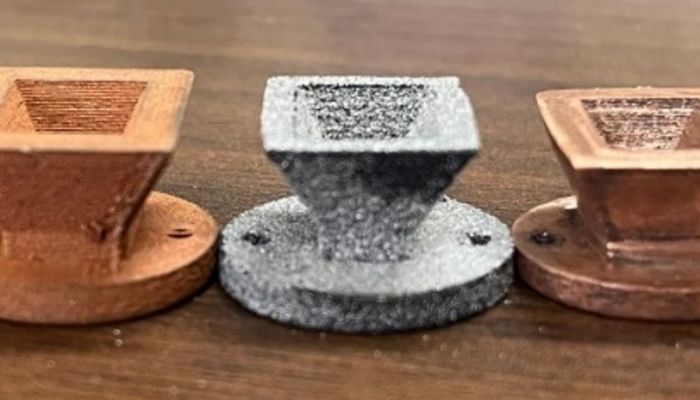
3D printed antenna components (Photo credits: PUCV Strategic Communication Department).
How Are Antennas Printed Using Pellets?
One of the highlights of this research was the production of pellets with a concentration of metal and ceramic particles of between 70% and 90%. The particle size was perfect for extrusion and the final product had ideal characteristics. In addition, the process proposed by the researchers allows the reduction of material losses, optimizes manufacturing times and improves printing standards through the use of artificial intelligence.
More from the desk
Six other notes from the rest of the bench.
 ApplicationsWhy is dental additive manufacturing growing?In its latest report, the Chinese consulting and market research firm, QY Research revealed the trends to expect in the dental 3D printing industry for 2025. The report, entitled “Global Dental 3D Printing Market Analysis, 2014 – 2025” suggests that…
 Applications3D Printing Is Revolutionizing Surgical Planning, and It’s Only the BeginningImagine what it was like when X-Rays were first introduced. Or CT scans, and MRIs. Think about how transformative that technology was, giving physicians the ability to see inside a patient’s body without opening them up. A whole new world,…
 ApplicationsMedical Application of the Month: Discovering Micro 3D PrintingHow can micro 3D printing technology revolutionize the medical sector and advance research? Can it be used to create medical devices, treatments for various forms of disease, or even functional tissues and organs? Boston Micro Fabrication is asking itself all…
 NewsHow is 3D Printing Used in Soccer?3D printing has increasingly captured the interest of people from all walks of life, whether for personal hobby projects or professional manufacturing in construction, the automotive industry, aerospace, medicine, and much more. One versatile area that spans both personal and&hel
 GuidesThe Most Impressive 3D Printed Jewelry Designs on the MarketWhether in jewelry or jewelry, additive manufacturing is a technique increasingly used by professionals in the sector because of its ability to design complex and unique parts, all more quickly. It is used in particular to produce molds used later…
 PrintersIEMAI3D and ISANMATE Advance Carbon Fiber Materials for 3D PrintingInterest in carbon fiber composite materials in 3D printing has increased considerably. According to a study published by Market Research & News, the market for carbon fiber composite materials for 3D printing is expected to register significant growth in the…