News
Chevron is Solving Supply Chain Issues with 3D Printing
Chevron, the second largest oil company in the United States and the sixth largest in the world, has turned to 3D printing to solve its supply chain problems. To do so, the U.S. company enlisted the services of Lincoln Electric,…
- 3 min read
- News
- Six more stories

Chevron, the second largest oil company in the United States and the sixth largest in the world, has turned to 3D printing to solve its supply chain problems. To do so, the U.S. company enlisted the services of Lincoln Electric, a firm that specializes in manufacturing production tools. In addition to offering welding and plasma cutting solutions, Lincoln Electric has one of the largest 3D metal printing facilities in the World. Together, the two companies were able to meet Chevron’s on-demand production needs.
It’s no coincidence that Chevron has turned to 3D printing. According to the press release, a delay in the supply chain put one of the company’s refineries at risk. But thanks to 3D printing, the company was responsive and flexible enough to quickly design replacement parts. The eight parts, each of which averaged about 3ft (0.9m) in length and weighed more than 500 lbs (226 kg) each, were designed from a nickel alloy within 30 days. Robert Rettew, materials technology engineer, reflected on the benefits the technology has brought to the compang, stating: “Our planned maintenance schedule was in jeopardy due to current supply chain issues. We realized this supply crunch could impact operations and our bottom line. We worked with Lincoln Electric to explore how parts could be created faster so we could resume operations as planned.”
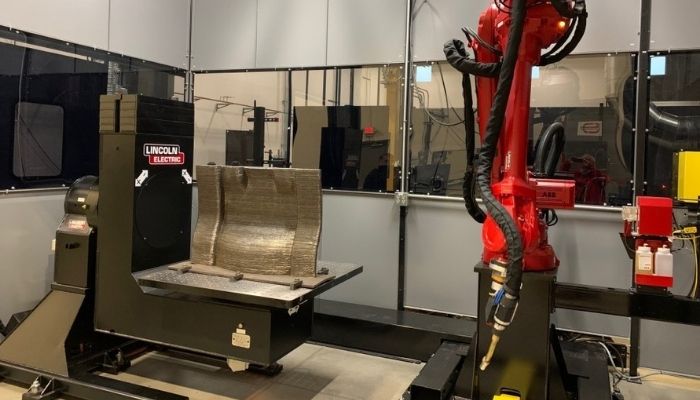
Photo Credits: Lincoln Electric
Additive Manufacturing and On-Demand Production
Since the onset of the pandemic, additive manufacturing has proven to meet many production needs. Faster than conventional methods, 3D printing also offers the possibility of local manufacturing. Where traditional techniques require assistance from other countries, particularly in terms of materials, 3D technologies allow for greater flexibility. Lincoln Electric in this case was able to offer an additive manufacturing solution for metal-based parts of up to 7 ft. (2.1 m) in length and weighing in excess of 5,000 lbs. (2,265 kg) to Chevron from its base in Ohio.
More from the desk
Six other notes from the rest of the bench.
 GuidesGenecis is converting food waste into 3D printing filamentsGenecis Bioindustries Inc. is a young Canadian company that uses various advanced technologies to convert food waste into PHA, biodegradable plastics obtained by bacterial fermentation. These materials can be converted into 3D printing filaments, which could eventually lead to mo
 NewsFashion breakthroughs thanks to 3D printing collaboration at NYFWAt New York Fashion Week (NYFW) last week, fashion witnessed some breakthroughs thanks to a new technique developed by one of the 3D printing giants, Stratasys. The collaboration between the 3D printer manufacturer and fashion designers threeASFOUR and Travis Fitch…
 ApplicationsThe Countdown to Space Flight: Relativity Space’s Terran 1 Set for Test Flight on March 8The countdown is on! You might remember us telling you about 3D printing for space being used for rockets, and one of these will soon be put to the test. Relativity Space will launch the Terran 1 on a test…
 SoftwarePrintWatch Detects 3D Printing Errors to Optimize Time and MaterialsU.S.-based Printpal has announced the official release of PrintWatch, a software and API that can detect printing errors during the part manufacturing process and take appropriate actions. The solution can stop printing in progress, warn the user of a defect…
 NewsTop 5 Videos: Reviving History With 3D PrintingHere we are again, another week, another assortment of fascinating videos delving into the world of 3D printing! Prepare for an interesting look back at the week in additive manufacturing as we highlight the test of an FPV (first person…
 GuidesWhat Are the Most Innovative 3D Printing Applications in the Automotive Sector?Among the application sectors in which we find additive manufacturing technologies, the automotive industry is one that is most taking advantage of them. AM allows large automotive companies to reduce costs, time and weight when producing complex parts. In addition,…