News
CellX Raises $4.3 Million in Funding to Expand 3D-Printed Pork Business
With China currently consuming 30% of the world’s meat, it’s no wonder a food tech company tackling global meat supply and sustainability has emerged from the region. After debuting its 3D printed cell-based pork meat at a tasting event for…
- 3 min read
- News
- Six more stories

With China currently consuming 30% of the world’s meat, it’s no wonder a food tech company tackling global meat supply and sustainability has emerged from the region. After debuting its 3D printed cell-based pork meat at a tasting event for investors, Shanghai-based startup CellX founded in 2020 was able to raise a whopping $4.2 Million dollars in its second round of funding. The company’s motto is ‘Eat meat, not animals’, and with that objective, the food startup’s primary goal is to reach price parity with conventional pork by 2025.
Quite different from lab-created “plant meat” which uses plant protein as raw material, actual animal meat is used as the cell meat’s building material. Though we have frequently seen bioprinting applied in the medical field, CellX is using bioprinting technology with animal cells, which has enabled the company is able to 3D print different edible meats such as fish, chicken, beef, and pork. “Our vision is to change the way meat is produced. This isn’t just a China issue, it’s a global issue, so for us to achieve our vision, we need to be a global company,” stated CellX founder Yang Ziliang in a statement to the press.
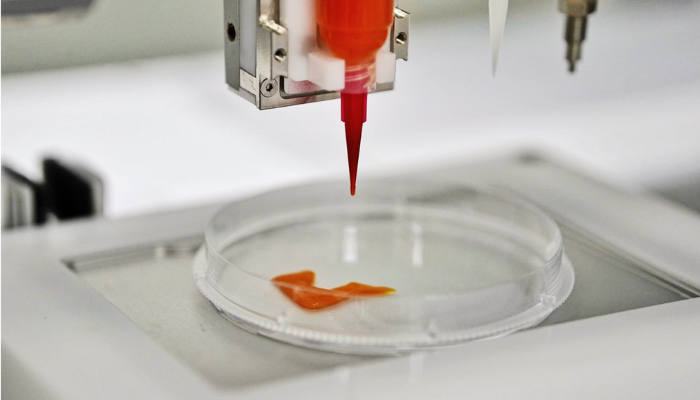
(Photo Credit: CellX)
Sustainability & 3D-Printed Meat
Traditional methods of mass-producing meat have detrimental impacts on the environment. In addition to its ecological impact, traditional methods of animal breeding and meat production gives rise to food safety problems related to pesticide residues and the overuse of antibiotics. CellX’s cell culture pork is created using 3D bioprinting. First, the team of scientists harvests cells from China’s native black pig and 3D-bioprints the cells into pork structures that have the taste and mouthfeel of pig meat.
More from the desk
Six other notes from the rest of the bench.
 Guides#3DStartup: Xolo and Volumetric 3D PrintingLast December, we presented xube, a compact 3D printer capable of printing parts in just a few seconds thanks to a volumetric printing process. Behind this innovation, is the young company Xolo. Based in Germany, it intends to change the…
 ApplicationsAustralia’s First Ever Multi-Metal 3D Printer Will Be Used to Boost the Aerospace SectorThe aerospace industry is constantly pushing boundaries, demanding ever lighter and stronger materials for its components, crucial for improving fuel efficiency, range, and overall performance of aircraft and spacecraft. Recently, Australia has made significant strides in this pu
 ApplicationsHarvard Researchers Develop Microbial Ink to 3D Print Living MaterialsWhat if you were told that 3D printing is getting closer and closer to revolutionizing science? A team of researchers at Harvard University and Brigham and Women’s Hospital is rising to the challenge. Recently, they developed a microbial ink or…
 ApplicationsResearchers Have Developed A Safer Bioink That Hardens at Body Temperature3D bioprinting is a technique that is gaining momentum in the medical industry. This technology uses bio-materials to create artificial tissue structures needed to treat patient diseases or injuries. The hydrogel-based bioinks used for this process are composed of cells.…
 NewsDOE Puts $45 Million Toward Additive Manufacturing InnovationOn the same day as the Biden-Harris administration’s launch of the American Climate Corps, a modern environmental reimagining of the New Deal-era Civilian Conservation Corps (CCC), the US Department of Energy announced a similarly green initiative. The DOE has outlined&hell
 PrintersA new 3D printer aboard the International Space Station?The European Space Agency (ESA) is currently testing a 3D printer capable of operating in zero gravity, designed by various international partners; it will be designed to print technical polymers with high mechanical and thermal properties. Although it is still…