News
Caltech Progresses Research Into Nanoscale 3D Printed Metals
When it comes to 3D printing even the largest structures, understanding the smallest details or imperfections can prove the difference between success and failure. In order to better understand how 3D printed objects perform in the nanoscale, researchers from the…
- 3 min read
- News
- Six more stories
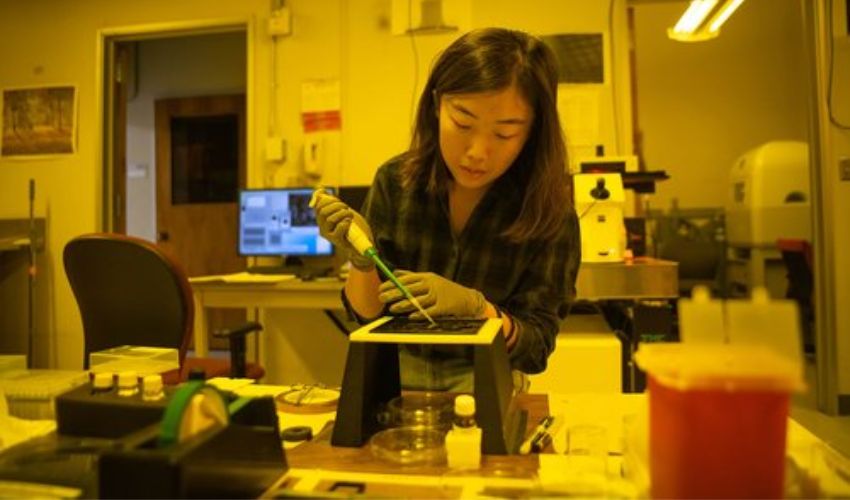
When it comes to 3D printing even the largest structures, understanding the smallest details or imperfections can prove the difference between success and failure. In order to better understand how 3D printed objects perform in the nanoscale, researchers from the California Institute of Technology (Caltech) have recently made a new discovery that has led to a new technique for 3D printing metals that are much stronger than similarly sized parts, which can be invisible to the naked eye.
The research was carried out by the lab of Julia R. Greer, Professor of Materials Science, Mechanics and Medical Engineering and director of the Kavli Nanoscience Institute. Building upon previous experiments in 2022, Greer’s lab developed a fabrication process technique for printing micro-sized metal objects that could be as thick as just a few pieces of paper. This year, the team has taken the size from the micro-scale to the nano-scale.
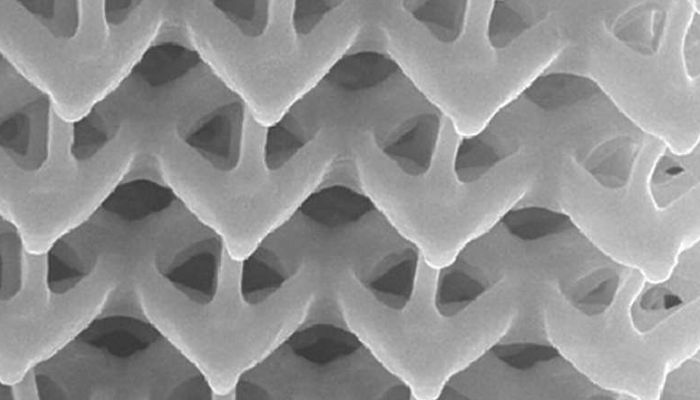
The nanoscale 3D printed lattice structure.
The shift takes the 3D printed parts and shrinks them down into a scale a thousandth the size of their previous experiments. The result revealed something somewhat unexpected: The smaller the print, the more disorderly the materials appeared on the atomic scale. In a normal-sized construction, that disorder would constitute a low-quality construction, prone to breakage and other weaknesses. However, in the nanoscale, the disorderly arrangement of these materials resulted in a part that was three to five times stronger than a construction with more ‘orderly’ arranged atoms.
More from the desk
Six other notes from the rest of the bench.
 NewsWEBINAR: Improving Investment Casting Processes With 3D Printed Stereolithography PatternsInvestment casting is one of the oldest metal-forming techniques that is still around today. Indeed, in 2021 it was estimated to be worth $15.83 billion by Grand View Research and is only expected to grow. Moreover, like all techniques, it…
 Guides#3DStartup: Balena and its Compostable, Biodegradable 3D Printing Materials for the Fashion IndustryThe fashion industry is one of the most polluting for our planet, consuming a lot of plastics which are unfortunately all too often thrown away too quickly and in the wrong way. Faced with this building ecological crisis, one young…
 NewsTOP 5 VIDEOS: 3D printing medical models to prepare for surgery…This week we found the top 5 videos about 3D printing and the way additive manufacturing is shaping our society. The technology has infiltrated many sectors, from medical to space! Check out our selection of the week to keep up with the innovations! This week we…
 PrintersThe Vertigo MK1: The 3D Printer With an Innovative Auto-Ejection SystemIn recent years, there has been growing interest in 3D printing automation, particularly in print farms and professional environments looking to optimize their processes and reduce the need for intervention. The Vertigo MK1, currently campaigning on Kickstarter, promises to provi
 NewsFluent Metal Is Our 2024 Startup of the Year2024 saw the rise of many groundbreaking startups leveraging additive manufacturing—but which one stands out above the rest? We featured a remarkable company each month, showcasing innovations ranging from personalized medical solutions to transformative manufacturing techniques.
 NewsXJet appoints Nobel Prize winner to lead pioneering applications & materialsXJet announced today the appointment of Professor Dan Schechtman to lead its Scientific Advisory Board. Winner of the 2011 Nobel Prize in Chemistry for the discovery of quasicrystals, Shechtman’s role will be to help steer XJet’s material and application development…