News
All You Need to Know About Resin 3D Printing
Resin 3D printing, also known as vat photopolymerization, is one of the most popular families of 3D printing technologies. It offers precise, detailed and high-quality results, making it a popular choice in many industrial sectors, such as jewelry, dentistry and…
- 3 min read
- News
- Six more stories
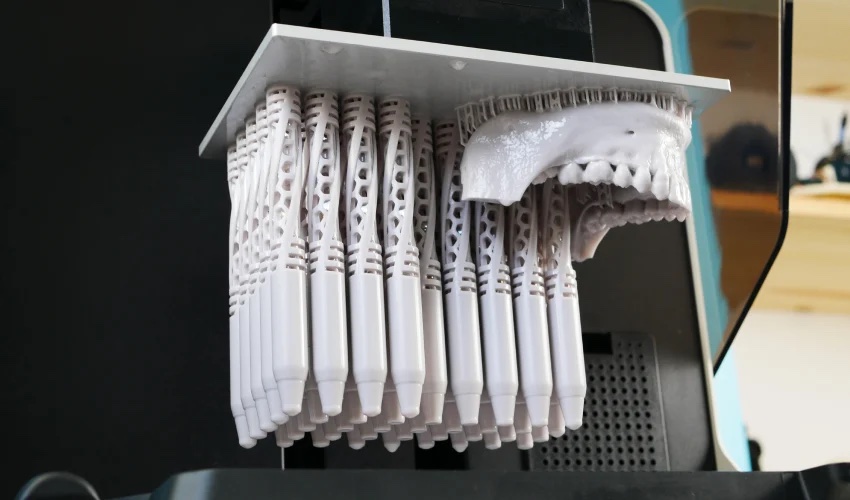
Resin 3D printing, also known as vat photopolymerization, is one of the most popular families of 3D printing technologies. It offers precise, detailed and high-quality results, making it a popular choice in many industrial sectors, such as jewelry, dentistry and rapid prototyping. In this article, we’ll explore in detail how resin 3D printing works and its applications.
Resin 3D Printing Basics
Resin 3D printing uses a type of liquid called photosensitive resin, which solidifies when exposed to UV radiation. This technology falls into three main categories: SLA, DLP and MSLA, which are distinguished by the light source used and the method of shaping this light.
- SLA (Stereolithography): SLA was introduced and patented in 1986 by Chuck Hull/3D Systems. This technology uses a laser directed by a galvanometer, which is a movable mirror, allowing the laser to be moved along the X and Y axes. The laser solidifies the photosensitive resin, layer by layer, to create the desired object.
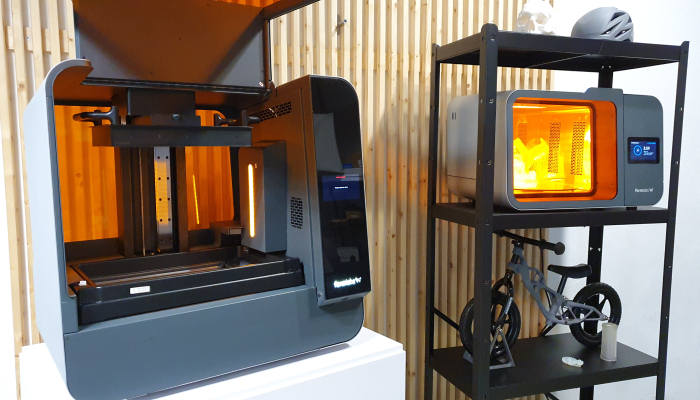
Formlabs’ Form 3L is a resin printer that uses the SLA printing process. Check out our test!
- DLP (Digital Light Processing): DLP was created and patented by Texas Instruments for projectors. DLP 3D printers use a projector to project UV light onto the resin tank. The UV light is redirected by small mirrors to turn each pixel on or off, enabling selective polymerization of the resin.
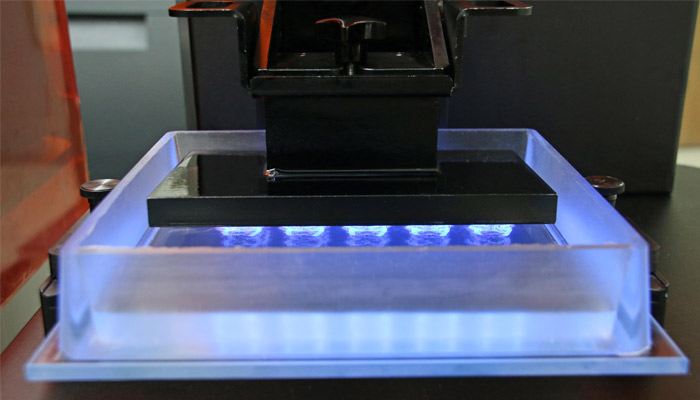
DLP allows you to create serial objects much faster than SLA. Learn more about the capabilities of these technologies (photo credits: EnvisionTec)
- MSLA (Masked Stereolithography Apparatuses): MSLA uses an LCD screen to mask the UV light source. By switching each pixel on and off, the LCD screen acts as a stencil capable of creating 2D shapes to allow the UV light to pass through and cure the resin.
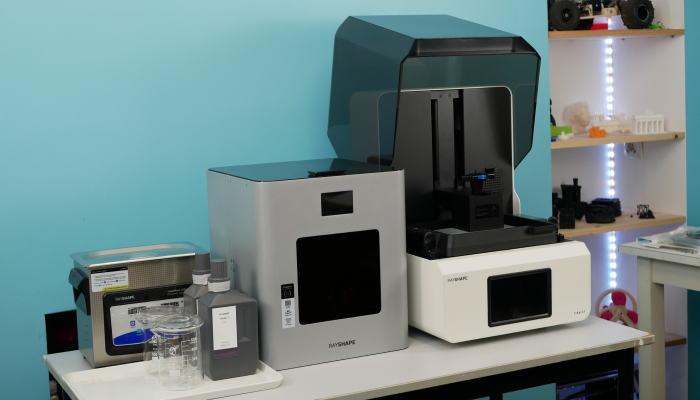
MSLA 3D printing is becoming increasingly popular, helping to reduce the entry cost of resin printing while offering precision and high quality. Find out how it differs from SLA printing.
All three methods share a similar architecture, consisting of:
More from the desk
Six other notes from the rest of the bench.
 SoftwarePrintWatch Detects 3D Printing Errors to Optimize Time and MaterialsU.S.-based Printpal has announced the official release of PrintWatch, a software and API that can detect printing errors during the part manufacturing process and take appropriate actions. The solution can stop printing in progress, warn the user of a defect…
 News3D Printing and Fabrics: The Unique Design Process Behind the Forma Fabrica Vase CollectionWith the ever-broadening use of additive manufacturing, the role of the 3D printer has spread from the factory floor to the art studio and beyond, with the 3D printer serving as a medium through which new artistic, conceptual and cultural…
 ApplicationsRelativity Space’s Launch Attempts of 3D-Printed Terran 1 Rocket Fail Due to Technical Issues‘More info to follow on cause of aborts today’. Space launches do not always go off without a hitch. It has been disappointment for American company Relativity Space in recent days, who hoped to launch the first 3D-printed rocket on…
 ApplicationsMoorhuhn bike: competing with carbon fibre frames?The purmundus challenge was presented for the eighth time on November 2020 as part of the digital Formnext Connect exhibition. This annual competition invites designers and engineers from around the world to participate in a theme-based 3D printing design contest.…
 MaterialsRethinking the AM Workflow: Montana Mixers on Solving Problems Before the PrinterAs additive manufacturing moves into production, the conversation is starting to change. Instead of asking whether a part can be printed, manufacturers are asking whether they can print it the same way every time. More often than expected, the answer…
 Applications3D Printing Boosts Efficiency Aboard RRS Sir David Attenborough Amid Its First Antarctic VoyageHaving embarked on its first mission to Antarctica last October, the RRS Sir David Attenborough, heralded as Britain’s most sophisticated polar research vessel, is experiencing a groundbreaking utilization of 3D printing technology. In an effort to enhance onboard operations, the