News
Can Additive Manufacturing Help Cargo Ships Become More Eco-Friendly?
Today’s cargo ships are powered by large, complex engines that represent a strategic challenge for the maritime industry, which has been seeking to become more sustainable for several years. The industry is looking to optimize the parts of these engines,…
- 3 min read
- News
- Six more stories

Today’s cargo ships are powered by large, complex engines that represent a strategic challenge for the maritime industry, which has been seeking to become more sustainable for several years. The industry is looking to optimize the parts of these engines, for example by reducing their weight to reduce fuel consumption. Thankfully, additive manufacturing might provide a solution. According to a press release from the Technical University of Denmark (DTU), a researcher in a collaborative project between DTU and MAN energy solutions has conducted an investigation to see whether it would be advantageous to have a 3D printed injection nozzle.
Maritime shipping accounts for more than 80% of world trade volume and about 70% of trade value. The industry is worth trillions of dollars, estimated to be worth about 60% of the 14 trillion US dollar seaborne trade industry in 2019 alone. And it holds with it some environmental concerns. Cargo ships can increase air pollution, water pollution, oil pollution and more. In fact, the International Maritime Organization (IMO) discovered in 2018 that the total greenhouse gases of shipping was about 1.056 million tonnes of CO2 emissions in 2019. And in the EU, ships produce 13.4% of greenhouse gas emissions from transport, meaning the industry is ripe for change to become more eco-friendly, with more and more projects appearing.
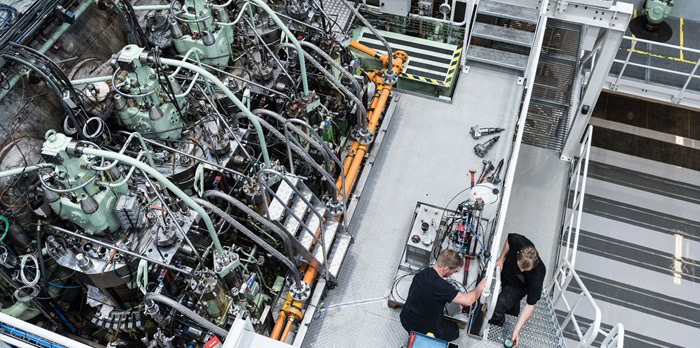
Engine durability is a strategic issue for the marine industry (photo credits: DTU)
In this case, the project focused on the injection nozzle which is an essential component of an engine as it injects fuel into the engine. This fuel is mixed with air to ensure proper combustion. Designed using traditional manufacturing methods, this nozzle can therefore have a significant impact on fuel consumption and therefore on the durability of an engine. This is especially a concern as the sustainabilty of cargo ships has been called into question.
More from the desk
Six other notes from the rest of the bench.
 Applications3D printing bone, a way to treat fractures?At the University of Arizona, a team of scientists is working on a 3D printing process to more effectively treat fractures, especially those of the US military. Dr. Szivek, a biomedical engineer and professor of orthopedic surgery in charge of the…
 NewsOrbex Commisions Europe’s Largest Industrial 3D PrinterOrbex, a Scottish company specializing in space launch, has just commissioned AMCM to build an industrial 3D printer set to be the largest of its kind in Europe. Weighing more than twelve metric tons, the machine is purposed for in-house…
 MaterialsIs Stabilizer Residue in Inks Inhibiting Conductivity in 3D Printed Electronics?Researchers from the University of Nottingham have revealed that stabilizer residue in additive manufacturing inks function to inhibit conductivity in 3D printed electronic devices. While it was previously thought that the principal cause of reduced vertical conductivity through
  NewsTop 5 Videos: World’s First 3D printed Skull ImplantThis week we found the top 5 videos about 3D printing and the way additive manufacturing is changing production. The technology has infiltrated many sectors, from medical to automotive – check our selection of the week to keep up with the innovations! If you enjoy these, you&hell
 ApplicationsSurgeons use 3D printing to fix 6-year-old boy’s spineSurgeons from France’s Amiens-Picardie University have used 3D printing alongside a robot to successfully perform surgery on a boy’s spine. The boy, 6, had been suffering from severe progressive scoliosis coupled with infantile spinal amyotraphy, rendering him unable
  NewsTitanium, its alloys and 3D printing with Ti6Al4VTitanium and its alloys, particularly Ti6Al4V, are of great importance in 3D printing. Titanium is a metal found in nature as an oxide, specifically rutile (TiO2) or ilmenite (FeTiO3). The extraction of pure titanium is carried out using the Kroll…