News
A 3D printing method based on the use of a single drop of resin
Researchers from the Chinese Academy of Sciences and MIT, claim to have developed a 3D printing technique based on photopolymerization that uses only a drop of resin to design a part. Based on the Continuous Digital Light Processing (cDLP) method,…
- 3 min read
- News
- Six more stories

Researchers from the Chinese Academy of Sciences and MIT, claim to have developed a 3D printing technique based on photopolymerization that uses only a drop of resin to design a part. Based on the Continuous Digital Light Processing (cDLP) method, it has already proven its effectiveness through various tests conducted by researchers. The process would greatly reduce the rate of wasted material, while keeping the same characteristics of resin.
Stereolithography is one of the oldest additive manufacturing methods on the market, offering high precision and a high level of detail. However, it is still limited by the possible volume of printing, even if some manufacturers seek to innovate in this area. For example, Azul3D has developed an ultra-fast, large format SLA machine. Today, there are several light-curing processes, such as DLP, which uses a light projector instead of a laser to harden the resin. Regardless of the method used, there is usually a post-processing step to remove the uncured resin from the printed part and ensure that the machine is cleaned well. A step that adds manufacturing time and increases the resin discard rate. This excess can limit print resolution and increase costs.
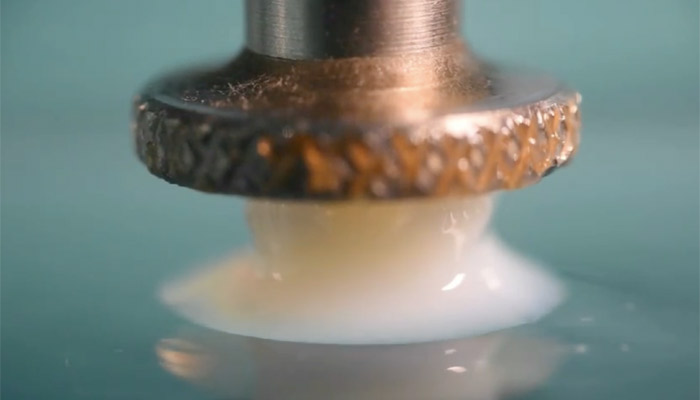
Only one drop of resin would be needed to 3D print the desired piece.
Given this observation, the research team developed a technique that would only use a single drop of resin. Inspired by the lotus and pitcher plants that collect and sink water spheres, their method works in a dynamic similar to that of a three-phase contact line (TCL). Specifically, a drop of resin is deposited on a photopolymerization plate, with ultraviolet light continuously projected underneath. During this time, the aluminum print bed placed above the curing interface lifts off of the plate with each printed layer.
More from the desk
Six other notes from the rest of the bench.
 News#TOP5 Videos: cat can walk again thanks to 3D printing, 3D printed collarbone and more!We found the TOP 5 videos of the week about 3D printing and the way additive manufacturing is shaping and changing our society. This week we touch on Carly, the cat that can walk again thanks to 3D printing, 3D printed…
 NewsNexa3D Has Announced the Acquisition of XYZprinting’s SLS TechnologyThe American manufacturer Nexa3D, which is known for its range of resin machines, has just announced the purchase of the SLS activity of the company XYZprinting. Not much information has been revealed so far, but this asset purchase is most…
 MaterialsRilsan® Polyamide 11 is used to manufacture a turbine in direct contact with drinking waterWhen it comes to product development, additive manufacturing has an important role to play, allowing for quicker iterations, leading to shorter production times. Many design offices have equipped themselves with 3D printing solutions to accelerate innovation and bring to the&hell
 NewsResearchers mimic nature for colorful 3D printingResearchers from the University of Illinois are demonstrating how additive manufacturing technologies can be used to produce multiple colors from a single ink. More specifically, the research paper entitled “Tunable structural color of bottlebrush block copolymers through direct-
 NewsMattel Is 3D Printing the Toys of TomorrowWhen it comes to producing toys, additive manufacturing is a helpful tool that has been used across various industries. Companies such as LEGO have already used AM for applications such as the creation of new parts and the elimination of…
 ApplicationsTop 5: Using Cold Spray Additive Manufacturing at ‘America’s Shipyard’Now that Sunday is finally here, we are taking a look back at the best 3D printing videos from the past week. Starting with the Norfolk Naval Shipyard, affectionately referred to as ‘America’s Shipyard,’ where we go behind the scenes…