News
Researchers mimic nature for colorful 3D printing
Researchers from the University of Illinois are demonstrating how additive manufacturing technologies can be used to produce multiple colors from a single ink. More specifically, the research paper entitled “Tunable structural color of bottlebrush block copolymers through direct-
- 3 min read
- News
- Six more stories
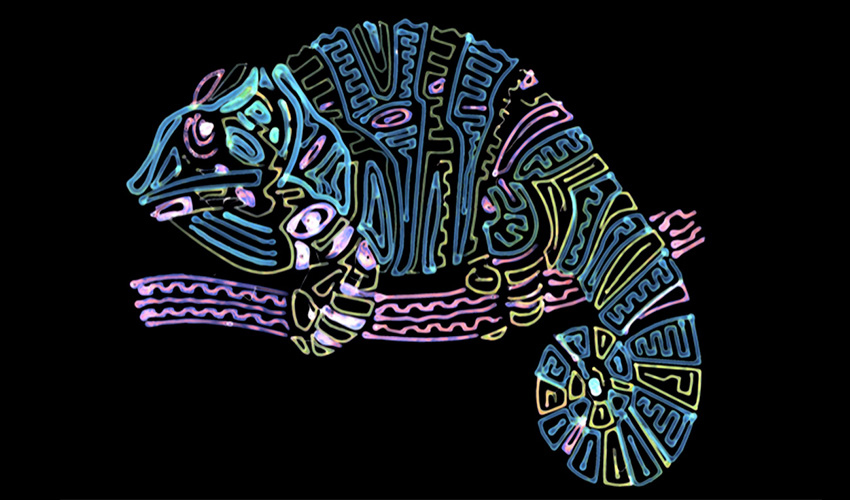
Researchers from the University of Illinois are demonstrating how additive manufacturing technologies can be used to produce multiple colors from a single ink. More specifically, the research paper entitled “Tunable structural color of bottlebrush block copolymers through direct-write 3D printing from solution”, was published in the journal Science Advances, and explores how 3D printing materials can reflect color by using nanoscale structures, called photonic crystals. This latest research is interesting as it showcases how new applications can be unlocked by studying AM materials rather than the printing process. As 3D printing technologies have matured, the next revolution seems to lie in material development.
In fact, Physical Sciences Editor at the University of Illinois News Bureau, Lois Yoksoulian explains that some of the most vibrant colors are found in nature. Therefore, looking at the phenomenon behind these vibrant colors can give scientists clues as how to achieve this using technology. He goes on to explain that the phenomenon is known as structural coloration (occuring at the nanoscale level). “When light rays reflect off these periodically placed structures located in the wings and skins of some animals and within some minerals, they constructively interfere with each other to amplify certain wavelengths and suppress others. When the structures are well ordered and small enough – about a thousand times smaller than a human hair, the rays produce a vivid burst of color.”
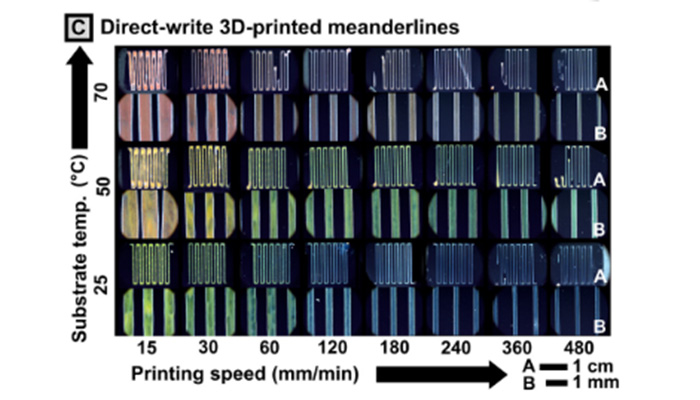
The speed and temperature of printing dictate the colors that we see
Therefore, in the polymer world, achieving nanoscale precision is key to obtain these colors. Ying Diao, a chemical and biomolecular engineering professor at the University of Illinois at Urbana-Champaign commented: “Precise control of polymer synthesis and processing is needed to form the incredibly thin, ordered layers that produce the structural color as we see in nature.” By carefully tuning the assembly process of uniquely structured bottlebrush-shaped polymers during 3D printing, researchers were able to print photonic crystals with tunable layer thicknesses that reflect the visible light spectrum from a single ink, according to the research paper. With work at the nanoscale level, one limitation is often scaling up because the level of precision that is required does not allow to 3D print quickly.
More from the desk
Six other notes from the rest of the bench.
 NewsPrintParts Partners with MakerGirl to Bridge STEM Gender GapEven with the advances made in recent years, women continue to be disproportionately unrepresented across STEM (science, technology, engineering, and math) industries, and in leadership positions in the technology sector. In 1970, women made up a mere 8% of STEM…
 NewsHow Miele Uses Replique’s 3D Printing Network For Home AppliancesBASF’s Chemovator business incubator alum Replique has partnered with Miele, a premium home appliance manufacturer based in Germany, for an additive manufacturing network deal. With this partnership, Replique will have the exclusive right to produce and ship 3D-printed Miele prod
 NewsNorthumbria University Aims to Combat Housing Crisis with Construction 3D PrintingConstruction 3D printing promises many advantages over traditional methods. It is often hailed as faster, cheaper and more sustainable than typical builds. However, there is still room for improvement. Concrete, the most commonly used material for construction 3D printing, leaves
 MaterialsAll You Need to Know About Multi-Material 3D PrintingMulti-material 3D printing is, as the name implies, 3D printing several materials in one continuous printing process. It is not the same as multi-color printing, where one material is printed in several color variations. Although the visual result of multi-material…
 Applications3D Printed Titanium Prosthesis is Attached to Dog’s Bone, Allowing Him to Walk AgainAdditive manufacturing has a number of applications in medicine, one of them being prostheses. The World Health Organization estimates that 30 million people worldwide need these devices, so manufacturing methods matter a great deal to a significant chunk of the…
 NewsFormnext Awards: Competing to Promote Innovation in 3D PrintingThe additive manufacturing sector continues to advance thanks to the talent and motivation of the people who are driving the technology forward and, with it, the industry as a whole. It is therefore essential that all these ideas receive the…