News
3D Robot Face With Living Skin Is the Next Level in Robotics
The first robot was developed in 1956 and today it is hard to imagine our lives without them. Whether industrial robots on the factory floor or service robots in the living room, such as roombas, they make many things easier…
- 3 min read
- News
- Six more stories

The first robot was developed in 1956 and today it is hard to imagine our lives without them. Whether industrial robots on the factory floor or service robots in the living room, such as roombas, they make many things easier for us. However, so far, robots have shown little resemblance to humans. This could soon change thanks to new advances in tissue research and with the help of 3D printing.
At the University of Tokyo, under the direction of Professor Shoji Takeuchi, artificially cultivated skin tissue was attached to robotic faces using 3D-printed perforation anchors. The cultivated skin, inspired by human skin bands, consists of living cells and has the ability to heal itself. To attach the skin to the surface, a perforation-like, V-shaped anchor was integrated into the robot head, providing both high strength and flexibility. The small perforations make it easier to attach the skin to the surface.
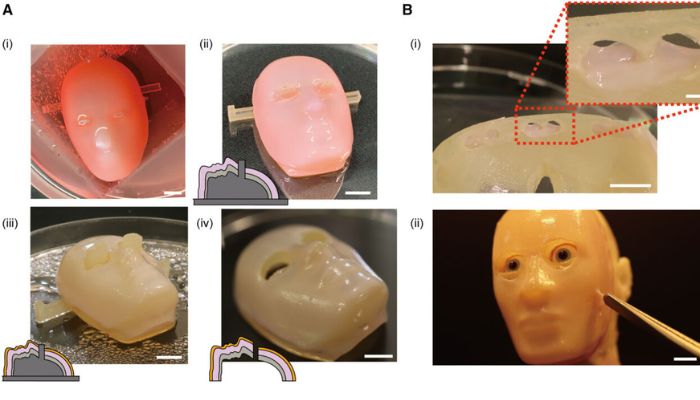
3D printing and applying the living skin to the 3D robotic face (photo credits: Takeuchi et al)
The V-shaped holes and the robot head were produced using the AGLISTA-3100 3D printer from Keyence, a Japanese company. The printer used material jetting technology, in which UV light-sensitive resin hardens and eventually forms the 3D object. This technology was chosen because it enables precise and reliable printing.
More from the desk
Six other notes from the rest of the bench.
 Applications3D Pets Can Help Dogs Back on Their Feet With Just a 3D Printer and a SmartphoneAlmost half of all canine limb amputations are either due to cancer treatment or accidents. While there have been multiple efforts focused on animal prostheses, it has often been more difficult to find an effective and widespread solution. For example,…
 GuidesThe Most Impressive 3D Printed Jewelry Designs on the MarketWhether in jewelry or jewelry, additive manufacturing is a technique increasingly used by professionals in the sector because of its ability to design complex and unique parts, all more quickly. It is used in particular to produce molds used later…
 ApplicationsFord Motor Company purchases new Production System P-1 from Desktop MetalAlready a leader in additive manufacturing in the automotive sector, Ford does not intend to stop here. The American firm has confirmed that it has already ordered the P-1, Desktop Metal‘s latest 3D printer, and will be one of the…
 ApplicationsCaracol Partners with Additive Engineering Solutions for Aerospace and DefenseThe aerospace and defense industry is increasingly turning toward additive manufacturing because the technology can offer custom, highly optimized solutions for complex applications. Due to the growing demand, more and more partnerships are emerging between different companies, w
 NewsUMaine Uses Giant 3D Printer to Speed Nuclear Reactor BuildThe University of Maine is proving that large-scale 3D printing is rapidly becoming one of the most transformative tools in modern infrastructure development. When California-based Kairos Power set out to build its experimental Hermes nuclear reactor in Tennessee, the company&hel
 NewsTop 3D Printing Applications Showcased at Formnext 2021While we were at Formnext last week, we saw many incredible innovations and machines. Though it was clear that sustainability and industrialization were key trends at the event, there were many other applications shown including toys, those for the food…